


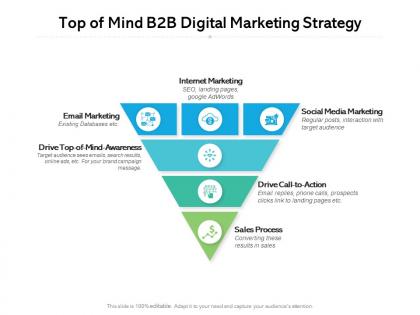
Top of mind b2b digital marketing strategy




Try Before you Buy Download Free Sample Product
 Impress Your
 Audience
 100%
100% Editable
 Save Hours
 of Time


Our Top Of Mind B2B Digital Marketing Strategy encourage you to express yourself freely. Avoid ever having to feel cramped.
People who downloaded this PowerPoint presentation also viewed the following :
Top of mind b2b digital marketing strategy with all 2 slides:
Avoid a dull classroom atmosphere with our Top Of Mind B2B Digital Marketing Strategy. They ensure the entire exercise becomes exciting.
FAQs for Top of mind b2b
Key components include content marketing, search engine optimization, social media engagement, email automation, and account-based marketing targeting. These strategies enhance lead generation by delivering valuable insights, improving online visibility, and nurturing prospect relationships, with many organizations finding that integrated approaches significantly accelerate sales cycles while reducing customer acquisition costs.
Businesses can leverage LinkedIn by optimizing company profiles, sharing industry insights, engaging in relevant groups, utilizing targeted advertising, and building thought leadership through consistent content. Through strategic networking and LinkedIn's professional algorithms, organizations streamline lead generation, enhance brand credibility, and accelerate sales cycles, with many B2B companies finding significantly higher conversion rates than traditional platforms.
Content marketing serves as the foundation of successful B2B digital strategies, driving lead generation, thought leadership, customer education, and brand authority through valuable, targeted content. Through blogs, whitepapers, case studies, and webinars, organizations streamline buyer journeys, enhance customer relationships, and accelerate sales cycles, with many B2B companies finding that strategic content delivers measurable ROI and competitive advantage.
B2B SEO targets decision-makers through industry-specific keywords, thought leadership content, technical optimization, and account-based targeting strategies that address complex buying journeys. By focusing on problem-solving content, long-tail keywords, and LinkedIn optimization, B2B companies enhance visibility among C-suite executives and procurement teams, ultimately delivering qualified leads and shorter sales cycles.
B2B companies should track lead generation metrics, conversion rates, customer acquisition costs, pipeline velocity, and revenue attribution across digital channels. These metrics enable organizations to optimize campaign performance, allocate resources strategically, and demonstrate ROI, with many finding that tracking engagement quality alongside quantity ultimately delivers better sales alignment and higher-value customer relationships.
B2B email marketing delivers value through targeted segmentation, personalized content, automated nurture sequences, and strategic timing aligned with buyer journeys. Manufacturing companies and financial services firms increasingly leverage behavioral triggers, account-based approaches, and multi-touch campaigns to enhance lead quality, accelerate sales cycles, and ultimately strengthen client relationships while reducing acquisition costs.
B2B landing page best practices include clear value propositions, minimal form fields, compelling headlines, social proof elements, and strategic call-to-action placement. These elements work together by reducing friction, building credibility, and guiding prospects through conversion, with many technology and professional services companies finding that focused messaging and trust indicators significantly enhance lead quality and conversion rates.
Account-based marketing targets specific high-value accounts with personalized campaigns, while traditional B2B marketing casts wider nets to generate broader lead volumes. Through customized content, coordinated multi-channel outreach, and sales-marketing alignment, ABM enables deeper customer relationships, higher conversion rates, and increased deal sizes, with many enterprises finding that this strategic approach delivers significantly better ROI than conventional lead generation methods.
Tools that enhance B2B digital marketing include CRM platforms, marketing automation software, analytics dashboards, social media management systems, and lead scoring technologies. These solutions streamline campaign management, personalize customer journeys, and optimize resource allocation, with many organizations finding that integrated platforms deliver improved lead quality, faster sales cycles, and measurable ROI across multiple channels.
Social proof integration in B2B strategies involves embedding client testimonials on landing pages, featuring case studies in email campaigns, displaying customer logos prominently, and leveraging peer reviews across digital touchpoints. These elements build credibility by showcasing real success stories, with many organizations finding that strategic testimonial placement throughout the buyer journey significantly enhances conversion rates and accelerates sales cycles.
B2B marketing automation challenges include complex buyer journeys, lengthy sales cycles, data integration issues, lead scoring accuracy, and content personalization at scale. While these systems streamline processes, many organizations find that balancing automated efficiency with personalized relationship-building requires strategic planning, with successful implementation ultimately delivering improved lead quality and enhanced customer experiences.
Businesses can ensure sales-marketing alignment through shared CRM platforms, unified lead scoring systems, collaborative content creation, and integrated communication tools that provide real-time visibility into customer journeys. This strategic coordination streamlines prospect handoffs, eliminates data silos, and enhances customer experiences, with many organizations finding that aligned teams deliver significantly higher conversion rates and revenue growth.
Emerging B2B digital marketing trends include AI-powered personalization, account-based marketing automation, interactive content experiences, voice search optimization, and LinkedIn social selling strategies. These approaches streamline lead generation by delivering targeted messaging, enhancing buyer engagement, and accelerating sales cycles, with many organizations finding that strategic combinations of these trends ultimately deliver higher conversion rates and competitive advantage.
Data analytics drives B2B marketing insights by tracking customer behavior patterns, measuring campaign performance across channels, identifying high-value prospect segments, and predicting buying cycles through predictive modeling. These capabilities enable marketing teams to optimize resource allocation, personalize outreach strategies, and accelerate pipeline velocity, with many organizations finding that data-driven approaches deliver significantly higher conversion rates and ROI.
Effective B2B lead nurturing strategies include personalized email sequences, targeted content marketing, marketing automation workflows, retargeting campaigns, and progressive profiling. These approaches streamline engagement by delivering relevant content at each funnel stage, scoring leads based on behavior, and enabling sales teams to focus on qualified prospects, ultimately accelerating conversion rates and improving sales efficiency.
No Reviews