

Top performers employees ppt examples




Try Before you Buy Download Free Sample Product
 Impress Your
 Audience
 100%
100% Editable
 Save Hours
 of Time


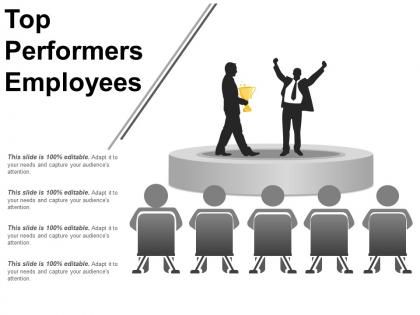
Improve your employee’s productivity by simply recognizing their efforts with our top performers employees PPT image. It will help in motivating your employees to perform with high precision. Use this performance management PPT diagram to evaluate as well analyze the high performing employees in your business. It will help in offering yielding results to your business. It also helps the management to easily achieve the long term business objectives. It also helps in improving your employee’s skills and strengths. Use this performance measurement PowerPoint design to engage more and more employees to achieve the business targets. Define the parameters which help in identifying the high performing employees for your company with this employee’s performance PowerPoint template. The factors which help in identifying the high performing workers are time efficiency, quality of work, meeting deadlines, punctuality, good communicator and more. So, therefore just start initializing this simple yet professional employee performance measurement PowerPoint slide image now. A good first impression is guaranteed by our Top Performers Employees Ppt Examples. You will acquire the initial impetus.
People who downloaded this PowerPoint presentation also viewed the following :
Top performers employees ppt examples with all 5 slides:
Bask in the blessings of the Divine with our Top Performers Employees Ppt Examples. You will feel as if in God's country.
FAQs for Top performers
Honestly, the best people I've worked with just get shit done while making everyone else better too. They own their mistakes, speak up about problems early, and actually do what they say they will. Also they share knowledge instead of being weird and secretive about it. But here's the thing - they balance their own deadlines with genuinely helping teammates. Short feedback, admitting when they're clueless about something. Being someone people can count on is like 80% of being great at work. Oh and asking smart questions instead of just nodding along.
Your best people will spend way less time messing around with slide layouts and actually focus on the good stuff - their message and delivery. I swear, I've watched people waste entire afternoons just picking fonts. With templates, everyone's presentations look consistent and professional, which honestly makes a huge difference with stakeholders. Your top performers can skip all the design headaches and put their energy into nailing their story and prepping for tough questions instead. Good templates basically let them jump straight to the parts they're already great at.
Honestly, start with what "winning" looks like in your job first. Sales numbers and project completion rates are pretty straightforward to track. Customer satisfaction scores work great too - though I've found error rates can be tricky depending on how your company defines them. Don't sleep on the harder-to-measure stuff like peer feedback or how often you're solving problems creatively. Meeting deadlines consistently matters more than people think. The key is picking maybe 3-4 things that actually move the needle instead of tracking everything under the sun. You'll just overwhelm yourself otherwise.
The best people I know are always figuring out what's actually working vs what's just wasting time. They don't stick to one approach - honestly, that's where most people mess up. Instead they build up different strategies and get good at reading which situation calls for what. Like you wouldn't use the same game plan for every problem, right? What really separates them though is how fast they bounce back from failures. They learn something and move on instead of beating themselves up. Start collecting strategies that actually work for you, then practice trusting your gut on when to use each one.
Look, the people who keep crushing it long-term? They never stop learning new stuff. Can't just coast on what got you here - everything moves too fast now. I'd block out maybe 2-3 hours each week for this. Read what's happening in your field, take some courses, pick other people's brains. Make it routine, not something you scramble to do when you're already behind. Honestly, I've seen too many smart people get blindsided because they thought they knew enough. Your skills have shelf lives now. Stay hungry or get left behind - it's really that simple.
Your best people can either thrive or completely shut down depending on team vibes. When there's trust and good collaboration, they'll take risks and share what they know - honestly, it makes everyone better. Toxic dynamics though? That's where you lose them. They either burn out covering for everyone else's mess or just mentally check out. I've watched this play out too many times. Good team cohesion means your stars get actual support instead of dealing with office politics all day. Look at how your team communicates first - that's usually where the problems start.
Honestly, figure out what's actually stressing your audience out and hit that right away. Don't dive into features first - I've watched way too many people's eyes glaze over during those demos. Business impact upfront, then get into the how. Make your slides clean. Bullet points everywhere just look messy. Walk through problem → solution → results, and actually practice those transitions so you're not stumbling between sections. Oh, and definitely leave space for questions as you go. End with concrete next steps though - people hate leaving meetings wondering what the hell happens next.
Dude, this stuff is so tricky because what makes someone a rockstar in one place can make them look like a total jerk somewhere else. Americans love the self-promotion thing - you know, "look what I did!" But try that in Japan and people think you're arrogant. Speed matters more in some cultures, others want you to talk everything through first. I watched this guy who crushed it in London completely bomb when he moved to Singapore because he kept stepping on toes. You've gotta have different scorecards for different places while keeping some basics that work everywhere.
Honestly, most high achievers I've noticed have this weird ability to just... keep going when everything sucks. They call it grit - basically sticking with long-term goals even through failures. Growth mindset is huge too. Instead of seeing setbacks as proof they're not good enough, they treat them like data points to learn from. Self-control plays a big part - they'll skip fun stuff now for bigger payoffs later. Oh, and they're usually driven by internal satisfaction rather than just chasing external validation, which makes them way more resilient. If you want to build these habits, pick one meaningful goal and practice not quitting when it gets uncomfortable.
Honestly, your top performers need way more frequent feedback - like weekly instead of quarterly. They get restless fast! Ask them about roadblocks you can help remove. Give them stretch challenges beyond their current role, maybe leadership stuff or projects in other departments. The "great work" comments don't cut it for these types. Sometimes flip the script and get their take on how processes could improve. I've found treating it more like a strategy chat works better than the usual performance review thing. Oh, and they actually want the tough feedback that pushes them forward.
Mentorship is a game-changer for high performers. Seriously cuts their learning curve by like 3-5 years. You get instant access to networks and insights that would take forever to build yourself. Plus they'll catch your blind spots before you crash and burn - that's huge. The really good mentors don't just give advice though. They'll create opportunities and open doors you didn't even know were there. Honestly, it's one of those things that just isn't fair - it separates the good from the truly great performers. If you're working with high-potential people, definitely pair them up with someone who's already done what they want to do.
Honestly, your top people need three main things. Give them autonomy - stop micromanaging every little decision they make. Growth opportunities are huge too, like conferences or mentoring programs. But here's the thing about recognition - you can't just do generic praise. Some want public shoutouts, others prefer quiet feedback or promotions. Oh, and actually listen when they pitch ideas or raise concerns (I know, revolutionary concept). Clear advancement paths help too. My advice? Just ask your best performers what would make them feel more supported. They'll tell you exactly what they need.
Honestly? Overconfidence is the big one - you stop asking for feedback and assume you've got it all figured out. Burnout's another killer since everyone dumps stuff on you when you're the reliable person. I've seen this happen so many times. Your network gets neglected too because you're heads-down executing constantly. Success can also make you weirdly resistant to trying new approaches. Short version: keep learning new skills and don't let being good at your current level trick you into thinking that's enough forever.
Tech is basically like having a performance booster - it makes your strengths stronger and patches up weak spots. I'd start with something that fixes your biggest daily annoyance first. AI can knock out boring repetitive stuff so you can focus on work that actually matters. Analytics show you patterns you'd never catch on your own. Honestly, collaboration tools are game-changers for tapping into people way smarter than you. Automation handles those soul-crushing tasks we all hate. Just don't add tech for the sake of it - pick tools that solve real problems in how you work.
Look, networking is honestly like having insurance for your career. People will hook you up with insights, send opportunities your way, and actually want to work with you when they know you personally. Work becomes so much less miserable when you don't hate everyone around you, you know? Also, you'll take better risks and bounce back faster when you've got that safety net of good relationships. I always think it's weird how some people avoid this stuff. Just start small - text an old coworker or ask someone to grab lunch this week.
-
Topic best represented with attractive design.
-
Use of different colors is good. It's simple and attractive.