


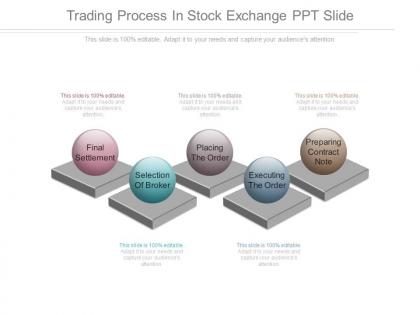
Trading process in stock exchange ppt slide




Try Before you Buy Download Free Sample Product
 Impress Your
 Audience
 100%
100% Editable
 Save Hours
 of Time


Give every clue close attention with our Trading Process In Stock Exchange Ppt Slide. They help analyze heinous crimes.
People who downloaded this PowerPoint presentation also viewed the following :
Trading process in stock exchange ppt slide with all 7 slides:
Discover a new moment with our Trading Process In Stock Exchange Ppt Slide. Do not just see it, but experience it.





FAQs for Trading process in stock
The key components include order placement, order matching, trade execution, clearing, and settlement. These components work together by enabling investors to submit buy/sell orders, matching them through electronic systems, executing trades at agreed prices, and ensuring proper transfer of securities and funds, with major exchanges like NYSE and NASDAQ processing millions of transactions daily while maintaining market integrity and efficiency.
Order matching systems work by automatically pairing buy and sell orders based on price and time priority, with algorithms continuously scanning order books to execute trades when matching criteria are met. Through electronic matching engines, exchanges like NYSE and NASDAQ process thousands of transactions per second, enabling faster trade execution, reduced spreads, and enhanced market liquidity for institutional and retail investors.
Market orders execute immediately at current market prices, providing speed and certainty of execution but no price control. Limit orders execute only at specified prices or better, offering price protection and potential cost savings but risking non-execution during volatile periods, with many traders finding that combining both strategies enhances portfolio management and trading flexibility.
Trading hours significantly impact stock exchange activities by determining market liquidity, volatility patterns, and pricing efficiency, with opening and closing periods typically experiencing higher volumes and price movements. Many institutional traders adjust their strategies around these patterns, executing large orders during high-liquidity periods while retail investors often capitalize on after-hours opportunities, ultimately enabling more strategic timing and enhanced portfolio performance.
Brokers act as intermediaries between investors and stock exchanges, executing buy and sell orders, providing market access, and offering investment advice and research. They facilitate transactions by matching buyers with sellers, ensuring regulatory compliance, and delivering real-time market data, ultimately enabling individuals and institutions to participate effectively in financial markets while minimizing trading complexities.
Electronic trading platforms differ from traditional methods by enabling automated, algorithm-driven transactions, real-time market access, and direct order execution without physical trading floors or intermediaries. These digital systems streamline operations by reducing transaction costs, minimizing human error, and providing 24/7 accessibility, with many financial institutions finding that electronic platforms deliver faster execution speeds and enhanced market transparency, ultimately giving traders significant competitive advantages in increasingly dynamic markets.
Stock prices are influenced by supply and demand dynamics, company earnings reports, economic indicators, market sentiment, and trading volume during active sessions. These factors create price volatility through investor reactions to news, quarterly results, and broader economic conditions, with many financial institutions finding that algorithmic trading and institutional investments amplify these movements, ultimately delivering rapid price adjustments.
Market makers facilitate liquidity by continuously quoting bid and ask prices for securities, providing immediate buying and selling opportunities for investors. Through their obligation to maintain two-sided markets, these firms enable seamless trading even during volatile periods, ultimately reducing price spreads and transaction costs while ensuring efficient price discovery across exchanges.
Stock trading risks include market volatility, liquidity constraints, emotional decision-making, leverage exposure, and inadequate research or timing. Successful traders mitigate these through diversified portfolios, stop-loss orders, disciplined risk management strategies, and continuous market analysis, with many financial institutions finding that systematic approaches and proper position sizing ultimately deliver more consistent returns while minimizing potential losses.
Regulatory compliance significantly shapes trading processes by enforcing transparency requirements, risk management protocols, transaction reporting standards, and market surveillance systems. These frameworks enhance market integrity and investor protection while requiring brokers and institutions to implement comprehensive compliance infrastructure, ultimately delivering greater market stability, reduced systemic risk, and increased investor confidence in trading environments.
Trading volumes represent the total number of shares traded during specific periods, serving as crucial indicators of market sentiment, liquidity levels, and price validation. High volumes typically confirm price movements and signal strong investor interest, while low volumes may indicate uncertainty or lack of conviction, with many traders finding that volume analysis combined with price action delivers more reliable trading signals and enhanced market timing.
News and economic indicators significantly influence trading decisions by providing critical market intelligence about company performance, sector trends, economic health, and regulatory changes. Traders analyze employment reports, GDP data, earnings announcements, and geopolitical developments to anticipate price movements, with many finding that combining technical analysis with fundamental news creates more informed investment strategies, ultimately delivering better risk management and competitive market positioning.
Essential analytical tools include technical indicators, chart patterns, volume analysis, fundamental metrics, and risk management calculators. These tools enable traders to identify market trends, evaluate stock valuations, and minimize potential losses through strategic position sizing, with many financial institutions finding that combining technical and fundamental analysis ultimately delivers more consistent trading outcomes and competitive advantage.
High-frequency trading impacts market dynamics by increasing trading volumes, reducing bid-ask spreads, and enhancing price discovery through rapid arbitrage corrections. While HFT provides greater market liquidity and tighter spreads benefiting retail investors, it also introduces volatility spikes and potential flash crashes, with many financial institutions finding that algorithmic strategies ultimately deliver competitive advantages despite regulatory concerns.
Algorithms automate trade execution, analyze market data in real-time, optimize pricing strategies, and manage risk parameters within stock exchanges. These sophisticated systems enable financial institutions to execute high-frequency trades, reduce operational costs, and minimize human error, with many trading firms finding that algorithmic solutions ultimately deliver faster market responses and enhanced competitive advantage.
-
Excellent work done on template design and graphics.
-
Presentation Design is very nice, good work with the content as well.