


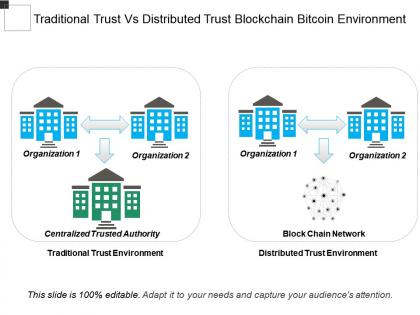
Traditional trust vs distributed trust blockchain bitcoin environment




Try Before you Buy Download Free Sample Product
 Impress Your
 Audience
 100%
100% Editable
 Save Hours
 of Time


Our Traditional Trust Vs Distributed Trust Blockchain Bitcoin Environment are topically designed to provide an attractive backdrop to any subject. Use them to look like a presentation pro.
People who downloaded this PowerPoint presentation also viewed the following :
Traditional trust vs distributed trust blockchain bitcoin environment with all 5 slides:
Use our Traditional Trust Vs Distributed Trust Blockchain Bitcoin Environment to effectively help you save your valuable time. They are readymade to fit into any presentation structure.

FAQs for Traditional trust vs distributed trust
Blockchain's fundamental trust mechanisms include cryptographic hashing, distributed consensus algorithms, immutable ledgers, peer-to-peer verification, and transparent transaction records. These technologies streamline verification processes by eliminating intermediaries, enabling real-time auditing, and ensuring data integrity across networks, with financial institutions and supply chain organizations finding that decentralized trust ultimately delivers enhanced security and operational transparency.
Decentralization enhances trust by eliminating single points of failure, distributing control across multiple nodes, and removing dependence on central authorities that can be compromised or corrupted. Unlike traditional systems requiring intermediaries, blockchain networks enable direct peer-to-peer verification through consensus mechanisms, with financial institutions and supply chain companies finding significantly reduced counterparty risks and enhanced transaction transparency.
Consensus algorithms establish blockchain trustworthiness by ensuring all network participants agree on transaction validity, preventing double-spending, and maintaining identical ledger copies across nodes. Through mechanisms like Proof of Work and Proof of Stake, financial institutions and supply chain companies achieve transparent, tamper-resistant records, ultimately delivering enhanced security and operational trust without requiring central authorities.
Smart contracts automate trust by executing predefined agreements without intermediaries, ensuring transparency, immutability, and automatic fulfillment of contractual obligations. Through blockchain's decentralized verification, organizations in sectors like supply chain, real estate, and financial services streamline transactions, reduce disputes, and minimize costs, while ultimately delivering faster settlements and enhanced security for all parties involved.
Cryptography serves as the foundational security layer in blockchain ecosystems, enabling trust through digital signatures, hash functions, public-key encryption, and consensus algorithms. These cryptographic mechanisms ensure transaction authenticity, data integrity, and network security across financial services, supply chain management, and healthcare platforms, ultimately delivering transparent, tamper-proof systems without requiring traditional intermediaries.
Trustless transactions function through cryptographic verification, consensus mechanisms, and distributed validation, eliminating the need for intermediaries by allowing network participants to verify transaction authenticity independently. This approach enables financial institutions, supply chain companies, and healthcare organizations to reduce processing costs, accelerate settlement times, and enhance security, ultimately delivering greater operational efficiency in an increasingly digital business environment.
Trustlessness eliminates intermediaries and reduces costs, but presents adoption challenges through technical complexity, regulatory uncertainty, and user education requirements. While financial services, supply chains, and healthcare systems benefit from automated verification and transparency, organizations must balance innovation potential with user experience considerations, ultimately delivering competitive advantages for those successfully navigating implementation complexities.
Blockchain technology restores trust through immutable transaction records, decentralized verification, and transparent audit trails that eliminate single points of failure. Industries like financial services, supply chain management, and healthcare increasingly leverage these mechanisms to reduce fraud, enhance accountability, and streamline compliance processes, ultimately delivering greater operational transparency and customer confidence.
Public blockchains face challenges with transaction speed, energy consumption, and regulatory uncertainty, while private blockchains struggle with limited transparency, centralized control, and reduced network effects. While public networks like Bitcoin enhance trust through decentralization, private implementations often compromise on openness for efficiency, with many financial institutions finding that hybrid approaches balance transparency with operational control.
Governance models significantly influence blockchain trust by establishing transparent decision-making frameworks, consensus mechanisms, and stakeholder participation protocols that ensure network integrity and accountability. Through on-chain voting systems and multi-signature processes, organizations like decentralized finance platforms and supply chain networks enhance operational transparency, minimize centralized control risks, and ultimately deliver greater stakeholder confidence while enabling more democratic, scalable blockchain adoption.
Identity management solutions enhance trust in blockchain digital interactions by providing verifiable credentials, secure authentication protocols, decentralized identity verification, and immutable identity records. Through cryptographic verification and smart contract integration, financial institutions streamline KYC processes, healthcare organizations secure patient data exchanges, and supply chain networks authenticate participant credentials, ultimately delivering transparent, tamper-proof identity validation while reducing fraud risks.
Blockchain's immutability creates permanent, unalterable transaction records that eliminate disputes and enhance accountability between stakeholders over time. Through cryptographic hashing and distributed consensus, organizations in supply chain management, financial services, and healthcare can verify historical data integrity, reduce audit costs, and streamline compliance processes, ultimately delivering transparent partnerships and sustained competitive advantage.
Real-world trust mechanisms include Ethereum's smart contract auditing, Bitcoin's proof-of-work consensus validation, Hyperledger Fabric's permissioned network controls, multi-signature wallet requirements, and oracle verification systems. These mechanisms streamline operations by ensuring transaction integrity, automating compliance verification, and reducing intermediary costs, with financial institutions and supply chain companies finding that robust trust frameworks ultimately deliver enhanced security and operational efficiency.
Interoperability enhances trust by enabling seamless data verification, cross-chain asset transfers, and unified security protocols across different blockchain networks. Through standardized communication protocols, financial institutions and supply chain operators can validate transactions across multiple platforms while maintaining transparency, ultimately reducing counterparty risk and delivering consistent trust frameworks in increasingly interconnected digital ecosystems.
Ethical considerations include data privacy, algorithmic transparency, energy consumption, digital divide access, and governance accountability. While blockchain enhances trust through decentralization and immutability, organizations must balance transparency with privacy rights, ensure equitable access across communities, and address environmental impacts, ultimately delivering responsible innovation that serves broader societal interests.
-
Unique design & color.
-
Unique and attractive product design.
-
Nice and innovative design.
-
Out of the box and creative design.
-
Amazing product with appealing content and design.