


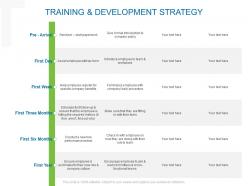
Training and development strategy ppt powerpoint layouts





Try Before you Buy Download Free Sample Product
 Impress Your
 Audience
 100%
100% Editable
 Save Hours
 of Time


Your recent experiment has proved successful. Our Training And Development Strategy Ppt Powerpoint Layouts willhelp demonstrate the process.
People who downloaded this PowerPoint presentation also viewed the following :
Training and development strategy ppt powerpoint layouts with all 5 slides:
Make your demonstration more entertaining. Use our Training And Development Strategy Ppt Powerpoint Layouts to keep the interest up.




FAQs for Training and development strategy
Effective training and development strategies include needs assessment, learning objectives alignment, diverse delivery methods, performance measurement systems, and continuous feedback mechanisms. These components work together by identifying skill gaps, creating targeted learning experiences, and tracking progress across departments, with many organizations finding that strategic training programs enhance employee retention, boost productivity, and deliver sustainable competitive advantage.
Aligning training programs with organizational goals requires conducting thorough needs assessments, mapping skill gaps to strategic objectives, and establishing clear performance metrics that connect learning outcomes to business results. Through strategic workforce planning, organizations streamline talent development, enhance operational efficiency, and accelerate goal achievement, with many companies finding that aligned training programs deliver measurable ROI and competitive advantage.
Technology revolutionizes training and development by enabling personalized learning paths, virtual reality simulations, AI-powered assessments, mobile accessibility, and real-time progress tracking. These digital solutions streamline content delivery, reduce training costs, and enhance engagement across organizations, with many companies finding that employees retain information better through interactive platforms, ultimately delivering faster skill development and improved performance outcomes.
Assessing training effectiveness involves measuring learning outcomes, behavioral changes, business impact metrics, participant feedback, and knowledge retention rates. Organizations typically use pre-and-post assessments, performance evaluations, productivity metrics, and ROI calculations, with many companies finding that combining qualitative feedback with quantitative data delivers comprehensive insights into program success and areas for improvement.
Personalization strategies include adaptive learning platforms, multimodal content delivery, competency-based pathways, learning style assessments, and flexible pacing options. These approaches enhance engagement by accommodating visual, auditory, and kinesthetic learners through interactive simulations, video modules, and hands-on workshops, with many organizations finding that tailored training significantly improves retention rates and skill application across diverse teams.
Employee feedback integrates into training program development through surveys, focus groups, performance reviews, exit interviews, and direct manager consultations to identify skill gaps and learning preferences. Organizations leverage this input to create targeted curricula, select relevant delivery methods, and customize content formats, with many companies finding that feedback-driven programs achieve higher engagement rates and deliver measurable performance improvements across departments.
Remote training challenges include engagement difficulties, technology barriers, limited interaction, distractions, and tracking progress effectively. Organizations address these through interactive platforms, breakout sessions, and gamification elements, while implementing structured schedules, technical support systems, and regular check-ins, ultimately delivering scalable learning experiences that maintain quality and foster collaboration across distributed teams.
Inclusive training requires multiple delivery formats, accessible content design, accommodating diverse learning styles, providing language support, and ensuring physical accessibility across all programs. Organizations enhance participation by offering flexible scheduling, remote options, and adaptive technologies, with many companies finding that comprehensive accessibility strategies ultimately improve engagement rates, reduce skill gaps, and strengthen overall workforce development outcomes.
Training ROI metrics include employee performance improvements, retention rates, productivity increases, skill assessment scores, and revenue per employee changes. These measurements enable organizations to quantify training effectiveness by tracking cost reduction, faster project completion, and enhanced customer satisfaction, with many companies finding that comprehensive measurement systems ultimately deliver competitive advantage and strategic workforce optimization.
Mentoring and coaching can be structured through formal pairing systems, skill-based matching, regular check-ins, goal-setting frameworks, and progress tracking mechanisms. These approaches enhance knowledge transfer, accelerate employee development, and improve retention rates, with many organizations finding that structured mentoring programs deliver measurable improvements in performance and career advancement outcomes.
Best practices for onboarding new employees include structured orientation programs, role-specific training modules, mentorship assignments, clear goal setting, and regular check-ins during the first 90 days. These approaches streamline integration by establishing expectations, accelerating productivity, and building cultural alignment, with many organizations finding that comprehensive onboarding reduces turnover while enhancing employee engagement and long-term retention.
Training and development foster continuous learning by establishing regular skill-building programs, creating mentorship networks, implementing knowledge-sharing platforms, and recognizing learning achievements across all organizational levels. These strategic approaches enable employees to adapt to evolving industry demands, enhance cross-functional collaboration, and drive innovation, with many organizations finding that sustained learning initiatives ultimately deliver higher employee engagement and competitive advantage.
Leadership plays a crucial role in supporting training initiatives by securing resources, modeling continuous learning behaviors, communicating strategic importance, and creating accountability for skill development outcomes. Through executive sponsorship and visible participation, leaders demonstrate organizational commitment to growth, with many companies finding that leadership-backed training programs deliver significantly higher employee engagement, retention rates, and ultimately competitive advantage.
**INPUT**: How do you identify skill gaps that a training program should address? **OUTPUT**: Identifying skill gaps involves conducting performance assessments, employee surveys, manager feedback sessions, competency mapping, and analyzing productivity metrics against industry benchmarks. Organizations typically combine these methods with direct observation and exit interview data, enabling them to pinpoint specific deficiencies in technical skills, leadership capabilities, and operational knowledge, ultimately designing targeted training programs that enhance workforce effectiveness and competitive positioning. [Word count: 60 words]
Emerging trends in training and development include microlearning modules, AI-powered personalized learning paths, virtual reality simulations, peer-to-peer knowledge sharing platforms, and data-driven skills gap analysis. These approaches enhance employee engagement and retention by delivering targeted, flexible learning experiences, with many organizations finding that strategic combinations of these methods accelerate skill development while reducing traditional training costs.
No Reviews