


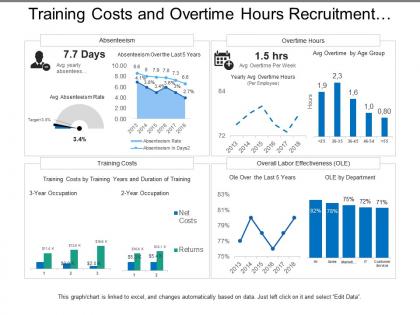
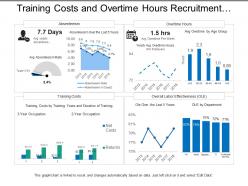
Training costs and overtime hours recruitment dashboard




Try Before you Buy Download Free Sample Product
 Impress Your
 Audience
 100%
100% Editable
 Save Hours
 of Time


Dig out inner details with our Training Costs And Overtime Hours Recruitment Dashboard. Carry out an in depth investigation.
People who downloaded this PowerPoint presentation also viewed the following :
Training costs and overtime hours recruitment dashboard with all 6 slides:
Be a benefactor with our Training Costs And Overtime Hours Recruitment Dashboard. Deliver excellent benefits for your clients.
FAQs for Training costs and overtime
An effective recruitment dashboard should include time-to-fill, cost-per-hire, source effectiveness, candidate quality scores, offer acceptance rates, and diversity metrics. These metrics enable HR teams to streamline hiring processes, optimize recruitment channels, and enhance candidate experiences, with many organizations finding that comprehensive dashboards ultimately deliver faster placements and improved talent acquisition outcomes.
Visualization techniques enhance recruitment data readability by transforming complex metrics into intuitive charts, graphs, and heat maps that highlight key patterns and trends. Through interactive dashboards, HR teams can quickly identify bottlenecks in hiring pipelines, track candidate conversion rates, and monitor recruiter performance across departments, ultimately enabling faster decision-making and more strategic talent acquisition.
Predictive analytics enable recruitment teams to forecast hiring needs, identify top candidate sources, and predict candidate success rates by analyzing historical data patterns, market trends, and performance metrics. Through machine learning algorithms, organizations in sectors like technology and healthcare can reduce time-to-hire, minimize turnover risks, and optimize resource allocation, ultimately delivering more strategic talent acquisition and competitive hiring advantages.
A recruitment dashboard helps track candidate demographics by consolidating diversity data, geographic distribution, experience levels, educational backgrounds, and application sources into visual analytics. Through real-time reporting, organizations can monitor hiring patterns, identify potential bias in sourcing channels, and ensure compliance with diversity initiatives, ultimately enabling data-driven decisions that enhance inclusive recruitment strategies.
Best practices for integrating recruitment dashboards with ATS systems include API connectivity, real-time data synchronization, standardized data mapping, automated workflow triggers, and comprehensive user access controls. These integrations streamline hiring processes by eliminating manual data entry, enhancing candidate tracking accuracy, and enabling seamless collaboration between HR teams, with many organizations finding significantly faster time-to-hire and improved recruitment analytics.
Recruitment dashboards aid diversity and inclusion by tracking demographic data across hiring stages, identifying bias patterns in selection processes, and monitoring progress toward inclusion goals through real-time analytics. These tools enable HR teams to spot disparities in candidate sourcing, interview outcomes, and offer acceptance rates, while providing actionable insights that help organizations create more equitable hiring practices and demonstrate measurable progress to stakeholders.
Recruitment dashboards should prioritize job board APIs, ATS integration, candidate tracking systems, social media recruiting platforms, and employee referral databases for real-time updates. These data sources streamline hiring workflows by delivering instant candidate pipeline visibility, automated status tracking, and performance metrics, with many HR teams finding that real-time integration reduces time-to-hire while enhancing recruitment efficiency and decision-making speed.
User feedback significantly influences recruitment dashboard design by identifying pain points, streamlining workflows, and enhancing user experience through iterative improvements. HR teams and recruiters provide insights on essential metrics, navigation preferences, and reporting needs, with many organizations finding that incorporating stakeholder input delivers more intuitive interfaces, faster candidate processing, and ultimately improved hiring efficiency and team adoption rates.
Common recruitment dashboard pitfalls include overloading with irrelevant metrics, neglecting real-time data integration, poor visual hierarchy, and lacking stakeholder input during design. These issues create confusion rather than clarity, with many HR teams finding that focusing on core KPIs like time-to-hire, candidate quality scores, and source effectiveness delivers better hiring decisions and streamlined recruitment processes.
Recruitment dashboards enable benchmarking by tracking key metrics like time-to-hire, cost-per-hire, candidate quality scores, and offer acceptance rates against industry averages. Through automated data visualization, organizations can identify performance gaps, optimize recruitment strategies, and maintain competitive hiring practices, with many companies finding that consistent benchmarking reduces hiring costs while improving candidate experiences.
Mobile-friendly recruitment dashboards should include candidate pipeline tracking, application status updates, interview scheduling, resume viewing, communication tools, and real-time analytics. These functionalities streamline hiring workflows by enabling recruiters to review applications, coordinate interviews, and make decisions remotely, with many organizations finding that mobile accessibility accelerates time-to-hire while enhancing recruiter productivity.
Recruitment dashboards facilitate collaboration by providing shared visibility into candidate pipelines, real-time application status updates, and centralized communication threads for each role. Through integrated feedback systems and automated notifications, HR teams and hiring managers can coordinate interview scheduling, share candidate evaluations, and track decision-making progress seamlessly, ultimately reducing time-to-hire while ensuring alignment on hiring criteria and candidate quality across departments.
Automated reporting significantly enhances recruitment dashboard effectiveness by providing real-time metrics, eliminating manual data entry errors, and enabling instant visibility into hiring funnel performance across multiple departments. This streamlines decision-making for HR teams and hiring managers, while delivering faster candidate processing, improved resource allocation, and ultimately competitive advantage in talent acquisition markets.
Recruitment dashboards help measure employer branding success by tracking application quality, candidate source effectiveness, time-to-hire metrics, and employee referral rates across multiple channels. These analytics enable HR teams to assess brand perception through candidate engagement scores, social media reach, and conversion rates, while identifying which branding strategies deliver stronger talent pools, ultimately optimizing recruitment ROI and competitive positioning.
Data accuracy strategies include implementing automated data validation rules, establishing regular audit schedules, integrating real-time synchronization across HR systems, standardizing data entry protocols, and creating verification checkpoints throughout the recruitment process. These approaches streamline data quality by minimizing manual errors, ensuring consistent formatting, and enabling continuous monitoring, with many organizations finding that combining automated validation with systematic review processes ultimately delivers more reliable insights and faster hiring decisions.
No Reviews