


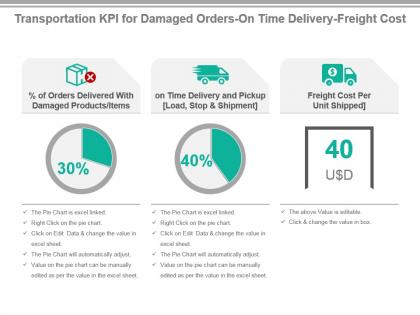
Transportation kpi for damaged orders on time delivery freight cost ppt slide




Try Before you Buy Download Free Sample Product
 Impress Your
 Audience
 100%
100% Editable
 Save Hours
 of Time


Elaborate on exceptional acts of bravery with our Transportation Kpi For Damaged Orders On Time Delivery Freight Cost Ppt Slide. Highlight displays of indomitable courage.
People who downloaded this PowerPoint presentation also viewed the following :
Transportation kpi for damaged orders on time delivery freight cost ppt slide with all 6 slides:
Break free from the shackles with our Transportation Kpi For Damaged Orders On Time Delivery Freight Cost Ppt Slide. Allow your thoughts to experiment anew.




FAQs for Transportation kpi for damaged orders on time delivery freight
Transportation management KPIs include on-time delivery rates, freight cost per mile, vehicle utilization rates, fuel efficiency metrics, and customer satisfaction scores. These indicators enable logistics managers to streamline operations, reduce transportation costs, and enhance service reliability, with many shipping companies finding that consistent monitoring ultimately delivers competitive advantage and improved customer experiences.
Transportation KPIs align with business objectives through strategic metric selection that connects operational performance to corporate goals, customer satisfaction targets, and financial outcomes. By linking delivery times to revenue growth, cost per mile to profitability targets, and service quality to customer retention, organizations create cohesive performance frameworks that drive both operational excellence and business success.
KPIs enable transportation companies to monitor fuel consumption, vehicle utilization, maintenance schedules, driver performance, and route optimization in real-time. These metrics streamline operations by identifying inefficiencies, reducing unnecessary mileage, and preventing costly breakdowns, with many logistics companies finding that strategic KPI implementation delivers up to 20% cost reductions while enhancing delivery performance.
Organizations leverage real-time data analytics to improve transportation KPIs by enabling dynamic route optimization, predictive maintenance scheduling, and immediate performance monitoring across fleet operations. Through IoT sensors and GPS tracking, logistics companies streamline fuel efficiency, reduce delivery times, and enhance customer satisfaction, while transportation agencies optimize traffic flow and minimize operational costs, ultimately delivering competitive advantage.
Best practices for measuring on-time delivery rates include establishing clear delivery windows, implementing real-time GPS tracking, setting standardized measurement intervals, using automated data collection systems, and creating customer-defined delivery success metrics. These approaches streamline accuracy by eliminating manual errors, enhancing visibility across supply chains, and enabling proactive adjustments, with many logistics companies finding that automated tracking delivers improved customer satisfaction and operational efficiency.
Transportation KPIs directly impact customer satisfaction by measuring delivery times, order accuracy, shipment tracking reliability, and cost efficiency. These metrics enable logistics companies to identify service gaps, streamline route optimization, and enhance communication transparency, with many retailers and e-commerce businesses finding that consistently monitored KPIs ultimately deliver faster deliveries and improved customer experiences.
Essential fuel efficiency metrics include miles per gallon (MPG), fuel cost per mile, fuel consumption per ton-mile, idle time percentages, and route optimization effectiveness. These metrics enable transportation companies to identify inefficient vehicles, optimize delivery routes, and reduce operational costs, with many logistics operators finding that systematic fuel monitoring delivers 10-15% cost reductions while enhancing competitive positioning.
Sustainability initiatives can be tracked through transportation KPIs including carbon emissions per mile, fuel efficiency ratios, alternative fuel adoption rates, route optimization metrics, and vehicle utilization percentages. These measurements enable organizations to monitor environmental impact while reducing operational costs, with logistics companies and municipal transport systems finding that systematic tracking delivers both regulatory compliance and competitive advantage in increasingly eco-conscious markets.
IoT and AI enhance transportation KPI visibility by providing real-time data collection, predictive analytics, automated monitoring systems, and comprehensive dashboard integration across fleet operations. These technologies enable logistics companies, shipping firms, and delivery services to track fuel efficiency, route optimization, and vehicle performance instantly, while predicting maintenance needs and delivery delays, ultimately delivering faster decision-making and improved operational transparency.
Organizations face challenges including data integration across multiple systems, establishing accurate measurement methodologies, ensuring real-time visibility, and aligning KPIs with strategic objectives. These implementation hurdles often stem from fragmented logistics networks, inconsistent data quality, and resistance to performance transparency, with many transportation companies finding that successful KPI adoption requires cross-functional collaboration and technology integration.
Predictive analytics enhances transportation KPI performance by forecasting demand patterns, optimizing route efficiency, and predicting maintenance needs before failures occur. Through machine learning algorithms, logistics companies streamline fuel consumption, reduce delivery delays, and minimize vehicle downtime, with many freight operators finding that predictive models ultimately deliver 15-20% cost reductions while improving customer satisfaction.
Effective communication of transportation KPI results involves visual dashboards with real-time metrics, executive summaries highlighting key performance trends, and sector-specific reports tailored to different stakeholder groups. These approaches enhance transparency by presenting complex logistics data clearly, enabling faster decision-making across supply chain teams, and ultimately delivering improved operational alignment and strategic accountability.
Transportation KPIs drive supply chain resilience improvements by identifying bottlenecks, measuring delivery reliability, and tracking cost fluctuations across multiple routes and carriers. These metrics enable organizations to diversify transportation networks, implement contingency planning, and optimize resource allocation, with logistics companies finding that real-time KPI monitoring delivers faster recovery times and reduced disruption costs.
Organizations should consider benchmarks including on-time delivery rates, cost per mile, fuel efficiency, vehicle utilization, and customer satisfaction scores when evaluating transportation KPIs. These metrics enable companies to streamline operations, reduce costs, and enhance service quality, with many logistics providers finding that combining operational and financial benchmarks ultimately delivers competitive advantage in an increasingly complex supply chain environment.
Continuous improvement frameworks integrate with transportation KPIs through systematic data collection, regular performance reviews, root cause analysis, and structured feedback loops that identify optimization opportunities. These methodologies enable logistics companies and supply chain organizations to reduce delivery times, minimize fuel costs, and enhance route efficiency, with many transportation firms finding that combining frameworks like Lean Six Sigma with real-time KPI monitoring delivers measurable competitive advantages.
-
It saves your time and decrease your efforts in half.
-
Attractive design and informative presentation.