


Travel and tourism startup company pitch deck ppt template




Try Before you Buy Download Free Sample Product
 Impress Your
 Audience
 100%
100% Editable
 Save Hours
 of Time


Are you planning to raise funds for a travel and tourism startup. You might want to have a top-notch business plan or pitch deck. Check out our professionally designed Travel and Tourism Startup Company pitch deck that will help you get inspired and build an excellent pitch deck for your upcoming investment round. This pitch deck highlights the market validations statistical information, such as temporary housing sites, listings, etc. Major trends related to the travel industry include increased domestic travel, health, safety requirements, etc. This template covers slides such as competitive landscape analysis based on travel technology, market segmentation, and targeting for the travel business. We have also included slides such as the strategic business model for better insight into the working of the travel company. Sustainable competitive advantages and, key differentiators, go-to-market plans are also displayed in this presentation. This pitch deck covers slides for information regarding the companys top management, customer reviews, testimonials, investment ask with previous funding details. Customize this 100 percent editable pitch deck now.
People who downloaded this PowerPoint presentation also viewed the following :
Content of this Powerpoint Presentation
Have a dream to start your own travel and tourism business but are unsure where to start? You have come to the right place! Before we start, however, we must address important facts that will help you assess the profitability of your business proposition.
The global travel and tourism market is expected to grow significantly, exceeding $8.9 trillion by 2026, with a compound annual growth rate (CAGR) of more than three from 2021 to 2026. This growth trajectory demonstrates the sector's recovery and expansion after the pandemic, emphasizing tourism's growing economic contribution globally. If you think these numbers are crazy, you are in for a bigger surprise!
A massive $8.8 trillion is being spent every year on tourism globally. No wonder that Travel is one the fastest-growing sectors globally, and presents endless growth opportunities for startups.
This blog shows you how to build a unique pitch deck template to impress investors and raise capital for your travel and tourism startup. The 100% editable and customizable nature of SlideTeam’s PowerPoint Templates provides you with the structure and the desired flexibility to edit your presentations.
Let’s get started!
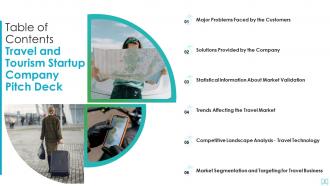
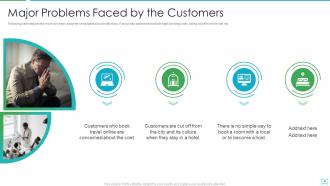
Template 1: Major Problems Faced by the Customers
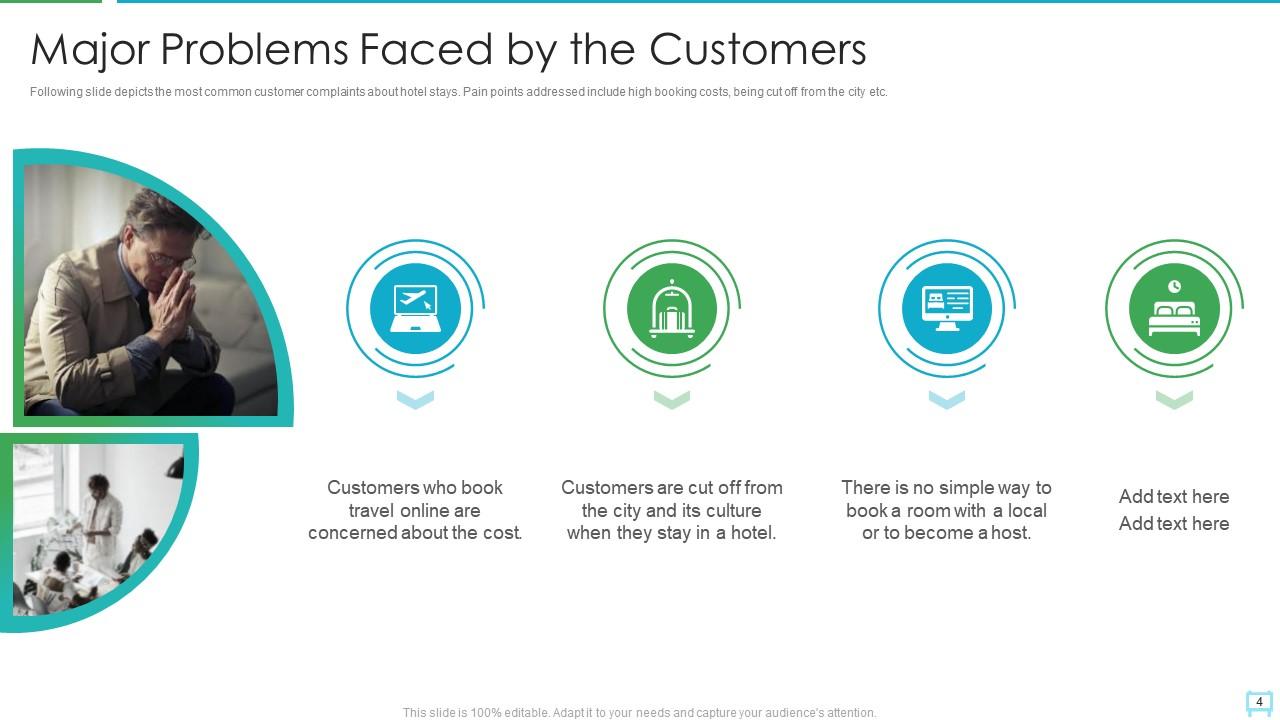
This PPT Slide identifies common issues that travelers encounter during hotel stays. Also, it addresses customer pain points such as high booking costs and feeling disconnected from local culture while staying in hotels. Also, it points out difficulties customers face in booking accommodation through local hosts or platforms. This PPT helps businesses understand these challenges and strategize solutions to enhance customer satisfaction and engagement in the travel and tourism sector. Implementation of the content leads to improvements in service delivery and customer experience.
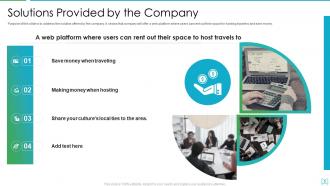
Template 2: Solutions Provided by the Company
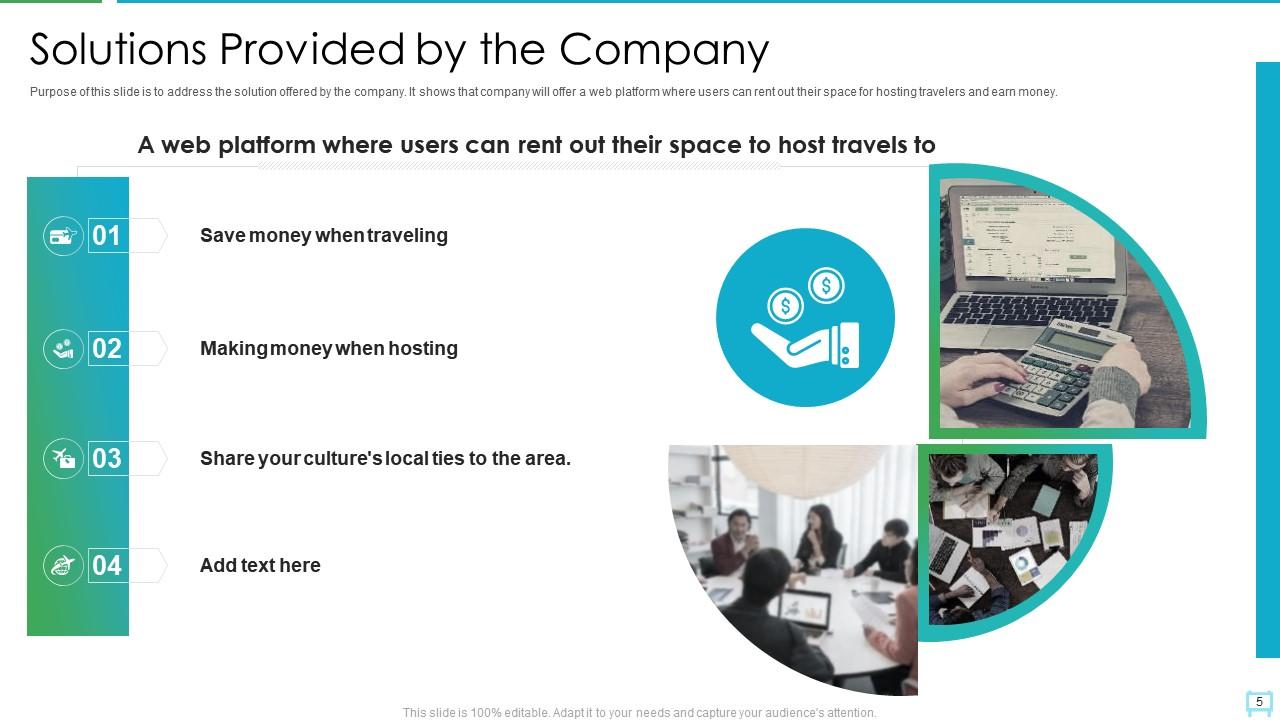
This PPT Preset outlines how a web platform can improve travel experiences. It details the company’s solution allowing users to rent out their space to travelers, which not only saves money for travelers but also enables hosts to earn. The platform emphasizes cultural exchange, enhancing local engagement by allowing hosts to share local culture with guests. This slide illustrates the benefits of the platform, providing a clear pathway for users to connect, share, and monetize their spaces.
Template 3: Statistical Information About Market Validation
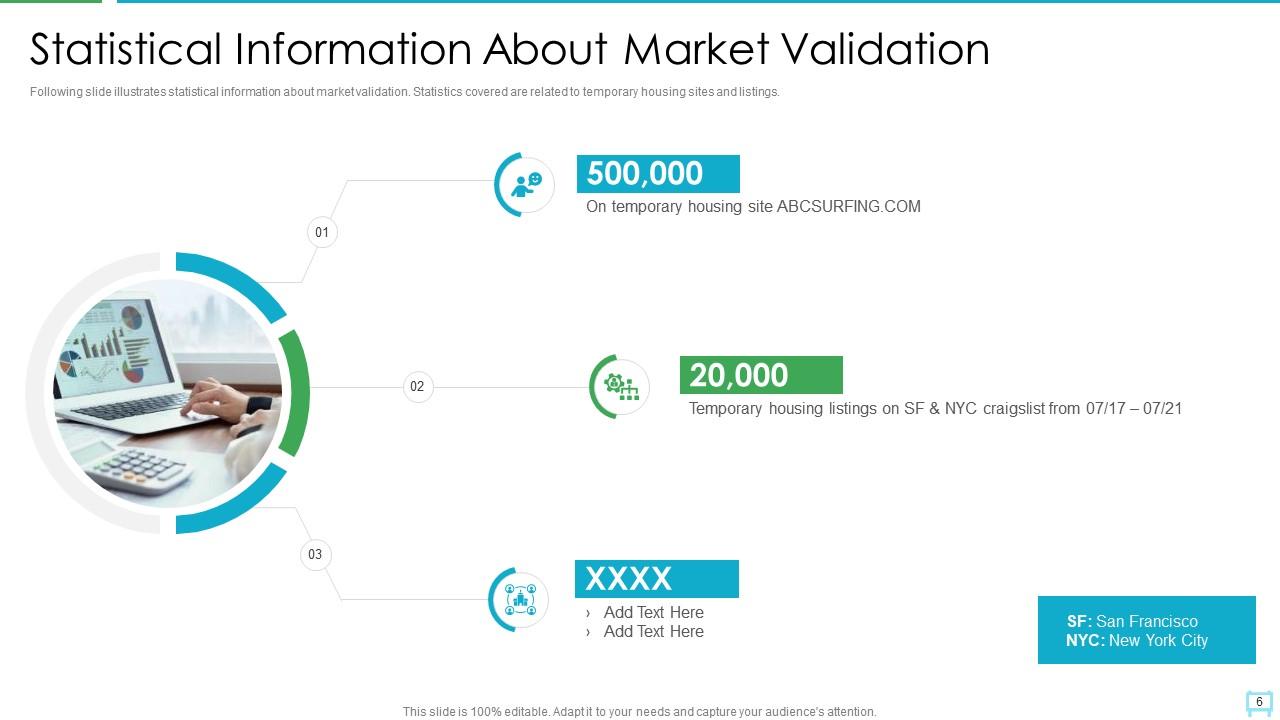
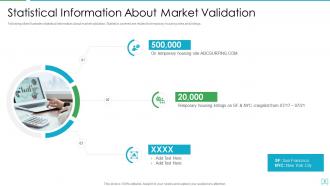
This PowerPoint Presentation offers a snapshot of key market validation statistics for temporary housing, focusing on user engagement and market penetration. It presents significant numbers, like 500,000 users on a specific hosting site and 20,000 temporary housing listings from regional classifieds, illustrating the scale and reach of online temporary housing solutions. This slide is essential for businesses assessing the viability and growth potential within the temporary housing market, providing concrete data to strategize and optimize their market approaches.
Template 4: Trends Affecting the Travel Market
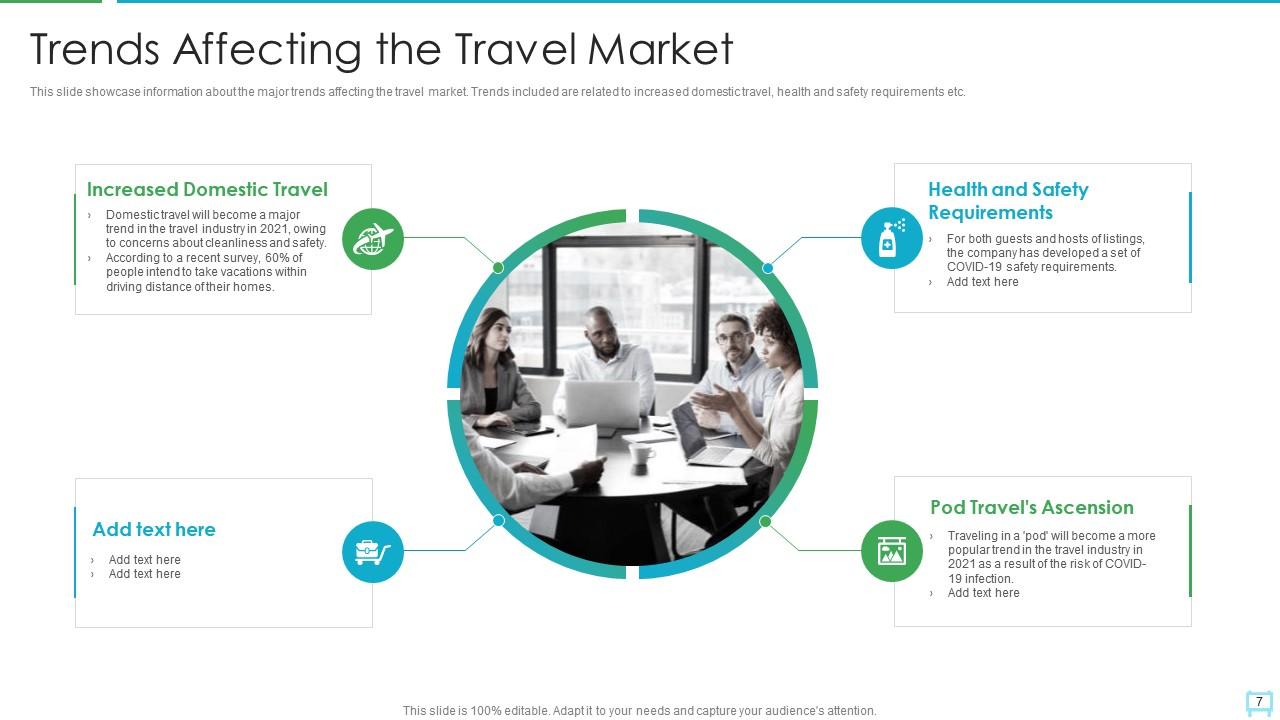
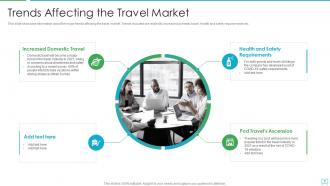
This PPT Set discusses key trends affecting the travel industry, with a focus on how shifts such as increased domestic travel, increased health and safety requirements, and the rise of pod travel influence industry dynamics. Also, it provides a visual breakdown of each trend, along with statistics and insights that businesses can use to adapt to new consumer behaviors. The template assists professionals in understanding these changes, allowing them to plan ahead of time to meet changing market demands.
Template 5: Competitive Landscape Analysis
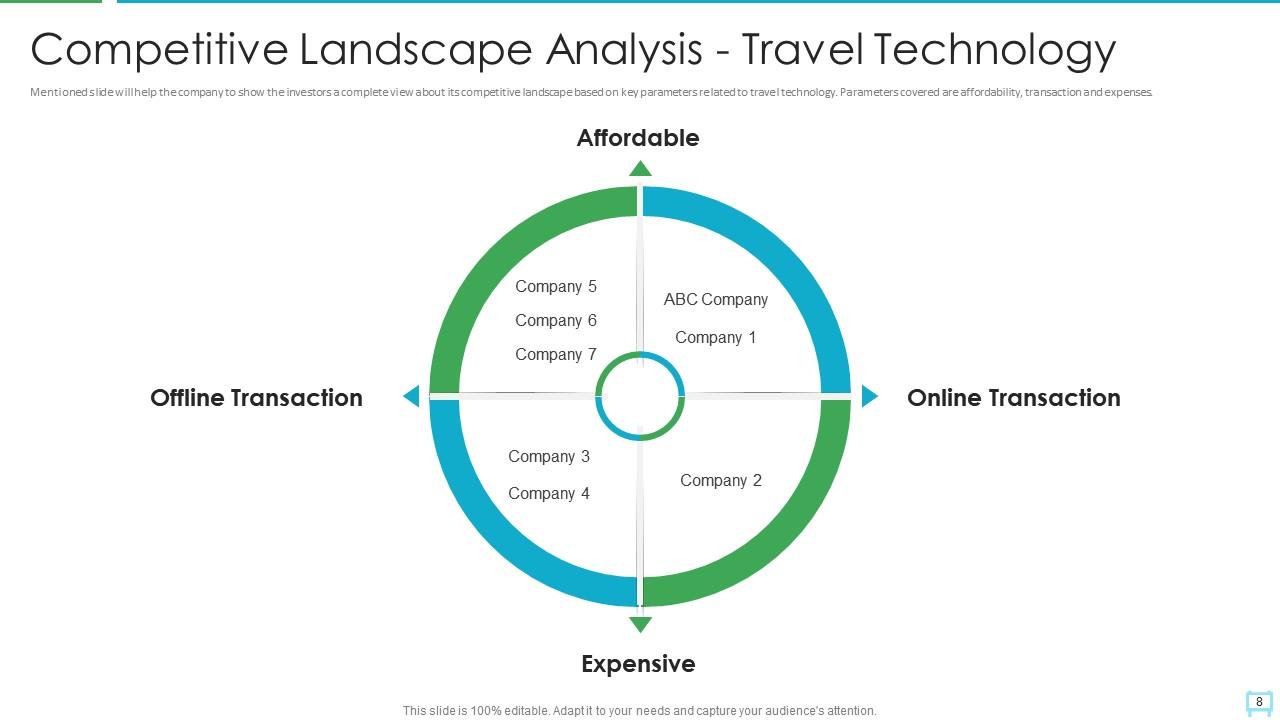
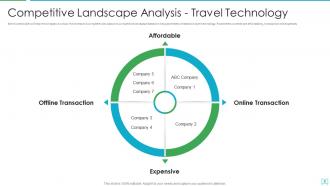
This PowerPoint presentation provides a competitive landscape analysis for the travel technology sector, comparing companies based on affordability, transaction methods (offline vs. online), and expense levels. The graphic divides businesses into quadrants to show where they rank in terms of providing affordable or expensive services, as well as their preference for conducting transactions offline or online. This visualization helps investors and stakeholders get a clear, comprehensive competitive overview of key players and their market positioning.
Template 6: Market Segmentation and Targeting for Travel Business
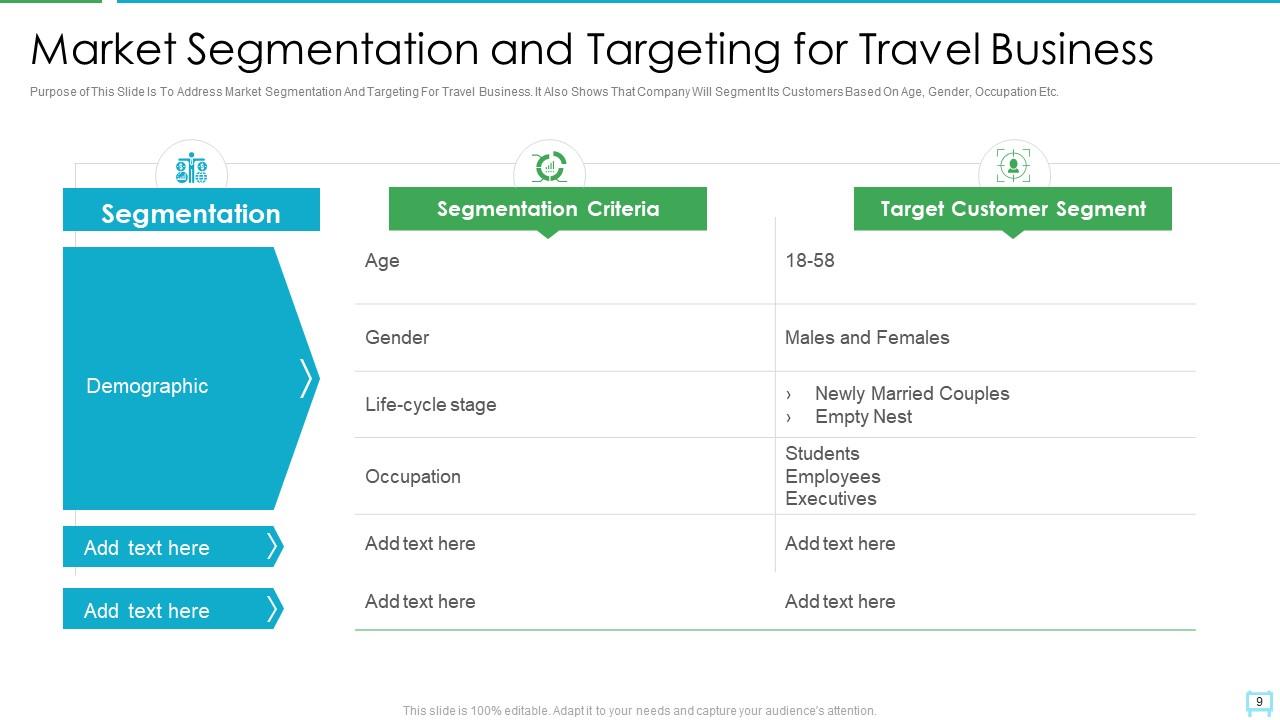
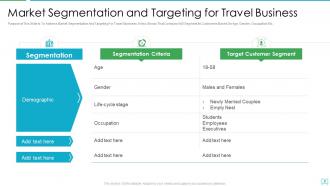
This PPT Presentation outlines the market segmentation and targeting strategies for a travel business. Also, it categorizes demographic segmentation with criteria such as age, gender, life-cycle stage, and occupation while identifying specific target customer segments, including ages 18-58, both genders, newly married couples, empty nesters, students, employees, and executives. This slide assists marketers in tailoring their offerings to meet the needs and preferences of these distinct groups.
Template 7: Strategic Business Model
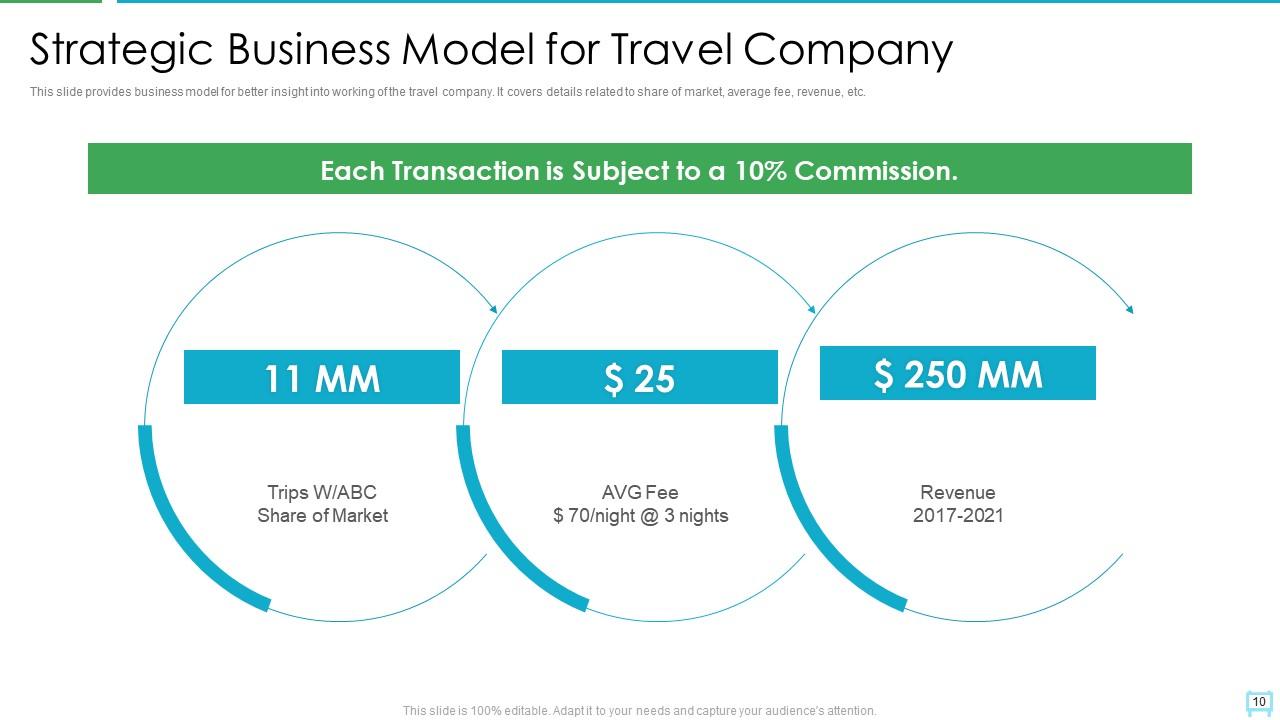
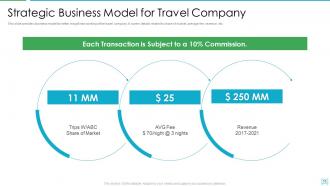
This PowerPoint Presentation depicts a travel company's strategic business model, including key financial metrics from 2017 to 2021. It includes the company's market share of 11 million trips, an average fee structure of $25 with an assumption of $70 per night over three nights, and a total revenue of $250 million. Every transaction is subject to a 10% commission. This slide is critical to understanding the company's revenue generation and market position.
Template 8: Sustainable Competitive Advantages and Key Differentiators
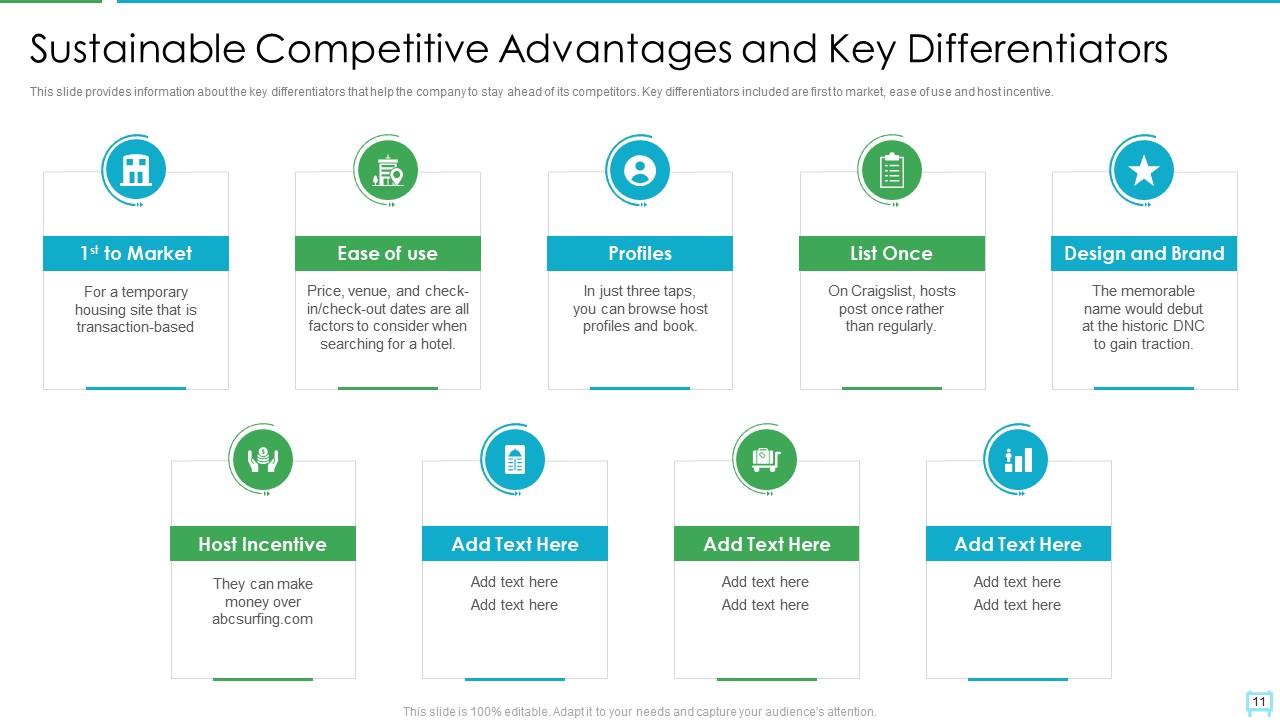
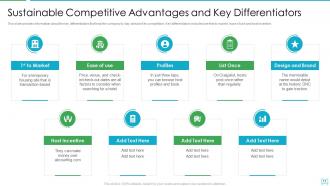
This PowerPoint Slide highlights the sustainable competitive advantages and key differentiators for a company in the temporary housing market. It showcases attributes such as being first to market, ease of use, streamlined host profiles, efficient listing process, host incentives, and a strong design and brand identity. Each feature is designed to underline how these elements help the company maintain a competitive edge by enhancing user experience and brand recognition. This slide is ideal for illustrating strategic advantages to stakeholders or potential investors.
Template 9: Go to Market Plan
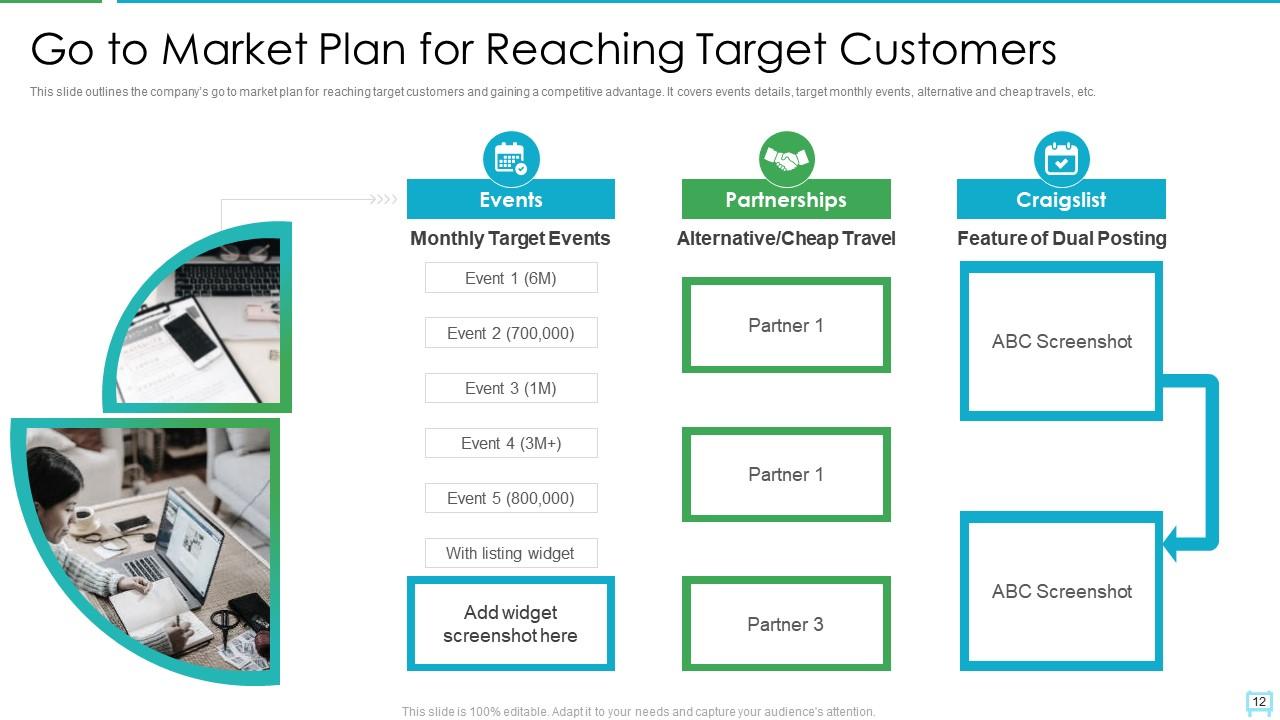
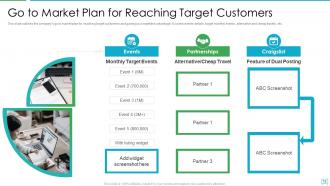
This PowerPoint presentation outlines a go-to-market strategy for reaching target customers. It divides the strategy into three parts: events, partnerships, and a feature called Dual Posting on Craigslist. The slide describes monthly target events with expected attendance, strategic partnerships with entities that provide alternative or low-cost travel solutions, and the use of Craigslist to increase exposure through dual posting capabilities. This approach allows you to reach a larger audience and leverage partnerships for a competitive advantage, making it ideal for strategic planning and operational meetings.
Template 10: Investment Sought
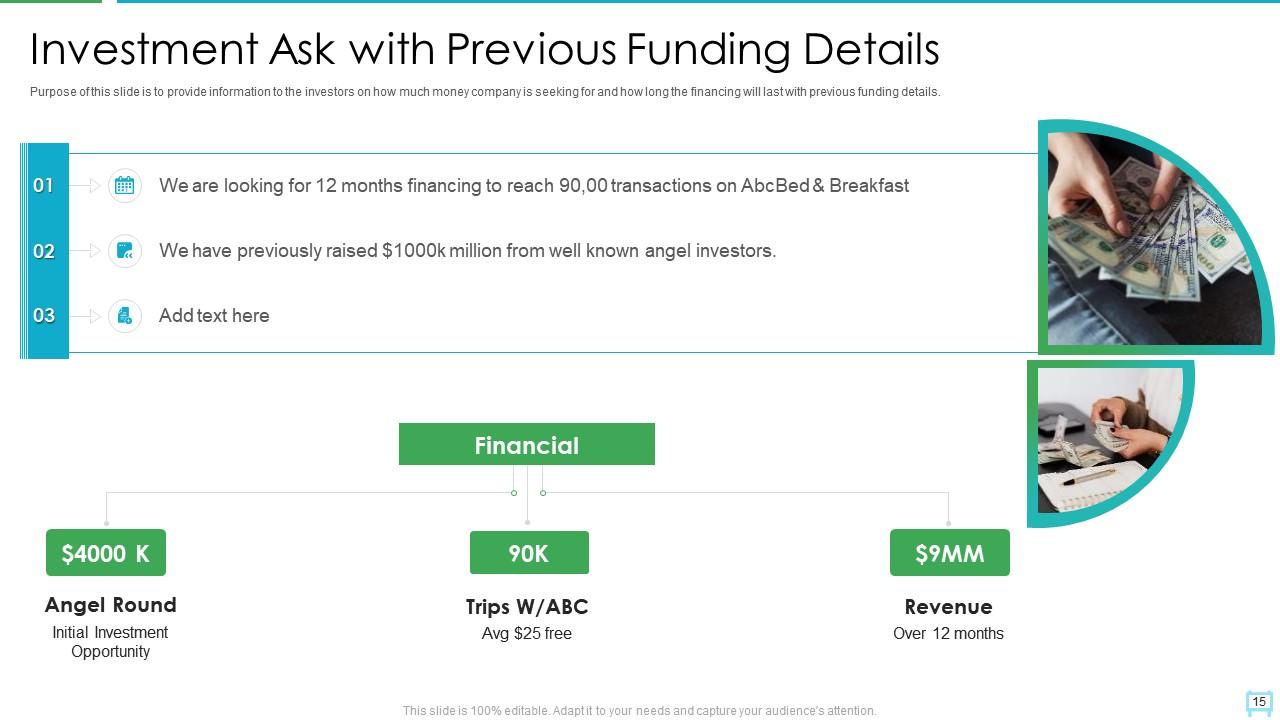
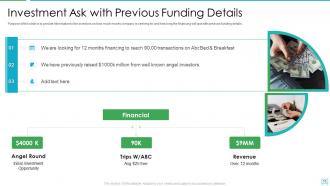
This PPT Set is intended for a pitch to investors. It summarizes the investment request and provides information on previous funding rounds for a travel company. It emphasizes the company's need for a 12-month financing plan to reach 90,000 transactions, its previous success in raising $1000k from angel investors, and financial projections of $9 million in revenue over the next 12 months. The slide also features an angel round investment opportunity, presenting it as an informative and persuasive tool for prospective investors.
Ready, Set, Launch!
With the travel and tourism market expected to exceed $8.9 trillion by 2026, now is the best time to launch your startup. With our versatile Pitch Deck PPT Template, you can turn your lofty goals into tangible accomplishments. Remember that each slide in your deck is more than just a tool; it is a step toward obtaining the necessary funding. Create a confident pitch, highlight your innovative ideas, and prepare to take the travel and tourism industry by storm.
Travel and tourism startup company pitch deck ppt template with all 33 slides:
Use our Travel And Tourism Startup Company Pitch Deck Ppt Template to effectively help you save your valuable time. They are readymade to fit into any presentation structure.







FAQs for Travel and tourism startup company pitch
Honestly, the AI personalization stuff is getting pretty wild - these platforms know what you want to book before you do. Everything's gone contactless now too, which is actually super convenient. Your phone basically becomes your room key and boarding pass. AR lets you virtually walk through hotels before booking, which saves so much disappointment. Apps are tracking carbon footprints for flights now if you're into that. Voice assistants can handle crazy complex trips with multiple stops. Might be worth seeing how your usual booking apps compare - some are way behind on this stuff.
So basically every travel site you use now has AI running behind the scenes. Those flight recommendations? They're analyzing your search history and preferences to show you stuff you'll actually want. Dynamic pricing changes based on demand - that's algorithms too. Some travel companies are getting pretty good at building custom itineraries based on your budget and interests, though the chatbots still kinda suck half the time. Oh, and those "recommended for you" hotel suggestions aren't random - that's machine learning figuring out your travel style. It's honestly wild how personalized everything's gotten compared to like five years ago.
Dude, travel apps are honestly insane now. Everything's on your phone - boarding passes, hotel stuff, restaurant bookings, even translation when you're trying to order food and butchering the local language. The coolest part? They actually update in real-time, so you'll get pinged about gate changes or traffic delays instantly. I can basically run my entire trip from my phone, which is kinda crazy when you think about it. Oh, and if you're ever building one of these things - make sure it works offline because airport WiFi is usually trash.
So blockchain basically makes your travel bookings way more transparent - like you get this tamper-proof digital receipt for everything. No more surprise fees or sketchy charges later. Airlines are using it for loyalty programs now which is cool because nobody can mess with your points. Hotels too. You'll see faster payments since there's less middlemen involved, and honestly the security is just better than regular booking sites. Some platforms are already doing this if you look for ones that mention blockchain integration. It's not everywhere yet but definitely worth checking out when you're booking trips.
Dude, VR is like test-driving a car but for vacations. Walk through hotel rooms virtually before booking - no more surprises when that "ocean view" turns out to be a sliver of blue through someone's laundry line (been there). You can check out restaurants, hiking trails, whatever, to see if they actually match the vibe you're going for. Way better than trusting those overly filtered photos online. I'd definitely pitch this to your travel clients - people get so anxious about dropping money on trips they've never experienced. This kills that worry.
Oh man, they're literally tracking EVERYTHING. Your search history, how long you stare at that flight price, what device you're on - even the weather where you're going. It's wild how creepy it gets. Big data lets them adjust prices instantly based on your patterns and what competitors are charging. I mean, at least they use it to suggest stuff you might actually want? But yeah, definitely browse incognito and clear those cookies if you don't want to get screwed over by their pricing algorithms.
Dude, COVID basically forced the entire travel industry to jump into the future overnight. People couldn't do the usual booking stuff anymore, so companies finally had to roll out all that tech they'd been putting off - mobile check-ins, chatbots, flexible rebooking systems, the works. Honestly, it's crazy how fast things moved when they had no other choice. Airlines and hotels that were still stuck in 2015 suddenly figured out contactless everything within months. Now travelers expect all this digital stuff as the bare minimum, so if you're working in travel tech, you've gotta keep up or you'll get left behind. Wild times.
Honestly, loyalty programs are all over the place depending on where you are. Asia goes crazy for gamification - badges, achievements, all that social stuff. Europe's obsessed with sustainability rewards right now. Americans? Still just want their cashback, which is so typical lol. Age matters too though. Younger people want everything instantly on their phones, while older folks stick with basic point systems. Business travelers everywhere just care about upgrades, not discounts. I'd probably segment by region first, then worry about age groups after. Way easier than trying to do everything at once.
Honestly, TravelTech is rough right now. Customer acquisition costs are insane - like seriously painful. You're up against Booking and Expedia who've got endless cash to burn. Margins are practically nonexistent, and don't even get me started on regulatory stuff. Every country wants different paperwork and compliance hoops. Post-pandemic travelers are still weird about booking patterns too. They want everything flexible and refundable, which kills profitability. My advice? Pick one tiny niche and own it completely. Going head-to-head with the big players is basically financial suicide at this point.
Honestly, travel apps are getting pretty good at helping you be more eco-friendly. You can find carbon calculators, green hotels, and stuff that supports local communities directly. Some track your impact and suggest carbon offsets - which I didn't think I'd care about but actually do now. Plus the data helps spread tourists around so popular spots don't get completely overrun. Apps like TripIt and EcoBnb are solid if you want convenience but don't want to feel terrible about your footprint. Way easier than researching everything yourself.
Honestly, the coolest stuff I'm seeing is AI chatbots that can actually figure out what you're asking - like they'll handle flight changes without making you want to scream. Most apps now have real-time messaging built right in, which is clutch. Some companies are doing VR help desks where agents can show you around airports virtually (still feels super futuristic to me). Everyone's adding WhatsApp support too since calling those awful 1-800 numbers is basically torture. The really smart ones use predictive analytics to text you about delays before you even check. I'd probably start with omnichannel support if you're looking to upgrade.
So yeah, facial recognition is everywhere now at airports - security, gates, bag drop, the works. Just scan your face instead of fumbling with boarding passes. Hotels are doing facial check-ins too, though tbh it still feels kinda sci-fi weird to me. Your fingerprints work for TSA PreCheck lanes, which is clutch. Some cruise lines even let you buy drinks by scanning your face (dangerous lol). Everything's way faster, but definitely peek at their privacy stuff since they're storing your biometric data. You can usually opt out if it creeps you out.
Remote work is getting so much easier now. AI tools automatically scout workspaces and suggest destinations based on your schedule and visa stuff. Co-working passport apps are everywhere - one membership gets you into thousands of spaces worldwide. Visa applications used to be the worst part, but there are platforms now that handle everything automatically. eSIM apps and nomad-specific VPNs are making connectivity way better too. Oh, and definitely check out Nomad List's workspace finder - I've been using it tons lately and it's perfect for location scouting. Game changer honestly.
So basically you get to see what travelers actually do vs what they claim in surveys - way more honest data. Track hashtags and sentiment around destinations, plus see which content gets crazy engagement. Instagram stories about "hidden gem" spots? They predict tourism patterns months out, which honestly blows my mind every time. You can also peek at competitor mentions to see where you're crushing it or falling behind. I'd start monitoring your main destinations and travel keywords, then check sentiment shifts monthly. Oh and use that intel to shape your marketing - it's like having a crystal ball but actually useful.
Honestly, start with privacy - people are handing over location data, payment info, everything. That stuff needs to be locked down tight. The whole digital divide thing is messy too. Tech-savvy users get all the cool features while others just get frustrated trying to book a flight. Your algorithms might end up being biased without you realizing it - like showing pricier options to certain zip codes. Oh, and travel tech kinda pushes people to consume more, which isn't great environmentally. Run privacy audits and test for bias before launching anything new. Trust me on this one.
-
Understandable and informative presentation.
-
Editable templates with innovative design and color combination.