


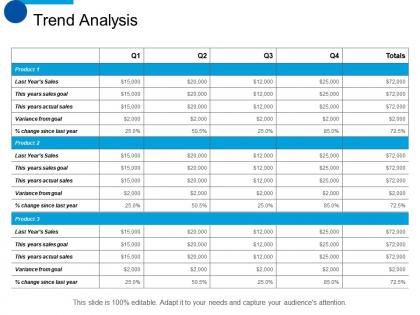
Trend analysis business planning ppt professional format




Try Before you Buy Download Free Sample Product
 Impress Your
 Audience
 100%
100% Editable
 Save Hours
 of Time


Add to the informality with our Trend Analysis Business Planning Ppt Professional Format. Enable discussions in a friendly atmosphere.
People who downloaded this PowerPoint presentation also viewed the following :
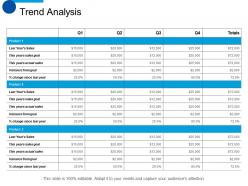
Trend analysis business planning ppt professional format with all 5 slides:
Don't deal in half truths with our Trend Analysis Business Planning Ppt Professional Format. Always display complete data.



FAQs for Trend analysis business planning
Successful business trend analysis requires monitoring market data patterns, consumer behavior shifts, competitive landscape changes, technological adoption rates, and regulatory developments. These indicators work together by revealing emerging opportunities, identifying potential threats, and validating strategic decisions, with many organizations finding that comprehensive trend analysis ultimately delivers competitive advantage and improved market positioning.
Companies leverage data analytics to identify emerging trends by monitoring social media sentiment, analyzing consumer behavior patterns, tracking competitor activities, and examining market data in real-time. Through predictive analytics and machine learning algorithms, businesses in retail, finance, and healthcare can spot shifts before competitors, enabling proactive strategy adjustments, enhanced product development, and ultimately delivering significant competitive advantage in increasingly dynamic markets.
Consumer behavior serves as a primary catalyst for business trends, influencing product development, marketing strategies, service delivery models, and operational approaches across industries. As preferences shift toward sustainability, digital experiences, and personalization, companies in retail, hospitality, and financial services adapt their offerings accordingly, ultimately driving innovation and competitive differentiation in an increasingly consumer-centric marketplace.
Small businesses can conduct effective trend analysis through free tools like Google Trends, industry reports, social media monitoring, customer feedback analysis, and competitor observation. By leveraging these accessible resources, small enterprises streamline market insights, identify emerging opportunities, and make strategic decisions that enhance competitive positioning, with many finding that consistent monitoring delivers significant advantages despite budget constraints.
Business trend analysis relies on tools like Tableau, Power BI, Google Analytics, SEMrush, and social listening platforms such as Hootsuite Insights. These technologies streamline data visualization, competitive intelligence, and market monitoring by automating data collection, identifying emerging patterns, and delivering real-time insights, with many organizations finding that strategic combinations enhance forecasting accuracy and competitive advantage.
Macroeconomic factors influence business trends by affecting consumer spending, investment flows, and operational costs across sectors. Interest rate changes impact real estate and financial services differently than manufacturing, while inflation affects retail margins and healthcare costs, with many organizations finding that proactive trend analysis enables strategic positioning and competitive advantage in increasingly volatile economic environments.
Businesses differentiate between fads and trends by analyzing market duration, consumer behavior patterns, underlying economic drivers, and adoption rates across demographics. While fads typically show rapid spikes followed by quick decline, sustainable trends demonstrate consistent growth with deep market penetration, especially in sectors like technology and healthcare, ultimately delivering lasting competitive advantage.
Technology accelerates business trend evolution by enabling real-time data analytics, predictive modeling, and automated market insights across global markets. Through AI-driven analysis and cloud-based platforms, organizations streamline trend identification, enhance decision-making speed, and ultimately deliver competitive advantages, with many companies finding that technology-powered insights reduce response times and improve strategic positioning.
Competitor analysis is crucial for understanding market trends, as it reveals strategic shifts, emerging technologies, consumer behavior changes, and industry direction through real-world data. By analyzing competitors' product launches, marketing strategies, and market positioning, businesses can identify opportunities, anticipate disruptions, and adapt their strategies proactively, ultimately gaining competitive advantage in rapidly evolving markets.
Business trend forecasting methods include predictive analytics, market research surveys, social media sentiment analysis, economic indicators monitoring, and expert panel consultations. Through advanced data modeling and cross-industry analysis, organizations can identify emerging patterns, anticipate market shifts, and adapt strategies proactively, with many companies finding that combining multiple forecasting approaches delivers more reliable predictions and sustainable competitive advantage.
Businesses incorporate trend analysis into strategic planning by conducting regular market research, analyzing competitor movements, monitoring consumer behavior patterns, and tracking technological developments. This strategic combination enables organizations to anticipate market shifts, identify emerging opportunities, and adjust resource allocation accordingly, with many companies finding that proactive trend integration delivers competitive advantage and enhanced operational efficiency.
Businesses should prioritize data privacy, ensure transparent methodologies, avoid bias in interpretation, respect consumer consent, and maintain accuracy in reporting when analyzing trends. These ethical practices enable organizations to build stakeholder trust, comply with regulations like GDPR, and make responsible decisions that enhance long-term reputation while delivering competitive insights.
Cultural shifts significantly influence global business trends by altering consumer preferences, workplace expectations, and market demands across regions. From sustainability consciousness driving eco-friendly products to remote work culture transforming office spaces, these shifts create new opportunities in sectors like green technology, digital collaboration tools, and personalized services, ultimately enabling businesses to adapt their strategies and capture emerging markets.
Technology, healthcare, retail, financial services, and energy are experiencing the most significant trend shifts driven by digital transformation, regulatory changes, and evolving consumer expectations. These industries face disruption through AI automation, telemedicine adoption, e-commerce acceleration, fintech innovation, and renewable energy transitions, with organizations finding that adapting quickly delivers competitive advantages and sustainable growth.
Businesses can adapt marketing strategies through trend analysis by adjusting messaging, reallocating budgets across channels, targeting emerging demographics, and modifying product positioning to align with consumer preferences. Companies in retail and financial services increasingly leverage these insights to optimize campaign timing, enhance customer segmentation, and deliver personalized experiences, ultimately gaining competitive advantage in rapidly evolving markets.
No Reviews