


Triple Bottom Line Framework Business Strategy Best Practice Tools




Try Before you Buy Download Free Sample Product
 Impress Your
 Audience
 100%
100% Editable
 Save Hours
 of Time


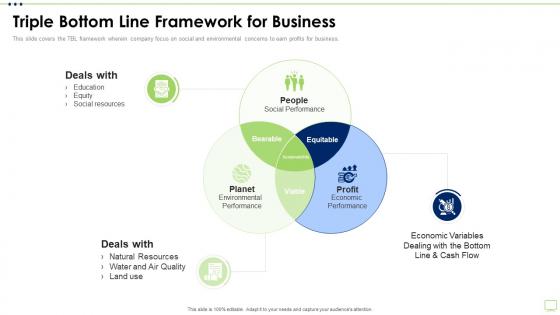
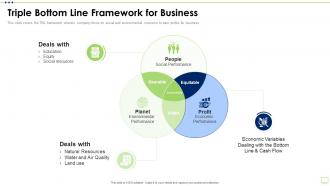
This slide covers the TBL framework wherein company focus on social and environmental concerns to earn profits for business.
People who downloaded this PowerPoint presentation also viewed the following :
Triple Bottom Line Framework Business Strategy Best Practice Tools with all 6 slides:
Use our Triple Bottom Line Framework Business Strategy Best Practice Tools to effectively help you save your valuable time. They are readymade to fit into any presentation structure.





FAQs for Triple Bottom Line Framework Business Strategy
The Triple Bottom Line framework encompasses three key components: people (social responsibility and employee welfare), planet (environmental sustainability and resource conservation), and profit (economic viability and financial performance). This strategic approach enables organizations to measure success holistically, with many companies in retail, manufacturing, and financial services finding that balancing these elements ultimately delivers enhanced stakeholder trust and sustainable competitive advantage.
Businesses can effectively measure their triple bottom line impact through social metrics like employee satisfaction and community engagement, environmental indicators such as carbon footprint and waste reduction, and financial performance assessments including revenue growth and cost efficiency. These comprehensive measurement frameworks enable organizations to track sustainability goals, demonstrate stakeholder value, and maintain competitive advantage, with many companies finding that integrated reporting ultimately delivers greater transparency and long-term business resilience.
Companies successfully implementing Triple Bottom Line include Patagonia's environmental activism and fair labor practices, Unilever's Sustainable Living Plan reducing environmental impact while improving health outcomes, and Ben & Jerry's social mission integration alongside profitability. These organizations demonstrate how balancing people, planet, and profit drives customer loyalty, operational efficiency, and long-term competitive advantage, with many finding that sustainable practices ultimately enhance brand value and market positioning.
Adopting the Triple Bottom Line significantly enhances company reputation by demonstrating commitment to people, planet, and profit, building trust with socially conscious consumers and stakeholders. Companies like Patagonia and Unilever find that this balanced approach strengthens brand loyalty, attracts top talent, and delivers competitive advantage in increasingly values-driven markets.
Small businesses can integrate Triple Bottom Line principles through sustainable sourcing, energy-efficient operations, fair employee compensation, community partnerships, and transparent reporting practices. These approaches enable smaller organizations to reduce operational costs, attract environmentally conscious customers, enhance employee retention, and build stronger local relationships, ultimately delivering competitive advantages while contributing positively to society and environmental sustainability.
Companies face challenges including conflicting priorities between profit maximization and social/environmental goals, difficulty measuring non-financial impacts, increased operational costs, stakeholder alignment issues, and resource allocation decisions. These competing demands often require strategic trade-offs, with many organizations finding that integrated sustainability frameworks and long-term thinking help balance immediate financial pressures with broader social responsibility, ultimately delivering enhanced brand reputation and competitive advantage.
The Triple Bottom Line framework transforms corporate governance by integrating people, planet, and profit considerations into strategic decisions, board evaluations, and stakeholder reporting processes. This comprehensive approach enables organizations to balance shareholder returns with environmental sustainability and social impact, with many companies finding that TBL governance structures enhance long-term resilience, attract conscious investors, and ultimately deliver sustainable competitive advantage.
Stakeholders play a crucial role in shaping Triple Bottom Line strategy by providing feedback, setting expectations, and influencing priorities across people, planet, and profit dimensions. Through investor demands, customer preferences, employee advocacy, and community partnerships, companies increasingly align their social, environmental, and financial goals with stakeholder values, ultimately delivering enhanced reputation and sustainable competitive advantage.
Technology enables organizations to monitor Triple Bottom Line performance through integrated sustainability platforms, IoT sensors, AI-driven analytics, automated ESG reporting tools, and blockchain verification systems. These solutions streamline data collection across people, planet, and profit metrics, while providing real-time insights that enhance operational efficiency, reduce environmental impact, and improve stakeholder transparency, ultimately delivering competitive advantage in increasingly sustainability-focused markets.
Adopting a Triple Bottom Line approach delivers significant financial benefits including reduced operational costs through resource efficiency, enhanced brand value and customer loyalty, improved employee retention, access to sustainable financing options, and reduced regulatory risks. These strategic advantages enable corporations to streamline operations while attracting conscious consumers and investors, ultimately delivering competitive advantage and long-term profitability.
The Triple Bottom Line directly aligns with sustainability and CSR by measuring corporate performance across people, planet, and profit dimensions rather than financial metrics alone. This framework enables organizations to demonstrate environmental stewardship, social impact, and economic viability simultaneously, with many companies finding that comprehensive Triple Bottom Line reporting enhances stakeholder trust, attracts conscious consumers, and ultimately delivers competitive advantage in an increasingly sustainability-focused marketplace.
Consumers drive Triple Bottom Line adoption through purchasing decisions favoring sustainable brands, demanding transparency in environmental and social practices, and supporting companies with ethical supply chains. By boycotting irresponsible businesses, engaging through social media advocacy, and choosing products with verified sustainability certifications, consumers create market pressures that ultimately compel organizations to balance profit with people and planet considerations.
Common misconceptions about the Triple Bottom Line include viewing it as mere marketing, believing it requires sacrificing profits for social good, assuming it's only for large corporations, thinking it's too complex to measure, and considering it a passing trend. While implementing TBL presents challenges, many organizations across healthcare, manufacturing, and retail find that strategic integration of people, planet, and profit actually enhances operational efficiency and delivers sustainable competitive advantage.
The Triple Bottom Line strengthens organizational resilience by diversifying risk across people, planet, and profit dimensions, while fostering innovation through sustainable product development, circular economy practices, and stakeholder engagement strategies. Companies integrating these approaches, particularly in manufacturing and retail sectors, enhance brand loyalty, attract top talent, and access new markets, ultimately delivering competitive advantage and financial sustainability in an increasingly conscious marketplace.
Businesses can assess Triple Bottom Line performance using financial metrics like ROI and profit margins, social indicators including employee satisfaction and community impact scores, and environmental measures such as carbon footprint and waste reduction data. Tools like sustainability dashboards, ESG reporting frameworks, and integrated assessment platforms enable organizations to track these interconnected metrics comprehensively, ultimately delivering transparent stakeholder reporting and competitive advantage.
-
Content of slide is easy to understand and edit.
-
Very unique and reliable designs.