


Unity is key of success flat powerpoint design




Try Before you Buy Download Free Sample Product
 Impress Your
 Audience
 100%
100% Editable
 Save Hours
 of Time


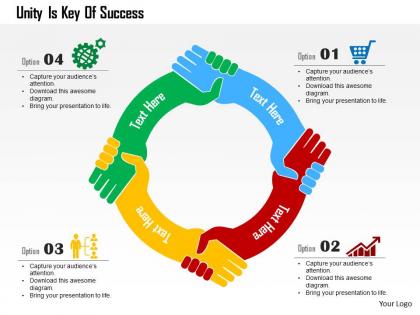
Share the importance of teamwork with our unity is key to success PowerPoint slide. In corporate industry, association is required not just to meet the desired targets but also to ensure the smooth functioning of the business process. This presentation graphic beautifully depicts the message of co-operation that you may show it your investors, business associates, colleagues or even clients. A success can be achieved if you have support of your team and this is what our PPT diagram talks about. Partnership makes the job easier as if every individual understand the importance of unity then that makes it a better place to work and develop. So make your viewers aware that collaboration is required in the business development using this PowerPoint slide. The presentation illustration is easily modifiable and this provides you an option to amend it as per your liking. Be the first one to get edge in this competitive world by downloading this engaging PPT design. Look around other designs as well to search the appropriate one. They will gift you the crown.
People who downloaded this PowerPoint presentation also viewed the following :
Unity is key of success flat powerpoint design with all 5 slides:
Acquire the ability to cope with our Unity Is Key Of Success Flat Powerpoint Design. Get the courage to face any challenge.


FAQs for Unity is key of success
**INPUT**: What are the key principles of unity in team dynamics? **OUTPUT**: Key principles of unity in team dynamics include shared vision alignment, transparent communication protocols, collaborative decision-making processes, mutual accountability frameworks, and consistent goal prioritization. These principles streamline organizational efficiency by eliminating silos, accelerating project timelines, and enhancing cross-functional cooperation, with many companies finding that unified teams deliver significantly higher performance outcomes and competitive advantage.
Unity enhances workplace collaboration by creating shared goals, fostering open communication, and building mutual trust among team members. When organizations prioritize unity through cross-functional projects and inclusive decision-making, teams streamline workflows, reduce conflicts, and accelerate project completion, with many companies finding that unified workplaces deliver significantly higher productivity and employee engagement.
Leaders foster unity among diverse teams through inclusive communication, shared goal-setting, cross-cultural collaboration initiatives, regular team-building activities, and celebrating different perspectives as strategic advantages. By implementing structured mentorship programs, creating diverse project teams, and establishing clear communication protocols, organizations enable stronger cohesion, enhanced innovation, and improved performance outcomes, with many finding that diversity becomes their greatest competitive asset.
Organizations can measure team unity effectiveness through employee engagement surveys, collaboration metrics, communication frequency analysis, cross-functional project success rates, and retention statistics. These assessment methods enable leaders to identify unity gaps, track improvement initiatives, and benchmark team cohesion, with many companies finding that regular unity measurement ultimately delivers stronger team performance and enhanced organizational resilience.
Common barriers to achieving unity in multicultural environments include communication differences, conflicting cultural values, unconscious biases, varying work styles, and differing conflict resolution approaches. These challenges present opportunities for organizations to implement strategic cultural training, inclusive leadership practices, and structured dialogue frameworks, with many global companies finding that addressing these barriers ultimately enhances collaboration and drives innovation.
Unity strengthens organizational resilience during crises by fostering collaborative problem-solving, maintaining clear communication channels, and ensuring coordinated response efforts across all departments. When teams work cohesively, organizations can adapt more quickly to challenges, allocate resources efficiently, and maintain operational continuity, with many companies finding that unified workforces recover faster and emerge stronger from disruptions.
Communication serves as the foundation for unity by facilitating transparent information sharing, building trust, resolving conflicts constructively, and ensuring everyone understands shared goals and expectations. Through regular team meetings, collaborative platforms, and open feedback channels, organizations enhance coordination, minimize misunderstandings, and create stronger interpersonal bonds, ultimately delivering improved productivity and workplace cohesion.
Conflict resolution strategies promote unity by establishing open communication channels, creating structured dialogue processes, and focusing on shared goals rather than individual differences. These approaches enable teams to address underlying tensions constructively, build mutual understanding, and develop collaborative problem-solving skills, ultimately transforming disagreements into opportunities for stronger group cohesion and trust.
Effective team-building activities include collaborative problem-solving challenges, cross-departmental project rotations, structured peer mentoring programs, team volunteering initiatives, and regular informal social gatherings. These approaches strengthen unity by fostering trust, improving communication, and breaking down silos, with many organizations finding that consistent team-building investment ultimately delivers enhanced collaboration and measurable productivity gains.
Unity in virtual teams centers on establishing shared purpose, consistent communication protocols, collaborative digital workflows, and inclusive team culture across geographical boundaries. Through strategic video conferencing, project management platforms, and regular virtual touchpoints, remote organizations streamline coordination, enhance productivity, and maintain strong team cohesion, ultimately delivering improved employee engagement and competitive operational efficiency.
Unity drives innovation and creativity by fostering psychological safety, encouraging diverse perspective sharing, building trust for risk-taking, and creating collaborative problem-solving environments where team members freely contribute ideas. This cohesive foundation enables teams to experiment with breakthrough solutions, accelerate product development cycles, and deliver competitive advantages, with many organizations finding that unified teams consistently outperform fragmented ones in creative output.
Psychological factors influencing team unity include shared purpose, mutual trust, psychological safety, collective identity, and positive interdependence among members. These elements work together by fostering open communication, reducing conflict, and building emotional connections, with many organizations finding that teams demonstrating these factors achieve higher performance, better collaboration, and ultimately stronger competitive advantage.
Visual presentation tools enhance unity expression through consistent templates, unified color schemes, standardized formatting, shared visual elements, and collaborative design features. These tools enable project teams to create cohesive presentations that reflect collective insights, maintain brand consistency across deliverables, and streamline communication workflows, with many organizations finding that unified visual approaches significantly improve stakeholder engagement and project outcomes.
Historical examples of unity driving social change include the Civil Rights Movement, India's independence struggle, women's suffrage campaigns, labor union formations, and anti-apartheid resistance movements. These movements demonstrate how collective action, shared vision, and sustained coordination can overcome systemic barriers, ultimately delivering transformative policy changes, expanded rights, and lasting institutional reforms that continue shaping modern democratic societies.
Unity significantly influences leadership approaches through collaborative decision-making, inclusive communication strategies, shared accountability structures, and consensus-building techniques. These leadership adaptations enhance team cohesion, organizational alignment, and strategic execution, with many executives finding that unity-focused approaches deliver improved employee engagement, faster implementation of initiatives, and stronger competitive positioning in increasingly complex business environments.
-
Bravo!
-
Enough space for editing and adding your own content.
-
Informative design.