


Us banking structure ppt powerpoint presentation file information





Try Before you Buy Download Free Sample Product
 Impress Your
 Audience
 100%
100% Editable
 Save Hours
 of Time


Our Us Banking Structure Ppt Powerpoint Presentation File Information give close attention to each alternative. They allow you to assess your choices.
People who downloaded this PowerPoint presentation also viewed the following :
Us banking structure ppt powerpoint presentation file information with all 5 slides:
Allow your individuality to emerge with our Us Banking Structure Ppt Powerpoint Presentation File Information. Customize the display to create an impact.




FAQs for Us banking structure ppt powerpoint
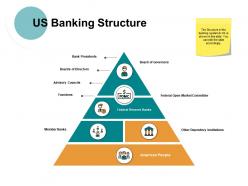
The US banking structure comprises commercial banks, investment banks, credit unions, savings institutions, and regulatory bodies like the Federal Reserve, FDIC, and OCC. These components interact through interconnected lending networks, regulatory oversight, and payment systems, with commercial banks serving retail customers while investment banks handle securities, ultimately delivering comprehensive financial services and systemic stability across the economy.
Commercial banks focus on traditional services like deposits, loans, and retail banking for consumers and businesses, while investment banks specialize in capital markets, underwriting securities, mergers and acquisitions, and trading activities. These distinct roles enable commercial banks to provide everyday financial services and credit access, while investment banks facilitate corporate financing and strategic transactions, ultimately delivering complementary functions that support both individual financial needs and broader economic growth across industries.
The Federal Reserve, FDIC, OCC, NCUA, and state banking regulators oversee US banking, with functions including monetary policy implementation, deposit insurance, bank charter supervision, credit union regulation, and compliance enforcement. These agencies work together to maintain financial stability, protect consumers, and ensure sound banking practices across commercial banks, credit unions, and state-chartered institutions, ultimately delivering systemic risk management and consumer confidence.
The Federal Reserve has fundamentally shaped US banking through regulatory oversight, monetary policy controls, stress testing requirements, and systematic risk management frameworks. By establishing capital requirements, conducting annual stress tests, and providing emergency lending facilities, the Fed has enhanced banking stability, reduced systemic risks, and maintained public confidence, while enabling banks to better weather economic downturns and support continued lending to businesses and consumers.
The Glass-Steagall Act's repeal in 1999 enabled modern banks to combine commercial and investment services, creating financial conglomerates but increasing systemic risk exposure. While this deregulation allows institutions like JPMorgan Chase and Bank of America to offer comprehensive services, streamline operations, and enhance competitive positioning, it also presents regulatory challenges and concentration concerns that shape today's banking landscape.
Technology and digital banking have revolutionized US banking structure by enabling online-only institutions, reducing physical branch networks, and streamlining operations through automation and AI-driven services. Traditional banks now compete with fintech startups offering faster loan approvals, mobile-first experiences, and lower operational costs, ultimately delivering enhanced customer convenience while forcing established institutions to accelerate their digital transformation strategies.
Concentration risks include systemic vulnerabilities during financial crises, reduced market competition, moral hazard from "too big to fail" status, limited credit diversity, and regulatory challenges. While large institutions deliver operational efficiencies and comprehensive services, this concentration can amplify economic shocks across the financial system, with many economists finding that excessive consolidation ultimately constrains innovation and increases taxpayer bailout exposure.
Regional banks strengthen local economies by providing personalized lending to small businesses, financing community development projects, and maintaining deep relationships with local entrepreneurs and municipalities. These institutions typically reinvest deposits within their markets, supporting everything from agricultural ventures to retail expansion, while delivering faster decision-making and specialized knowledge that large national banks often cannot match.
Credit unions differ from traditional banks through their nonprofit, member-owned cooperative structure, typically offering higher savings rates, lower loan rates, and reduced fees compared to profit-driven banks. While banks focus on shareholder returns, credit unions prioritize member benefits through personalized service and community-focused lending, with many members finding enhanced financial outcomes and stronger local connections.
The US banking structure addresses financial inclusion through community development financial institutions, credit unions, mobile banking platforms, and regulatory initiatives like the Community Reinvestment Act. These mechanisms streamline access by reducing barriers, enhancing digital services, and incentivizing lending in underserved areas, with many institutions finding that targeted outreach ultimately delivers broader customer bases and sustainable growth.
The 2008 financial crisis significantly reshaped US banking through consolidation, stricter regulations, and enhanced oversight mechanisms. Many smaller institutions were absorbed by larger banks, while new frameworks like Dodd-Frank introduced capital requirements, stress testing, and consumer protections, ultimately delivering a more resilient system with stronger risk management capabilities.
Banking charters significantly affect operations through regulatory oversight, geographic reach, and compliance requirements, with national charters offering broader operational flexibility and state charters providing localized advantages. National banks operate under federal regulations with multi-state capabilities, while state-chartered banks navigate varying state laws, ultimately delivering different competitive advantages depending on their strategic market focus and growth objectives.
Foreign banks contribute significantly to the US banking landscape through representative offices, branches, subsidiaries, and agency operations, providing specialized services like trade finance, corporate lending, and international transactions. These institutions enhance competition and innovation in commercial banking, with many European and Asian banks finding that their US presence enables better service to multinational clients while accessing America's capital markets.
Capital requirements and stress testing enhance US banking system stability by ensuring banks maintain adequate financial buffers, undergo rigorous scenario planning, and demonstrate resilience against economic shocks. Through these regulatory frameworks, financial institutions can better absorb losses, maintain lending capacity during downturns, and protect depositor funds, ultimately delivering greater systemic stability and public confidence.
Globalization is driving US banks toward digital transformation, strategic international partnerships, enhanced regulatory compliance, and specialized fintech integrations. These trends enable banks to streamline cross-border transactions, accelerate international services, and deliver seamless customer experiences, with many financial institutions finding that global connectivity ultimately enhances competitive positioning and operational efficiency.
No Reviews