


Various Billing Software Comparison Chart Strategic Guide To Develop Customer Billing System




Try Before you Buy Download Free Sample Product
 Impress Your
 Audience
 100%
100% Editable
 Save Hours
 of Time


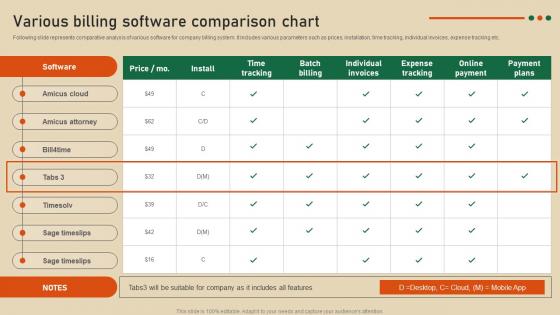
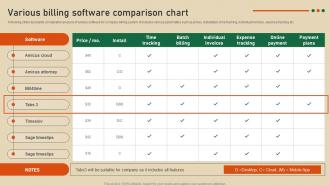
Following slide represents comparative analysis of various software for company billing system. It includes various parameters such as prices, installation, time tracking, individual invoices, expense tracking etc.
People who downloaded this PowerPoint presentation also viewed the following :
Various Billing Software Comparison Chart Strategic Guide To Develop Customer Billing System with all 6 slides:
Use our Various Billing Software Comparison Chart Strategic Guide To Develop Customer Billing System to effectively help you save your valuable time. They are readymade to fit into any presentation structure.





FAQs for Various Billing Software Comparison Chart Strategic Guide To Develop
Key billing features include automated invoicing, payment processing, tax calculations, recurring billing management, and comprehensive reporting dashboards. These capabilities streamline financial operations by reducing manual errors, accelerating payment cycles, and enhancing cash flow visibility, with many businesses finding that integrated solutions ultimately deliver improved efficiency and better customer payment experiences.
Integration with existing accounting systems significantly impacts billing software selection by determining data synchronization capabilities, workflow continuity, and implementation complexity. Seamless integration streamlines financial processes, reduces manual data entry, and ensures accurate reporting across platforms, with many organizations finding that compatible systems deliver faster month-end closes and enhanced operational efficiency.
Cloud-based billing solutions offer remote accessibility, automatic updates, lower upfront costs, and scalable infrastructure, while on-premise systems provide greater data control, customization options, and security oversight. Many organizations find that cloud solutions streamline operations through seamless integration and reduced IT maintenance, though enterprises with complex compliance requirements often prefer on-premise deployments for enhanced governance.
User interfaces differ across billing software platforms through dashboard complexity, customization options, mobile accessibility, integration capabilities, and workflow automation features. While enterprise solutions like SAP offer comprehensive but complex interfaces, smaller platforms like FreshBooks prioritize simplicity and intuitive navigation, with many businesses finding that streamlined interfaces ultimately enhance user adoption and operational efficiency.
Common billing software pricing models include per-user monthly subscriptions, transaction-based fees, tiered feature packages, flat monthly rates, and usage-based billing. These models significantly impact total costs through scalability requirements, feature accessibility, and transaction volumes, with many organizations finding that hybrid approaches often deliver better cost predictability while accommodating growth patterns.
Reporting and analytics capabilities vary significantly across billing software, ranging from basic invoice tracking and payment summaries to advanced predictive analytics, customizable dashboards, and real-time financial insights. While entry-level solutions offer standard reports, enterprise platforms deliver sophisticated data visualization, automated forecasting, and integration analytics, with many financial services and subscription businesses finding that advanced reporting capabilities streamline decision-making and enhance operational efficiency.
Essential security features include end-to-end encryption, multi-factor authentication, role-based access controls, automated data backups, and PCI DSS compliance for payment processing. These safeguards streamline operations by protecting sensitive financial data, preventing unauthorized access, and ensuring regulatory compliance, with many financial services and healthcare organizations finding that robust security ultimately delivers customer trust and competitive advantage.
Customer support proves critical when selecting billing software, as billing issues directly impact cash flow, customer relationships, and operational continuity. Responsive support becomes essential during invoice disputes, integration challenges, or system downtime, with many businesses finding that inadequate support can result in delayed payments, frustrated customers, and costly operational disruptions that outweigh initial software savings.
Automation features streamline invoice generation, payment processing, recurring billing cycles, and financial reporting within modern billing solutions. These capabilities enhance operational efficiency by reducing manual data entry, minimizing human errors, and accelerating payment collection processes, with many businesses finding that automated billing ultimately delivers faster cash flow and significantly lower administrative costs.
Mobile accessibility in billing systems varies significantly through native apps, responsive web interfaces, offline capabilities, and real-time synchronization features. While basic systems offer limited mobile invoice viewing, advanced platforms enable comprehensive mobile invoicing, payment processing, and customer management, with cloud-based solutions delivering seamless cross-device functionality and enhanced user experiences.
Industries with complex billing requirements benefit most from specialized software, including telecommunications, healthcare, SaaS companies, utilities, legal services, and subscription-based businesses. These sectors leverage automated invoicing, recurring billing management, and compliance tracking to streamline operations, reduce errors, and accelerate payment cycles, ultimately delivering improved cash flow and enhanced customer experiences.
Scalability considerations significantly influence billing software selection by determining transaction volume capacity, user expansion flexibility, feature adaptability, and integration capabilities with growing tech stacks. Growing businesses require solutions that seamlessly accommodate increased customer bases, multiple payment methods, and complex billing scenarios, while maintaining performance efficiency and cost-effectiveness, ultimately delivering sustainable operational growth without requiring frequent system migrations.
Billing software with multi-currency support enables global operations by automatically converting currencies, managing exchange rate fluctuations, and ensuring compliance with international accounting standards. These systems streamline international transactions for businesses expanding globally, with e-commerce companies and multinational corporations finding that automated currency management reduces manual errors, accelerates payment processing, and ultimately delivers seamless customer experiences across diverse markets.
Compliance requirements significantly shape billing software features by mandating audit trails, tax calculation accuracy, data encryption, and regulatory reporting capabilities. Financial services and healthcare organizations particularly benefit from automated compliance monitoring, secure payment processing, and detailed transaction logging, ultimately streamlining regulatory adherence while reducing audit complexities and potential penalties.
**INPUT**: What user feedback mechanisms are commonly incorporated into billing software? **OUTPUT**: Billing software typically incorporates in-app feedback forms, customer satisfaction surveys, support ticket systems, live chat integration, and rating prompts after transactions or interactions. These mechanisms enable businesses to capture real-time insights about billing experiences, streamline issue resolution, and enhance customer relationships, with many organizations finding that proactive feedback collection significantly improves retention and reduces billing-related disputes. **Word count: 60 words**
-
Great designs, really helpful.
-
What an exhaustive collection of templates you guys have there in slideteam. Impressive!!!