


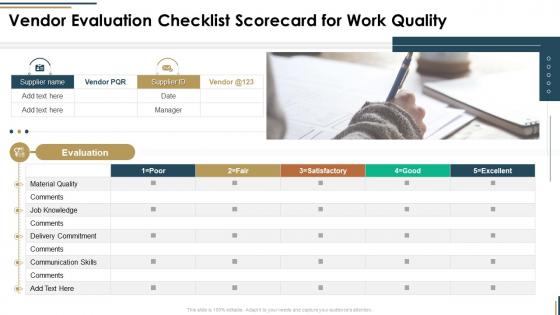
Vendor evaluation checklist scorecard for work quality vendor scorecard




Try Before you Buy Download Free Sample Product
 Impress Your
 Audience
 100%
100% Editable
 Save Hours
 of Time


Our Vendor Evaluation Checklist Scorecard For Work Quality Vendor Scorecard are topically designed to provide an attractive backdrop to any subject. Use them to look like a presentation pro.
People who downloaded this PowerPoint presentation also viewed the following :
Vendor evaluation checklist scorecard for work quality vendor scorecard with all 6 slides:
Use our Vendor Evaluation Checklist Scorecard For Work Quality Vendor Scorecard to effectively help you save your valuable time. They are readymade to fit into any presentation structure.





FAQs for Vendor evaluation checklist scorecard for work
When evaluating vendor reliability and trustworthiness, prioritize financial stability, track record with similar organizations, compliance certifications, references from current clients, and transparent communication practices. These criteria enable businesses to assess risk effectively, ensure consistent service delivery, and build strategic partnerships that support long-term operational goals and competitive advantage.
Assessing vendor financial stability involves reviewing audited financial statements, credit ratings, cash flow patterns, debt-to-equity ratios, and revenue consistency over multiple years. Through comprehensive due diligence, organizations evaluate payment histories, insurance coverage, and banking relationships, while many procurement teams increasingly use third-party financial assessment tools to minimize supply chain risks and ensure long-term partnership viability.
Understanding a vendor's regulatory compliance requires evaluating their certifications, audit reports, documentation practices, and ongoing monitoring systems. Through comprehensive due diligence including ISO certifications, SOC reports, and regulatory attestations, organizations can assess compliance frameworks across healthcare, financial services, and manufacturing sectors, ultimately ensuring partnership alignment with industry standards and minimizing regulatory risks.
Evaluate vendor scalability by assessing their infrastructure capacity, technology architecture, resource allocation flexibility, performance under increased demand, and integration capabilities with your existing systems. Consider vendors serving similar-sized organizations in your industry, examining their client growth trajectories and support scaling, while ensuring their solutions can accommodate your projected expansion without compromising service quality or requiring complete system overhauls.
Customer feedback plays a crucial role in vendor evaluation by providing real-world insights into service quality, reliability, and responsiveness that traditional metrics often miss. Through customer reviews, satisfaction surveys, and reference checks, organizations can assess vendor performance across multiple touchpoints, ultimately reducing risk and ensuring strategic partnerships that enhance customer experiences and operational efficiency.
Assessing vendor quality involves evaluating product specifications, service reliability, customer references, compliance certifications, and performance metrics against your requirements. Through pilot programs, demos, and reference calls with existing clients, organizations can verify capabilities, measure responsiveness, and assess long-term partnership potential, ultimately ensuring vendors deliver consistent value and strategic alignment.
When evaluating vendor customer support, consider response time commitments, availability of multiple communication channels, technical expertise of support staff, escalation procedures, and service level agreements. These factors determine how quickly issues get resolved, with many organizations finding that vendors offering 24/7 support, dedicated account managers, and proactive monitoring ultimately deliver better operational continuity and reduced downtime costs.
A vendor's technological infrastructure is critically important, serving as the foundation for reliability, scalability, security, and integration capabilities. Organizations should evaluate server capacity, data backup systems, cybersecurity protocols, API compatibility, and disaster recovery plans, as robust infrastructure directly impacts service continuity, operational efficiency, and long-term partnership success in an increasingly digital business environment.
Verifying vendor performance involves requesting detailed case studies with quantifiable results, contacting previous client references directly, reviewing third-party certifications, and examining public testimonials or industry awards. Many organizations also conduct pilot projects or proof-of-concept trials to validate claims firsthand, ultimately ensuring vendor capabilities align with specific business requirements and deliver measurable outcomes.
Determining vendor value compatibility involves assessing their communication styles, ethical practices, customer service approaches, and collaborative methodologies through reference checks, pilot projects, and cultural interviews. Organizations in healthcare, financial services, and manufacturing increasingly evaluate vendors' transparency, responsiveness, and problem-solving philosophies, finding that aligned values streamline partnerships and deliver more effective long-term outcomes.
Effective vendor pricing comparison involves evaluating total cost of ownership, contract flexibility, scalability options, hidden fees, and value-added services alongside base rates. This comprehensive approach enables organizations to identify strategic partnerships rather than just lowest bidders, with many procurement teams finding that mid-range vendors often deliver superior long-term value and operational efficiency.
Evaluating a vendor's track record involves reviewing their project completion rates, client testimonials, case studies, reference checks with previous customers, and documented delivery timelines across similar engagements. Request specific examples from comparable projects, analyze their performance metrics and quality standards, while assessing their communication processes and risk management approaches, ultimately ensuring they consistently deliver results that align with your operational requirements and strategic objectives.
Innovation serves as a critical differentiator when evaluating vendors, encompassing their R&D investment, technology roadmap, adaptability to market changes, and ability to deliver future-ready solutions. Forward-thinking vendors demonstrate consistent product evolution, integration capabilities with emerging technologies, and proactive enhancement of their offerings, ultimately enabling organizations to maintain competitive advantage and operational efficiency in an increasingly dynamic business landscape.
Vendor geographical location significantly impacts decision-making through factors like time zone alignment, communication efficiency, regulatory compliance, and logistics costs. While remote collaboration technologies minimize distance barriers, proximity often enhances partnership quality, enables faster issue resolution, and reduces operational complexities, with many organizations finding that strategic location selection ultimately delivers improved service levels and stronger vendor relationships.
Ensuring vendor alignment with long-term business goals involves conducting strategic assessments of their growth trajectory, technological roadmap, financial stability, and cultural compatibility with your organization's values. Through comprehensive due diligence, businesses evaluate vendor scalability, innovation capacity, and partnership flexibility, with many organizations finding that aligned vendors ultimately deliver sustained competitive advantage and seamless operational integration.
-
Understandable and informative presentation.
-
The content is very helpful from business point of view.