


Vendor Risk Management And Audit Checklist Increasing Supply Chain Value




Try Before you Buy Download Free Sample Product
 Impress Your
 Audience
 100%
100% Editable
 Save Hours
 of Time


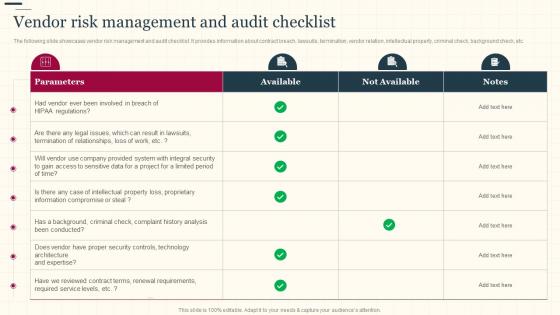
The following slide showcases vendor risk management and audit checklist. It provides information about contract breach, lawsuits, termination, vendor relation, intellectual property, criminal check, background check, etc.
People who downloaded this PowerPoint presentation also viewed the following :
Vendor Risk Management And Audit Checklist Increasing Supply Chain Value with all 6 slides:
Use our Vendor Risk Management And Audit Checklist Increasing Supply Chain Value to effectively help you save your valuable time. They are readymade to fit into any presentation structure.





FAQs for Vendor Risk Management And Audit Checklist Increasing
Effective vendor risk management programs include comprehensive vendor assessment, continuous monitoring, contractual risk controls, incident response protocols, and regular performance reviews. These components work together by establishing clear risk thresholds, automating compliance tracking, and ensuring swift remediation, with many organizations finding that integrated approaches significantly reduce third-party vulnerabilities while enhancing operational efficiency.
Organizations assess vendor financial stability through comprehensive financial statement analysis, credit score evaluations, cash flow assessments, debt-to-equity ratios, and third-party financial ratings. These evaluations enable companies to identify potential supply chain disruptions, negotiate better contract terms, and maintain operational continuity, with many finding that regular financial monitoring ultimately delivers reduced business risk and stronger vendor partnerships.
Technology revolutionizes vendor risk assessments through automated data collection, real-time monitoring, AI-powered risk scoring, centralized dashboards, and predictive analytics. These digital solutions enable organizations to continuously evaluate vendor performance, identify potential vulnerabilities faster, and make data-driven decisions, with many financial institutions and healthcare providers finding significantly reduced assessment times and enhanced accuracy.
Regulatory compliance requirements significantly reshape vendor risk management strategies by mandating enhanced due diligence processes, continuous monitoring protocols, and comprehensive documentation standards across all third-party relationships. Organizations must implement stricter vendor assessment frameworks, regular compliance audits, and detailed reporting mechanisms, with financial services and healthcare sectors finding that proactive compliance integration ultimately delivers reduced regulatory penalties and stronger operational resilience.
Common third-party vendor risks include data breaches, compliance violations, operational disruptions, reputational damage, and financial instability. These vulnerabilities can significantly impact organizations through exposed sensitive information, regulatory penalties, and supply chain interruptions, with many companies finding that comprehensive vendor assessments and continuous monitoring ultimately deliver enhanced security and operational resilience.
Organizations implement continuous monitoring through automated risk assessment platforms, real-time performance dashboards, regular compliance audits, vendor scorecards, and integrated communication systems. These technologies streamline oversight by tracking key performance indicators, flagging potential issues, and maintaining compliance documentation, with many financial services and healthcare institutions finding that proactive monitoring reduces operational disruptions while enhancing vendor relationships.
When selecting vendors for high-risk projects, organizations should evaluate financial stability, regulatory compliance history, security certifications, technical expertise, and proven track record in similar engagements. Through comprehensive due diligence, companies can assess vendor resilience, data protection capabilities, and operational continuity plans, with many financial services and healthcare institutions finding that rigorous vendor vetting significantly reduces project failures and compliance exposures.
Organizations balance cost savings with risk exposure by implementing comprehensive vendor assessment frameworks, diversifying supplier portfolios, and establishing clear risk thresholds for different vendor categories. Through strategic risk-cost modeling, companies can identify optimal vendor combinations that deliver competitive pricing while maintaining acceptable risk levels, with many financial institutions and healthcare organizations finding that investing in thorough due diligence ultimately reduces long-term operational costs and regulatory exposure.
Vendor risk management practices vary significantly across industries based on regulatory requirements, operational dependencies, and risk tolerance levels. Healthcare organizations prioritize HIPAA compliance and patient data protection, while financial institutions focus on fraud prevention and regulatory oversight, and manufacturing companies emphasize supply chain continuity and quality assurance, with each sector developing specialized frameworks that address their unique vulnerabilities and compliance obligations.
Companies effectively communicate vendor risk management policies through comprehensive training programs, regular stakeholder briefings, detailed documentation portals, and structured reporting dashboards that provide real-time risk visibility. These approaches streamline transparency by establishing clear escalation protocols, conducting quarterly review sessions, and implementing automated alerts, with many organizations finding that consistent multi-channel communication ultimately enhances stakeholder confidence and regulatory compliance.
When a vendor fails security compliance, organizations should immediately assess the risk severity, suspend data access if necessary, and initiate formal remediation protocols with specific timelines. This typically involves conducting thorough security audits, requiring corrective action plans, and implementing enhanced monitoring, with many companies finding that clear escalation procedures and alternative vendor preparation ultimately strengthen their overall supply chain resilience.
Organizations leverage data analytics to enhance vendor risk assessment through predictive modeling, real-time monitoring, automated scoring systems, and comprehensive risk dashboards. These analytical tools streamline vendor evaluation by identifying potential financial instabilities, compliance gaps, and performance patterns, with many financial institutions and healthcare organizations finding that data-driven assessments deliver faster decision-making and significantly improved risk visibility.
Vendor due diligence best practices include financial stability assessments, security audits, regulatory compliance verification, reference checks, and operational capability evaluations. These comprehensive reviews enable organizations to identify potential risks early, establish clear performance benchmarks, and ensure strategic alignment, with many companies finding that thorough upfront assessment significantly reduces long-term vendor-related disruptions and costs.
Vendor risk management integrates with enterprise risk management frameworks by aligning supplier assessments with organizational risk appetite, establishing consistent risk reporting protocols, and incorporating third-party risks into strategic decision-making processes. Through centralized risk dashboards and standardized evaluation criteria, organizations streamline oversight across all vendor relationships while maintaining comprehensive visibility into potential operational, financial, and compliance exposures.
Emerging trends in vendor risk management include real-time monitoring technologies, AI-powered risk assessment tools, enhanced third-party cybersecurity protocols, regulatory compliance automation, and integrated ESG evaluation frameworks. These technologies streamline vendor oversight by automating compliance tracking, accelerating risk identification, and delivering continuous performance insights, with many organizations finding that proactive monitoring significantly reduces operational vulnerabilities while enhancing strategic partnerships.
-
Thanks for all your great templates they have saved me lots of time and accelerate my presentations. Great product, keep them up!
-
I didn’t expect such a good service for the money I am paying. But, they exceed my expectations. Great work SlideTeam.