


Venture capital pitch deck ppt template





Try Before you Buy Download Free Sample Product
 Impress Your
 Audience
 100%
100% Editable
 Save Hours
 of Time


Here is a professionally designed pitch deck on Venture Capital that will benefit the company seeking funding of several million dollars. The structure covered by the deck starts from the title page, where the company can address the investors about its tagline and contact information. The title slide is followed by problem and solution slides a company can use them to highlight the pain points and solutions proposed to overcome them. Value Proposition slide will help the company highlight the unique features of its product. Market validation and traction slide will help the company illustrate audience segments and monthly growth information. The company can provide a market overview covering TAM SAM and SOM with a market size slide. The competition slide will help the investors identify the companys features compared to its competitors. The company can address the potential investors business model, growth, and critical members through slides, namely business model, growth strategy, and team. Finally, the company can tell its investors how much funding they have raised and spent, the budget they seek through slides, namely the use of funds and what we need. Get access now.
People who downloaded this PowerPoint presentation also viewed the following :
Content of this Powerpoint Presentation
Slide 1: This slide introduces Venture Capital Pitch Deck. State Your Company Name and begin.
Slide 2: This slide shows Table of Contents for Venture Capital Pitch Deck.
Slide 3: This slide presents Contact Details with address, contact numbers and email address.
Slide 4: This slide displays information about the pain points faced by customers.
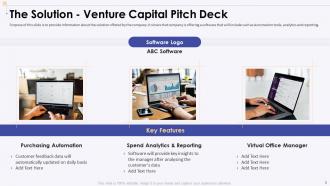
Slide 5: This slide displays information about the solution offered by the company such as Automation tools, analytics and reporting.
Slide 6: This slide address the potential investors about the product along with major benefits.
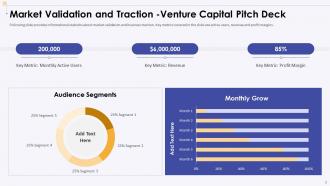
Slide 7: This slide shows Market Validation and Traction -Venture Capital Pitch Deck.
Slide 8: This slide presents the market overview of the company covering details of TAM SAM and SOM.
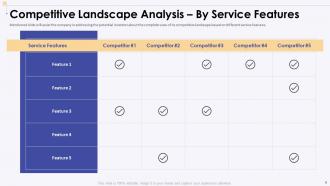
Slide 9: This slide will assist the company in addressing the potential investors about the complete view of its competitive landscape.
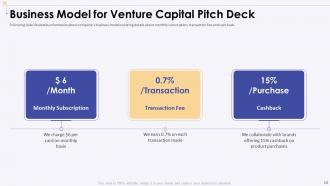
Slide 10: This slide displays information about company�s business model covering details about monthly subscription, transaction fee and cash back.
Slide 11: This slide portrays the activities that company will perform in order to grow its business.
Slide 12: This slide shows Our Management Team and Advisors - Venture Capital Pitch Deck.
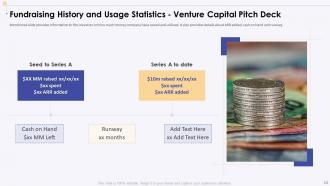
Slide 13: This slide presents Fundraising History and Usage Statistics - Venture Capital Pitch Deck.
Slide 14: This slide provide information to the investors on how much money company is seeking for and how long it will last.
Slide 15: This slide shows Venture Capital Pitch Deck for Icons.
Slide 16: This slide is titled as Additional Slides for moving forward.
Slide 17: This is About Us slide to show company specifications etc.
Slide 18: This is Our Mission slide with related imagery and text.
Slide 19: This is Our Team slide with names and designation.
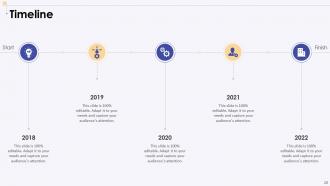
Slide 20: This is a Timeline slide. Show data related to time intervals here.
Slide 21: This slide shows Post It Notes. Post your important notes here.
Slide 22: This slide presents Pie Chart with data in percentage.
Slide 23: This slide displays Clustered Column chart with two products comparison.
Slide 24: This is Our Goal slide. State your firm's goals here.
Slide 25: This slide shows Roadmap with additional textboxes.
Slide 26: This slide shows Puzzle with related icons and text.
Slide 27: This is a Thank You slide with address, contact numbers and email address.
Venture capital pitch deck ppt template with all 27 slides:
Use our Venture Capital Pitch Deck Ppt Template to effectively help you save your valuable time. They are readymade to fit into any presentation structure.




















FAQs for Venture capital pitch
A successful venture capital pitch deck should include problem identification, solution overview, market size analysis, business model clarity, competitive landscape assessment, financial projections, team credentials, and funding requirements. These elements work together by demonstrating market opportunity, execution capability, and scalability potential, with many investors finding that compelling storytelling combined with data-driven insights ultimately delivers the strategic conviction needed for investment decisions.
Storytelling transforms pitch decks by weaving the startup's mission, market opportunity, and solution into a compelling narrative that resonates emotionally with investors while demonstrating clear business logic. Effective storytelling presents the problem as a relatable challenge, positions the startup as the hero with a unique solution, and illustrates the journey toward market success, ultimately delivering memorable presentations that secure funding and strategic partnerships.
The ideal venture capital pitch deck presentation typically runs 10-15 slides and lasts 10-20 minutes, covering essential elements like problem, solution, market opportunity, business model, and financial projections. This strategic length enables entrepreneurs to maintain investor attention while delivering comprehensive information, with many successful startups finding that concise, focused presentations enhance credibility and facilitate meaningful discussions about funding opportunities.
Founders can demonstrate market validation through customer testimonials, pre-orders, pilot program results, revenue traction, and strategic partnerships with established companies. These validation methods showcase real market demand by highlighting paying customers, successful beta tests, and measurable growth metrics, with many investors finding that tangible proof points significantly strengthen funding prospects and competitive positioning.
Key financial metrics include revenue growth rates, gross margins, customer acquisition costs, lifetime value ratios, and burn rate projections. These metrics demonstrate business viability by showcasing scalability potential, operational efficiency, and capital requirements, with many venture capitalists finding that clear unit economics and pathway to profitability ultimately differentiate compelling investment opportunities.
Design and visual appeal significantly enhance a pitch deck's effectiveness by improving information clarity, maintaining investor attention, and demonstrating professionalism and attention to detail. A well-designed deck streamlines complex financial data, reinforces brand credibility, and creates memorable impressions, with many venture capitalists finding that polished presentations reflect the founding team's execution capabilities and strategic thinking.
The team slide establishes investor confidence by showcasing relevant experience, complementary skills, domain expertise, track record of execution, and advisory support. Through highlighting previous successes, industry knowledge, and strategic partnerships, founders demonstrate their capability to navigate challenges, scale operations, and deliver returns, with many investors viewing team quality as the primary determinant of investment decisions.
Startups effectively address potential risks by acknowledging them proactively, presenting detailed mitigation strategies, demonstrating thorough market research, and showcasing experienced team capabilities to handle challenges. This transparent approach builds investor confidence through realistic planning, with many venture capitalists finding that startups addressing risks upfront appear more credible and investment-ready than those avoiding difficult questions.
Entrepreneurs should avoid overcomplicated slides, unrealistic financial projections, weak market analysis, unclear value propositions, and neglecting competitive landscapes. These presentation missteps often derail funding conversations by undermining credibility, with many venture capitalists finding that streamlined decks focusing on scalable business models, validated market opportunities, and experienced teams ultimately deliver stronger investor engagement and higher success rates.
Startups should prioritize clear, accessible language while strategically incorporating technical details that demonstrate expertise and differentiation. Successful presentations use simple analogies, visual demonstrations, and progressive disclosure, with many venture-backed companies finding that leading with business impact, then supporting with selective technical depth, resonates most effectively with diverse investor audiences.
Clear and concise messaging in a pitch deck enables investors to quickly grasp your value proposition, market opportunity, and competitive advantages without confusion or information overload. This strategic communication approach streamlines decision-making processes, enhances credibility with potential funders, and ultimately delivers higher engagement rates, with many startups finding that focused messaging significantly increases their chances of securing funding rounds.
Competitors should be positioned through comprehensive market mapping that highlights differentiation factors, competitive advantages, and unique value propositions rather than dismissing rival offerings. Strategic positioning involves showcasing barriers to entry, proprietary technology, superior business models, and market timing advantages, while demonstrating clear understanding of the competitive landscape and articulating why your solution delivers superior customer outcomes.
**INPUT**: What visual aids or graphics are most effective for illustrating growth potential in a pitch deck? **OUTPUT**: Effective growth visuals include hockey stick revenue charts, market size comparisons, user acquisition funnels, competitive positioning matrices, and milestone timelines. These graphics streamline complex projections by showcasing scalable business models, addressable market opportunities, and traction metrics, with many venture capital firms finding that clear visual storytelling accelerates investment decisions and enhances credibility. **Word count: 55 words**
Startups should customize their pitch deck by emphasizing growth metrics and scalability for VCs, profitability and market validation for angel investors, and strategic partnerships for corporate investors. Through targeted messaging, early-stage companies can highlight relevant traction data, financial projections, and competitive advantages that resonate with each investor's priorities, ultimately increasing their chances of securing funding.
Venture capitalists typically ask about market size validation, revenue model sustainability, competitive differentiation strategies, customer acquisition costs, and team execution capabilities. These questions help investors assess scalability potential and risk factors, with many VCs focusing on traction metrics, funding utilization plans, and exit strategy timelines, ultimately determining investment viability and strategic fit.
-
Design layout is very impressive.
-
Informative presentations that are easily editable.
-
Presentation Design is very nice, good work with the content as well.