


View legal research cycle chart ppt infographic template




Try Before you Buy Download Free Sample Product
 Impress Your
 Audience
 100%
100% Editable
 Save Hours
 of Time


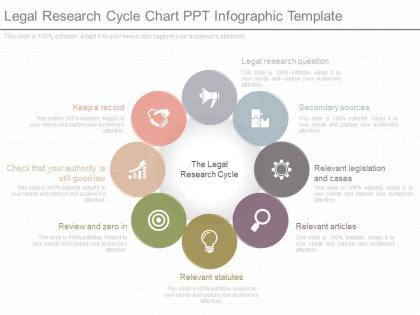
Confront contradictions with our View Legal Research Cycle Chart Ppt Infographic Template. Discover answers that are clear and correct.
People who downloaded this PowerPoint presentation also viewed the following :
View legal research cycle chart ppt infographic template with all 7 slides:
Let us know the message you are trying to convey and we'll make sure we make use of our View Legal Research Cycle Chart Ppt Infographic Template to bring that out. These are easily editable as per your preference.






FAQs for View legal research cycle chart
The legal research cycle includes problem identification, preliminary research, source analysis, legal authority evaluation, and synthesis of findings. These stages streamline case preparation by establishing factual frameworks, identifying relevant precedents, and analyzing statutory requirements, with law firms finding that systematic approaches ultimately deliver more comprehensive arguments and stronger client outcomes.
Primary legal sources include statutes, case law, regulations, and constitutional provisions that carry binding legal authority, while secondary sources encompass legal encyclopedias, law review articles, and practice guides that interpret and analyze primary law. In the research process, legal professionals typically begin with secondary sources to understand context and identify relevant primary authorities, then rely on primary sources for binding precedent and authoritative legal standards, ultimately delivering comprehensive legal analysis.
Essential legal research tools include legal databases like Westlaw and LexisNexis, case law repositories, statutory databases, secondary sources like legal encyclopedias, and citation analysis tools. These resources streamline research workflows by providing comprehensive case access, advanced search capabilities, and cross-referencing functions, with many law firms finding that integrated platforms significantly reduce research time while enhancing accuracy and thoroughness.
Legal researchers can stay updated through legal databases like Westlaw and LexisNexis, bar association publications, court websites, legal news services, and specialized journals. These resources enable systematic monitoring of legislative changes, recent court decisions, and regulatory updates, while many law firms and legal departments increasingly find that automated alert systems streamline tracking processes, ultimately delivering more comprehensive research and competitive advantage.
Understanding jurisdiction guides the entire legal research cycle by determining which laws, courts, and precedents apply to specific cases, ensuring researchers focus on relevant authorities and avoid irrelevant materials. This foundational knowledge streamlines research efficiency, prevents costly errors in case strategy, and enables legal professionals to build stronger arguments, with many law firms finding that proper jurisdictional analysis ultimately delivers faster case resolution and better client outcomes.
Legal researchers ensure source reliability through systematic verification methods including cross-referencing multiple authoritative databases, checking publication dates and jurisdictional relevance, and validating citations through primary legal sources. These verification processes streamline accuracy by confirming case precedents, statute authenticity, and regulatory updates, with many law firms and legal departments finding that rigorous source validation ultimately delivers enhanced case preparation and stronger legal arguments.
Legal research strategies for developing focused questions include defining the legal issue precisely, identifying key facts and parties, determining applicable jurisdiction, narrowing the scope through preliminary research, and formulating specific rather than broad inquiries. These approaches streamline research by eliminating irrelevant materials, targeting appropriate databases and sources, and establishing clear parameters, with many legal professionals finding that well-defined questions significantly reduce research time while enhancing accuracy.
Legal professionals can effectively organize research findings through systematic categorization by legal issues, chronological case timelines, jurisdiction hierarchies, and relevance rankings to specific arguments. Digital tools like legal databases, citation management software, and structured templates enable attorneys to synthesize complex information, cross-reference precedents, and build compelling case narratives, ultimately delivering stronger legal strategies and more efficient client representation.
Legal researchers must consider client confidentiality, avoiding conflicts of interest, maintaining research accuracy and completeness, respecting intellectual property rights, and ensuring unbiased analysis regardless of desired outcomes. These ethical foundations enhance professional credibility while delivering reliable insights, with many law firms finding that rigorous ethical standards ultimately strengthen client relationships and competitive positioning.
Artificial intelligence streamlines the legal research cycle by automating case law searches, analyzing vast document repositories, and identifying relevant precedents through natural language processing. These technologies enable law firms to reduce research time from hours to minutes, enhance accuracy in legal analysis, and deliver faster client services, with many practices finding that AI-powered tools ultimately provide significant competitive advantages in an increasingly efficient legal landscape.
Collaboration enhances legal research through shared expertise, diverse perspectives, workload distribution, and collective knowledge validation, enabling comprehensive case analysis and strategic insight development. Legal teams leverage collaborative platforms, peer review processes, and cross-functional partnerships with paralegals and subject matter experts, ultimately delivering more thorough research outcomes while streamlining efficiency and reducing individual attorney workloads.
Common legal research pitfalls include relying on outdated sources, insufficient keyword variety, ignoring jurisdiction-specific laws, neglecting primary sources, and failing to verify case law currency. These oversights compromise research accuracy by missing critical precedents, misinterpreting statutory changes, and overlooking procedural requirements, with many law firms finding that systematic verification processes ultimately deliver more reliable outcomes and stronger case preparations.
Legal writing differs from other forms of writing by requiring comprehensive statutory analysis, extensive case law review, and strict adherence to legal citation formats and precedential authority. Unlike general research writing, legal research demands meticulous fact verification, regulatory compliance analysis, and consideration of jurisdictional variations, with law firms and corporate legal departments finding that thorough legal research ultimately delivers more persuasive arguments and better client outcomes.
Citation management streamlines legal research by ensuring accuracy, maintaining credibility, and enabling efficient case building through systematic organization of sources, precedents, and statutory references. It enhances legal professionals' ability to construct compelling arguments, verify authority chains, and meet court requirements, while significantly reducing research time and minimizing citation errors that could undermine case strength.
Legal researchers can assess impact by tracking citation frequency in judicial decisions, monitoring policy changes influenced by their work, and measuring adoption rates in legal practice. Through collaboration with practitioners, researchers observe how findings shape case strategies, inform legislative reforms, and influence court rulings, while many law firms and legal institutions increasingly integrate academic insights into client advisement and litigation approaches.
-
Informative presentations that are easily editable.
-
Excellent design and quick turnaround.