


Vision mission and value statement powerpoint presentation slides





Try Before you Buy Download Free Sample Product
 Impress Your
 Audience
 100%
100% Editable
 Save Hours
 of Time


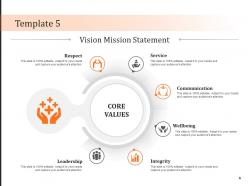
Introducing this Vision Mission And Value Statement PowerPoint Presentation Slides for making your task easy. State your vision, mission, and objectives in an attractive yet informative manner with the help of this business plan PPT slideshow. Use these company overview PPT templates to display the core values of your business clearly and concisely. Mention the value statements of your firm like mutual respect, service, effective communication, integrity, and leadership by taking the aid of this business summary PPT presentation. These well-color-coded company information PPT layouts are well-equipped to showcase your business profile in an accessible and comprehensive way. Gain the trust of your audience, potential clients, investors, and consumers by communicating your organizational goals and aims in a well-structured format with these business development PPT slides. Download our vision and mission powerpoint presentation and create a winning presentation that will grab the attention of your viewers. Additional slides offered at the end help you incorporate suitable icons, images, charts, and graphs into your presentation.
People who downloaded this PowerPoint presentation also viewed the following :
Vision mission and value statement powerpoint presentation slides with all 20 slides:
Use our Vision Mission And Value Statement Powerpoint Presentation Slides to effectively help you save your valuable time. They are readymade to fit into any presentation structure.




FAQs for Vision mission and value statement
Effective vision statement slides should include a clear, inspiring future-focused declaration, compelling visual elements that reinforce the message, supporting imagery or graphics that represent organizational aspirations, and concise language that resonates with stakeholders. These components work together to create emotional connection and strategic alignment, with many organizations finding that well-designed vision slides significantly enhance employee engagement and investor confidence.
A mission statement slide inspires stakeholders through clear, compelling language that connects purpose to tangible outcomes, strategic visual hierarchy, and authentic messaging that resonates with diverse audiences. By incorporating specific examples of organizational impact, stakeholder benefits, and future aspirations, companies create emotional connection while demonstrating measurable value, ultimately driving engagement and alignment across teams, investors, and customers.
Vision mission value statement slides should follow principles of visual hierarchy through clear headings and consistent typography, minimal text with concise statements, strategic white space, and brand-aligned color schemes. These design elements streamline communication by enhancing readability, focusing attention on key messages, and creating memorable presentations, with many organizations finding that well-designed slides significantly improve stakeholder engagement and message retention.
Vision statements focus on future aspirations and long-term goals, while mission statements define current purpose, core activities, and immediate objectives that guide daily operations. In presentation slides, vision statements typically use forward-looking language emphasizing growth and transformation, whereas mission statements employ present-tense descriptions of services, values, and stakeholder impact, with many organizations finding that visual distinction through different colors, icons, and positioning enhances audience comprehension.
Core values serve as the foundational principles that define organizational identity, shaping decision-making processes, employee behavior, company culture, and stakeholder relationships. These values should be presented visually through clean, memorable graphics with consistent typography, meaningful icons, and strategic color schemes that reinforce brand identity, while ensuring they're prominently displayed across presentations, ultimately delivering authentic organizational messaging and competitive differentiation.
Storytelling techniques enhance vision, mission, and value statements by creating emotional connections, making abstract concepts relatable, and transforming corporate messaging into memorable narratives that resonate with audiences. Through compelling anecdotes, real-world examples, and character-driven scenarios, organizations streamline communication, increase audience engagement, and ultimately deliver stronger organizational alignment, with many companies finding that narrative-driven presentations significantly improve employee buy-in and stakeholder understanding.
Common mistakes include overcrowding slides with excessive text, using generic corporate jargon instead of authentic language, creating statements that lack measurable specificity, and failing to align visual design with organizational brand identity. These missteps often result in presentations that fail to inspire stakeholders, with many organizations finding that clear, concise messaging paired with compelling visuals delivers greater employee engagement and strategic clarity.
Infographics effectively represent mission and values through visual storytelling elements like icons, flowcharts, timelines, and data visualizations that simplify complex organizational concepts. These visual tools enhance audience engagement by transforming abstract values into memorable graphics, with many companies finding that infographic-driven slides increase message retention and create stronger emotional connections during stakeholder presentations.
Aligning vision statements with organizational goals creates strategic coherence, ensures resource allocation efficiency, and drives unified decision-making across all departments and initiatives. This alignment can be illustrated through pyramid diagrams showing vision at the apex cascading to strategic objectives, timeline roadmaps connecting long-term vision to quarterly milestones, and matrix frameworks demonstrating how departmental goals directly support the overarching vision, ultimately delivering measurable progress and competitive advantage.
Audience feedback can be incorporated through post-presentation surveys, focus group discussions, stakeholder interviews, and real-time polling during presentations to assess clarity and resonance. Organizations refine their vision mission value statement slides by analyzing this feedback for language effectiveness, visual impact, and alignment with audience expectations, with many companies finding that iterative refinement based on stakeholder input significantly enhances message clarity and organizational buy-in.
Color psychology significantly influences how audiences perceive vision and mission statements by evoking specific emotions and associations, with blue conveying trust and stability, green suggesting growth and sustainability, and red implying energy and urgency. Strategic color choices enhance message credibility and memorability, with many organizations finding that aligned color palettes strengthen brand perception and audience engagement, ultimately delivering more impactful presentations.
**INPUT**: What are best practices for ensuring consistency in language and tone across vision, mission, and value slides? **OUTPUT**: Best practices include establishing a unified voice guide, using consistent terminology throughout, maintaining parallel sentence structures, aligning emotional tone, and ensuring coherent messaging hierarchy. Organizations streamline this process by creating style templates, conducting cross-team reviews, and testing language resonance with stakeholders, ultimately delivering cohesive brand narratives that enhance organizational alignment and stakeholder engagement. [Word count: 55 words]
Case studies and examples can be integrated through dedicated slides showcasing real-world applications, customer success stories, quantifiable achievements, and industry-specific implementations that demonstrate the vision in action. These supporting elements enhance credibility by providing tangible proof points, while helping stakeholders visualize practical outcomes and strategic alignment, ultimately strengthening buy-in and demonstrating measurable progress toward organizational goals.
Templates for vision mission value statements offer faster deployment, professional design consistency, proven layouts, and cost-effective implementation, while custom slides provide unique branding and tailored messaging. While templates streamline the creation process and ensure visual coherence across organizations, custom approaches enable distinctive positioning, with many companies finding that strategic template customization delivers both efficiency and brand authenticity.
Visuals like icons and diagrams enhance core values understanding by creating immediate recognition, simplifying complex concepts, and making abstract principles more memorable and emotionally resonant. These visual elements enable audiences to quickly grasp organizational identity, with many companies finding that strategic visual representation increases stakeholder engagement and reinforces cultural messaging across all communication channels.
-
Very unique and reliable designs.
-
Designs have enough space to add content.
-
The Designed Graphic are very professional and classic.
-
Awesome presentation, really professional and easy to edit.