


Dashboard For Tracking Impact Of Warehouse House Automation Implementing Warehouse Automation




Try Before you Buy Download Free Sample Product
 Impress Your
 Audience
 100%
100% Editable
 Save Hours
 of Time


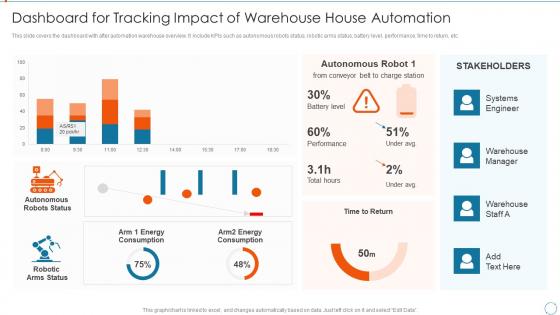
This slide covers the dashboard with after automation warehouse overview. It include KPIs such as autonomous robots status, robotic arms status, battery level, performance, time to return, etc.
People who downloaded this PowerPoint presentation also viewed the following :
Dashboard For Tracking Impact Of Warehouse House Automation Implementing Warehouse Automation with all 7 slides:
Use our Dashboard For Tracking Impact Of Warehouse House Automation Implementing Warehouse Automation to effectively help you save your valuable time. They are readymade to fit into any presentation structure.





FAQs for Dashboard For Tracking Impact Of Warehouse House Automation
Key components of an effective warehouse automation dashboard include real-time inventory tracking, automated picking and sorting systems, predictive maintenance alerts, performance analytics, and integration capabilities with existing ERP systems. These technologies streamline operations by reducing manual errors, optimizing resource allocation, and enhancing visibility across warehouse processes, with many logistics companies finding that comprehensive dashboards ultimately deliver faster fulfillment times and significantly improved operational efficiency.
Real-time data integration enhances warehouse decision-making by providing instant visibility into inventory levels, order status, equipment performance, and workforce productivity across all operational touchpoints. This immediate access enables managers to quickly address bottlenecks, optimize resource allocation, and respond to demand fluctuations, with many distribution centers finding that real-time insights reduce operational costs while improving customer satisfaction.
**INPUT**: What metrics should be prioritized on a warehouse automation dashboard for optimal performance tracking? **OUTPUT**: Priority warehouse automation dashboard metrics include inventory accuracy, order fulfillment speed, equipment utilization rates, error frequencies, and labor productivity ratios. These metrics enable operations managers to streamline workflows, minimize bottlenecks, and enhance overall efficiency, with many distribution centers finding that real-time visibility ultimately delivers faster customer service and significant cost reductions. **Word count: 54 words**
A warehouse automation dashboard improves inventory management accuracy through real-time tracking, automated data collection, predictive analytics, barcode scanning integration, and exception reporting capabilities. These systems streamline operations by minimizing human error, enabling instant stock visibility, and providing automated alerts for discrepancies, with many distribution centers finding that accurate inventory data ultimately delivers faster fulfillment and enhanced customer satisfaction.
User interfaces in warehouse automation dashboards significantly impact employee efficiency by providing intuitive navigation, real-time data visualization, and streamlined task management capabilities. Well-designed interfaces enable workers to quickly access critical information, reduce training time, and minimize errors in inventory tracking, with many logistics companies finding that user-friendly dashboards increase productivity by 25-40% while enhancing overall operational accuracy.
Visual analytics transform complex warehouse data into intuitive charts, graphs, heatmaps, and real-time metrics that enable managers to quickly identify bottlenecks, track performance trends, and optimize operations. Through interactive dashboards, warehouses can monitor inventory flows, equipment efficiency, and labor productivity at a glance, ultimately delivering faster decision-making and enhanced operational visibility across distribution centers.
Predictive analytics on warehouse dashboards reduces operational costs by forecasting demand patterns, optimizing inventory levels, and preventing equipment breakdowns before they occur. Through machine learning algorithms, warehouses can minimize overstocking, reduce labor inefficiencies, and schedule proactive maintenance, with many logistics companies finding that predictive insights deliver 15-25% cost reductions while enhancing operational efficiency.
Organizations face challenges including system integration complexities, employee resistance to new technologies, substantial upfront costs, and data migration hurdles when implementing warehouse automation dashboards. While these obstacles require strategic planning and change management, companies across retail, manufacturing, and logistics increasingly find that proper implementation delivers streamlined operations, enhanced visibility, and significant competitive advantages.
Alerts and notifications enable proactive warehouse management by providing real-time visibility into inventory levels, equipment status, order processing delays, and performance deviations before they become critical issues. Through automated monitoring systems, warehouse managers can address potential stockouts, equipment maintenance needs, and bottlenecks immediately, ultimately reducing downtime and maintaining optimal operational efficiency.
Mobile accessibility significantly enhances warehouse automation dashboard effectiveness by enabling real-time monitoring, remote troubleshooting, and instant decision-making from anywhere in the facility. This mobility empowers supervisors and technicians to respond immediately to alerts, adjust workflows on-the-go, and maintain operational continuity, ultimately delivering faster issue resolution and improved warehouse efficiency.
Customization options enable dashboards to display role-specific metrics and controls, with managers viewing overall KPIs and strategic analytics, while floor supervisors focus on operational metrics, inventory levels, and workforce allocation. This targeted approach streamlines decision-making by presenting relevant data to each role, ultimately enhancing operational efficiency and reducing information overload across warehouse teams.
Best practices for designing warehouse automation dashboards include prioritizing real-time visibility, ensuring mobile compatibility, implementing role-based access controls, and maintaining intuitive navigation with customizable widgets. These dashboards streamline operations by centralizing inventory tracking, equipment monitoring, and performance analytics, with many logistics companies finding that well-designed interfaces reduce decision-making time while enhancing operational efficiency and warehouse productivity.
Integration with robotic systems enhances warehouse dashboards by providing real-time robot performance monitoring, automated task coordination, and predictive maintenance alerts. Through seamless connectivity, warehouse managers can track robotic picking accuracy, optimize automated workflows, and reduce operational bottlenecks, while enabling data-driven decisions that ultimately streamline fulfillment processes and minimize costly downtime.
Data accuracy methods include real-time sensor integration, automated data validation protocols, regular system calibrations, cross-verification checkpoints, and standardized data entry procedures. Through IoT sensors and machine learning algorithms, warehouses can detect discrepancies immediately, minimize human error, and maintain inventory precision, with many logistics companies finding that automated verification systems reduce data inconsistencies by up to 90%.
Employee training significantly influences dashboard effectiveness by ensuring staff understand data interpretation, system navigation, alert prioritization, and performance metrics analysis. Comprehensive training programs enable warehouse teams to leverage real-time insights for decision-making, troubleshoot issues proactively, and optimize operational workflows, with many organizations finding that well-trained employees achieve faster implementation and sustained productivity gains.
-
The information is visually stunning and easy to understand, making it perfect for any business person. So I would highly recommend you purchase this PPT design now!
-
My team has been relying on SlideTeam’s professional PPT designs for a while now. It has greatly sped up quality work at my organization. So thanks!