


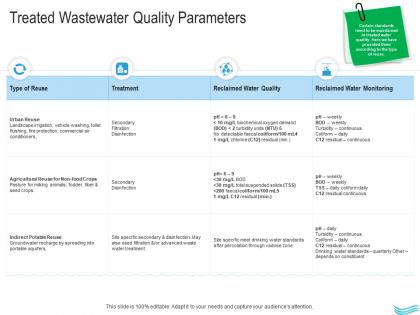
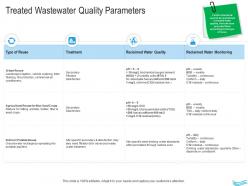
Water management treated wastewater quality parameters ppt slides




Try Before you Buy Download Free Sample Product
 Impress Your
 Audience
 100%
100% Editable
 Save Hours
 of Time


Our Water Management Treated Wastewater Quality Parameters Ppt Slides are topically designed to provide an attractive backdrop to any subject. Use them to look like a presentation pro.
People who downloaded this PowerPoint presentation also viewed the following :
Water management treated wastewater quality parameters ppt slides with all 2 slides:
Use our Water Management Treated Wastewater Quality Parameters Ppt Slides to effectively help you save your valuable time. They are readymade to fit into any presentation structure.
FAQs for Water management treated wastewater quality
Key water management challenges today include aging infrastructure requiring costly upgrades, increasing demand from growing populations, climate change creating unpredictable supply patterns, regulatory compliance complexities, and limited financial resources for system improvements. These interconnected issues present both operational and strategic hurdles, with many municipalities and industries finding that proactive planning, technology integration, and sustainable practices ultimately deliver enhanced resilience and long-term cost efficiency.
Technology improves urban water conservation through smart meters, leak detection sensors, automated irrigation systems, greywater recycling, and real-time monitoring platforms. These solutions streamline resource management by reducing waste, optimizing distribution, and enabling predictive maintenance, with many municipalities finding that integrated systems deliver up to 30% water savings while enhancing operational efficiency.
Governmental policies establish regulatory frameworks, allocate water rights, set quality standards, fund infrastructure projects, and coordinate multi-stakeholder collaboration for sustainable water management. These policies enable municipalities and industries to streamline conservation efforts, enhance distribution efficiency, and ensure equitable access, with many regions finding that strategic policy integration ultimately delivers improved resource security and environmental sustainability.
Climate change significantly impacts water availability through altered precipitation patterns, increased droughts, extreme weather events, and changing seasonal water flows. These challenges drive organizations to adopt advanced water management practices including smart irrigation systems, rainwater harvesting, and real-time monitoring technologies, with municipalities and agricultural sectors finding that proactive adaptation strategies ultimately deliver enhanced resilience and operational efficiency.
Best practices for residential rainwater harvesting include installing gutters with leaf guards, positioning first-flush diverters, using food-grade storage tanks, implementing proper filtration systems, and ensuring adequate overflow management. These systems streamline water conservation by reducing utility costs, supplementing irrigation needs, and decreasing stormwater runoff, with many homeowners finding that strategic placement and regular maintenance ultimately delivers significant savings and environmental benefits.
Industries can reduce their water footprint through recycling systems, efficient cooling technologies, precision irrigation, closed-loop processes, and smart monitoring sensors that optimize usage in real-time. Manufacturing plants, textile facilities, and food processors increasingly adopt these approaches, finding that strategic water management delivers cost savings, regulatory compliance, and enhanced operational efficiency while maintaining full productivity levels.
IWRM benefits include enhanced water security, improved ecosystem sustainability, reduced conflicts between users, optimized resource allocation, and strengthened climate resilience. This comprehensive approach enables municipalities, agricultural sectors, and industrial facilities to streamline operations, minimize waste, and deliver cost-effective services, while ultimately creating competitive advantages in increasingly water-stressed environments.
Communities can engage in sustainable water management through rainwater harvesting, greywater recycling, watershed restoration, community gardens with drought-resistant plants, and local water conservation education programs. These initiatives streamline resource allocation while reducing municipal costs, with many neighborhoods finding that collaborative approaches like shared cisterns and native landscaping ultimately deliver enhanced water security and stronger community resilience in increasingly water-stressed environments.
Water quality monitoring ensures urban water systems meet safety standards through continuous testing of chemical, biological, and physical parameters, while identifying contamination sources and regulatory compliance needs. This systematic approach enables cities to prevent waterborne diseases, optimize treatment processes, and maintain public health standards, with municipalities like Singapore and Amsterdam finding that real-time monitoring delivers cost savings and enhanced service reliability.
Agriculture can adapt through precision irrigation systems, drought-resistant crop varieties, soil moisture monitoring, water recycling technologies, and smart scheduling systems. These approaches streamline water usage by reducing waste, optimizing timing, and enhancing crop yields per gallon used, with many farms finding that strategic water management delivers significant cost savings while maintaining productivity in increasingly water-scarce environments.
**INPUT**: What strategies can be implemented to address water scarcity in developing regions? **OUTPUT**: Effective water scarcity strategies include rainwater harvesting, groundwater management, desalination technologies, water recycling systems, and infrastructure development for storage and distribution. These approaches enhance resource efficiency by maximizing collection, minimizing waste, and improving access, with many developing regions finding that strategic combinations deliver sustainable water security, reduced costs, and improved community resilience. [Word count: 54 words]
Public-private partnerships enhance water management infrastructure by combining government regulatory authority with private sector innovation, financing capabilities, and operational efficiency. Through these strategic collaborations, municipalities can accelerate infrastructure modernization, reduce public debt burdens, and leverage advanced technologies, with many water utilities finding that partnerships deliver improved service reliability, enhanced system performance, and sustainable long-term operations.
Over-extraction of groundwater creates land subsidence, wetland depletion, reduced stream flows, and declining biodiversity as ecosystems lose their water foundation. While these challenges present significant environmental costs, they increasingly drive organizations toward sustainable water management strategies, with municipalities, agricultural operations, and industrial facilities finding that conservation technologies and monitoring systems deliver both ecological protection and long-term operational resilience.
Behavioral changes significantly enhance water management by reducing consumption through shorter showers, fixing leaks promptly, and adopting water-efficient appliances and landscaping practices. These individual actions collectively streamline municipal water systems, minimize treatment costs, and extend resource availability, with many communities finding that consumer education and conservation incentives ultimately deliver measurable reductions in overall demand while enhancing long-term sustainability.
Innovative wastewater treatment solutions include membrane bioreactors, advanced oxidation processes, constructed wetlands, algae-based systems, and smart sensor networks for real-time monitoring. These technologies streamline operations by removing contaminants more effectively, reducing energy consumption, and enabling water reuse, with municipalities and industries finding that strategic implementation delivers significant cost savings and environmental benefits.
-
Topic best represented with attractive design.
-
Unique research projects to present in meeting.
-
Awesome use of colors and designs in product templates.
-
Qualitative and comprehensive slides.
-
Good research work and creative work done on every template.