


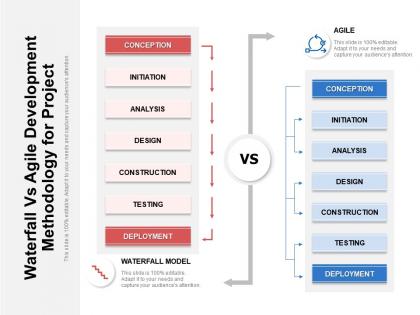
Waterfall vs agile development methodology for project




Try Before you Buy Download Free Sample Product
 Impress Your
 Audience
 100%
100% Editable
 Save Hours
 of Time


Our Waterfall Vs Agile Development Methodology For Project are explicit and effective. They combine clarity and concise expression.
People who downloaded this PowerPoint presentation also viewed the following :
Waterfall vs agile development methodology for project with all 2 slides:
Give your audience a fulfilling experience. They will find our Waterfall Vs Agile Development Methodology For Project elevating.
FAQs for Waterfall vs agile development
Waterfall follows a sequential, linear approach with distinct phases completed before progression, while Agile emphasizes iterative development, continuous feedback, and adaptive planning throughout the project lifecycle. These methodologies deliver different outcomes, with Waterfall providing structured documentation and predictable timelines, and Agile enabling faster responses to changing requirements, ultimately allowing organizations to choose based on project complexity and stakeholder needs.
Waterfall model proves most beneficial in projects with fixed requirements, strict regulatory compliance needs, clear timelines, and minimal expected changes throughout development. Industries like aerospace, healthcare device manufacturing, and government contracting often find Waterfall delivers better predictability, comprehensive documentation, and structured oversight, while Agile's flexibility becomes less valuable when requirements are static and regulatory approval processes demand detailed upfront planning.
Waterfall typically limits customer involvement to initial requirements gathering and final delivery phases, while Agile emphasizes continuous customer collaboration throughout development cycles. Through regular sprints, demos, and feedback sessions, Agile enables organizations to adapt quickly to changing requirements, reduce project risks, and ultimately deliver products that better align with customer needs and market demands.
Common challenges include resistance to cultural change, difficulty adapting to iterative planning, struggles with cross-functional collaboration, and adjusting to faster feedback cycles. Many organizations find that teams initially struggle with reduced documentation, increased customer interaction, and shorter sprint cycles, while ultimately discovering that proper training, gradual implementation, and strong leadership support streamline the transition significantly.
Waterfall follows sequential, fixed timelines with predetermined milestones marking complete phase deliverables, while Agile uses iterative sprints with flexible milestones that adapt based on stakeholder feedback and changing requirements. Through shorter development cycles, Agile enables faster course corrections, continuous delivery, and reduced project risk, ultimately delivering more responsive solutions in increasingly dynamic business environments.
Documentation serves as the foundational backbone in Waterfall development, with comprehensive requirements, design specifications, and user manuals created upfront before development begins. While Agile emphasizes working software over extensive documentation, it maintains essential records through user stories and sprint reviews, enabling teams to adapt quickly while preserving institutional knowledge and regulatory compliance.
Waterfall teams measure success through milestone completion, deliverable quality, adherence to timeline, and budget compliance at project phases. Agile teams focus on working software delivery, customer satisfaction, team velocity, and sprint goal achievement through iterative cycles. While Waterfall emphasizes predictability and comprehensive documentation, Agile prioritizes adaptability and continuous value delivery, with many organizations finding that Agile metrics enable faster course correction and enhanced stakeholder engagement.
Waterfall employs comprehensive upfront risk assessment, detailed documentation, and sequential phase gates with formal review processes, while Agile uses iterative risk identification, continuous stakeholder feedback, and adaptive planning through short sprints. These methodologies enable organizations to minimize project failures through structured oversight or flexible responsiveness respectively, with many software development teams finding that hybrid approaches ultimately deliver both predictability and adaptability.
Waterfall employs formal communication through documented handoffs between sequential phases, while Agile emphasizes continuous collaboration through daily standups, sprint reviews, and cross-functional teamwork. In Agile environments, teams collaborate in real-time iterations with frequent feedback loops, whereas Waterfall teams communicate primarily at phase gates, with many organizations finding that Agile's collaborative approach delivers faster problem resolution and enhanced project adaptability.
Waterfall methodologies rely on comprehensive planning tools like Microsoft Project, Gantt charts, requirements management systems, and detailed documentation platforms, while Agile emphasizes collaborative technologies including Jira, Scrum boards, continuous integration tools, and real-time communication platforms. These distinct toolsets enable organizations to streamline project execution, enhance team coordination, and deliver faster development cycles, with many software companies finding that strategic tool selection ultimately drives operational efficiency and competitive advantage.
Agile sprints are short, iterative cycles typically lasting 1-4 weeks with continuous feedback and adaptability, while Waterfall phases are sequential, longer stages like requirements, design, development, and testing that must complete before advancing. Sprints enable teams to deliver working software incrementally and respond to changing requirements quickly, whereas Waterfall phases provide structured progression and comprehensive documentation, with many organizations finding that sprint-based approaches ultimately deliver faster time-to-market and enhanced customer satisfaction.
Change requests significantly disrupt Waterfall projects, often requiring extensive documentation, timeline extensions, and budget increases due to the methodology's sequential structure and rigid planning phases. In contrast, Agile environments accommodate changes through iterative sprints and continuous stakeholder feedback, enabling teams to pivot quickly while maintaining project momentum, ultimately delivering more adaptive solutions that better meet evolving business requirements.
Agile teams integrate feedback through daily standups, sprint reviews, iterative testing, and continuous stakeholder collaboration, enabling real-time adjustments throughout development cycles. Unlike Waterfall's end-stage feedback collection, this approach allows software teams to pivot quickly, reduce costly revisions, and deliver products that better align with user needs, ultimately enhancing customer satisfaction and competitive responsiveness.
Waterfall KPIs include schedule adherence, budget compliance, requirement completion rates, defect density, and milestone achievement percentages. Agile projects emphasize velocity tracking, sprint burndown rates, customer satisfaction scores, and team productivity metrics, with many organizations finding that Agile's iterative measurement approach delivers faster feedback cycles and enhanced adaptability compared to Waterfall's milestone-based assessments.
Agile projects typically achieve higher customer satisfaction levels than Waterfall through continuous feedback loops, iterative delivery, and adaptive planning that incorporates changing requirements. While Waterfall can deliver satisfaction when requirements are stable and well-defined, Agile's frequent demos, sprint reviews, and collaborative approach enable organizations to address concerns immediately, ultimately delivering products that better align with evolving customer expectations and market demands.
No Reviews