


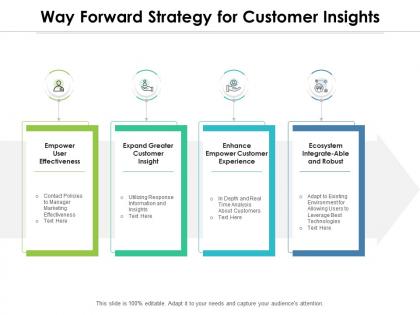
Way forward strategy for customer insights




Try Before you Buy Download Free Sample Product
 Impress Your
 Audience
 100%
100% Editable
 Save Hours
 of Time


Our Way Forward Strategy For Customer Insights are topically designed to provide an attractive backdrop to any subject. Use them to look like a presentation pro.
People who downloaded this PowerPoint presentation also viewed the following :
Way forward strategy for customer insights with all 2 slides:
Use our Way Forward Strategy For Customer Insights to effectively help you save your valuable time. They are readymade to fit into any presentation structure.
FAQs for Way forward strategy
**INPUT**: What are the key components of an effective customer insights strategy? **OUTPUT**: Effective customer insights strategies include data collection frameworks, analytics capabilities, customer journey mapping, feedback mechanisms, and cross-functional collaboration processes. These components work together by streamlining data interpretation, enhancing customer understanding, and enabling targeted decision-making, with many organizations finding that strategic integration ultimately delivers improved customer experiences and competitive advantage. [Word count: 55 words]
Businesses can leverage customer feedback through systematic data collection, sentiment analysis, feature prioritization, and iterative product development cycles. Companies like Amazon and Netflix excel at analyzing reviews, usage patterns, and direct feedback to refine their offerings, ultimately delivering enhanced user experiences and stronger market positioning.
**INPUT**: What tools and techniques are most effective for gathering customer insights? **OUTPUT**: Effective customer insights tools include surveys, social media analytics, customer interviews, behavioral tracking software, and focus groups. These techniques enhance understanding by capturing quantitative data, revealing sentiment patterns, and uncovering unmet needs, with many retail and financial services organizations finding that combining multiple methods delivers deeper customer intelligence and competitive advantage. [Word count: 53 words]
Customer demographics significantly influence insights strategies by determining segmentation approaches, communication preferences, purchasing behaviors, and channel selections that organizations prioritize in their research and analysis efforts. Different age groups, income levels, and geographic locations require tailored methodologies, with retail companies finding that millennials respond better to digital engagement strategies while traditional demographics prefer direct outreach, ultimately enabling more targeted and effective customer experiences.
Social media serves as a real-time feedback channel, sentiment tracker, and behavioral data source for comprehensive customer insights. These platforms enable businesses to monitor brand perception, identify emerging trends, and understand customer preferences through direct engagement and analytics, with many retail and hospitality companies finding that social listening delivers faster market intelligence and enhanced customer experiences.
Data analytics improves customer insight accuracy by processing vast datasets, identifying behavioral patterns, predicting future trends, and eliminating human bias through automated analysis. Through machine learning algorithms and real-time data processing, retail companies and financial institutions can segment customers more precisely, personalize offerings effectively, and anticipate market shifts, ultimately delivering enhanced customer experiences and competitive advantage.
Businesses maintain agile customer insights strategies by implementing real-time analytics, establishing cross-functional feedback loops, and regularly updating data collection methods. Through flexible technology platforms and iterative research approaches, organizations can quickly pivot based on emerging trends, seasonal changes, and market shifts, ultimately delivering more responsive customer experiences and maintaining competitive advantage.
Ethical considerations include obtaining explicit consent, ensuring data transparency, implementing robust security measures, respecting privacy boundaries, and providing clear opt-out mechanisms. These practices build customer trust by protecting personal information, maintaining regulatory compliance, and demonstrating corporate responsibility, with many organizations finding that ethical data handling ultimately delivers stronger customer relationships and competitive advantage.
Success in customer insights strategy is measured through key performance indicators like customer satisfaction scores, retention rates, revenue per customer, and time-to-insight delivery. These metrics enable organizations to track engagement improvements, operational efficiency gains, and strategic decision accuracy, with many companies finding that comprehensive measurement frameworks ultimately deliver enhanced customer experiences and competitive advantage.
Customer journey mapping significantly enhances insight generation by revealing pain points, emotional triggers, decision-making moments, and engagement gaps across touchpoints. Through systematic visualization of customer experiences, organizations identify optimization opportunities, personalization strategies, and service improvements, with retail and financial services companies finding that comprehensive mapping reduces customer acquisition costs while increasing satisfaction and loyalty rates.
Small businesses can implement customer insights strategies through free analytics tools, social media monitoring, customer surveys, email feedback campaigns, and direct customer conversations during interactions. These cost-effective approaches enable small businesses to gather valuable data about preferences, behaviors, and satisfaction levels, ultimately delivering improved customer experiences and competitive advantages without requiring significant financial investment.
Common pitfalls include relying on outdated data, focusing solely on demographics rather than behaviors, ignoring cross-departmental collaboration, and failing to establish clear measurement frameworks. Many organizations find that siloed approaches, inadequate sample sizes, and overlooking customer journey complexity ultimately undermine insights accuracy, while strategic integration across teams delivers more actionable intelligence and competitive advantage.
Qualitative research complements quantitative data by providing context, emotions, and motivations behind numerical patterns, revealing the "why" through interviews, focus groups, and observational studies. This strategic combination enables organizations to understand both what customers do and why they behave that way, ultimately delivering deeper insights for product development, marketing strategies, and enhanced customer experiences.
Employee input is crucial for customer insights as frontline staff directly interact with customers, observe behaviors firsthand, and understand pain points that surveys might miss. These team members provide real-time feedback on customer preferences, service gaps, and emerging trends, with many organizations finding that incorporating employee perspectives significantly enhances customer experience strategies and drives more targeted business improvements.
Customer insights drive innovation by revealing unmet needs, identifying market gaps, and highlighting pain points that spark new product development, service enhancements, and process improvements. Through data analytics and feedback analysis, organizations can prioritize R&D investments, streamline product launches, and create customer-centric solutions, with many companies finding that insights-driven innovation delivers faster time-to-market and stronger competitive advantage.
-
Attractive design and informative presentation.
-
Great designs, really helpful.
-
Illustrative design with editable content. Exceptional value for money. Highly pleased with the product.