


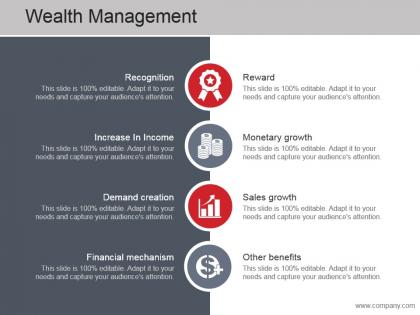
Wealth management ppt slide




Try Before you Buy Download Free Sample Product
 Impress Your
 Audience
 100%
100% Editable
 Save Hours
 of Time


Our Wealth Management Ppt Slide assure you alternatives galore. They allow you a lot of choice in any field.
People who downloaded this PowerPoint presentation also viewed the following :
Wealth management ppt slide with all 5 slides:
Heighten the chances of fostering agreement with our Wealth Management Ppt Slide. It will increase convergence.




FAQs for Wealth
Key components of an effective wealth management strategy include asset allocation, risk assessment, tax optimization, estate planning, and regular portfolio rebalancing. These elements work together by diversifying investments across multiple asset classes, minimizing tax liabilities, and adapting to changing market conditions, with many financial institutions finding that integrated approaches deliver superior long-term returns and enhanced client outcomes.
Risk tolerance assessment influences investment decisions by determining appropriate asset allocation, diversification strategies, and investment timeframes based on individual comfort levels with market volatility. Financial advisors and wealth management firms use these evaluations to construct personalized portfolios, balancing growth potential with acceptable risk levels, ultimately delivering investment strategies that align with client goals while minimizing emotional decision-making during market fluctuations.
Alternative investments include private equity, hedge funds, real estate, commodities, and infrastructure assets that help reduce portfolio volatility and enhance returns beyond traditional stocks and bonds. These assets enable wealth managers to deliver better risk-adjusted performance, access uncorrelated returns, and provide inflation protection, with many high-net-worth clients finding significantly improved portfolio resilience during market downturns.
Tax-efficient investing involves maximizing after-tax returns through strategic asset allocation, utilizing tax-advantaged accounts like 401(k)s and IRAs, and implementing tax-loss harvesting strategies. These approaches streamline wealth accumulation by minimizing tax liabilities, optimizing portfolio placement across account types, and timing capital gains strategically, with many high-net-worth individuals finding that coordinated tax planning ultimately enhances long-term wealth preservation and growth.
Working with a fiduciary wealth manager provides legally-mandated client-first advice, comprehensive financial planning, transparent fee structures, personalized investment strategies, and ongoing portfolio monitoring. This fiduciary obligation ensures your interests always take precedence over sales quotas or commissions, with many high-net-worth individuals finding that this approach delivers superior long-term returns and peace of mind.
Estate planning enhances long-term wealth preservation by minimizing tax liabilities, establishing strategic trusts, optimizing asset transfers, and implementing succession frameworks that protect generational wealth. Through comprehensive planning structures, families achieve significant tax advantages, seamless asset transitions, and legal protections, while ensuring wealth continuity across generations, ultimately delivering sustainable financial legacies and enhanced family prosperity.
**INPUT**: What specific financial tools or software can aid in wealth management? **OUTPUT**: Wealth management tools include portfolio management platforms, financial planning software, risk assessment applications, tax optimization systems, and client relationship management solutions. These technologies streamline operations by automating portfolio rebalancing, enhancing client reporting, and delivering comprehensive financial analytics, with many advisory firms finding that integrated platforms ultimately reduce operational costs while improving client experiences. [Word count: 56 words]
Wealth management strategies should be reviewed annually at minimum, with major life events like marriage, career changes, inheritance, or market volatility triggering immediate reassessments. Financial advisors increasingly recommend quarterly check-ins for high-net-worth clients, enabling portfolio rebalancing, tax optimization, and goal alignment adjustments that enhance long-term wealth preservation and growth outcomes.
Market volatility significantly influences long-term wealth management through portfolio rebalancing, risk tolerance reassessment, and strategic asset allocation adjustments. While short-term fluctuations can create uncertainty, experienced wealth managers leverage volatility for dollar-cost averaging and opportunistic investments, with many institutional portfolios finding that disciplined, diversified strategies ultimately deliver enhanced returns and sustained growth over extended periods.
Behavioral finance principles improve wealth management outcomes by addressing cognitive biases, emotional decision-making patterns, and psychological barriers that often lead to poor investment choices. Through systematic bias recognition, automated rebalancing systems, and structured decision frameworks, wealth managers help clients overcome loss aversion, overconfidence, and market timing mistakes, ultimately delivering more disciplined investment strategies and improved long-term returns.
Ethical considerations in wealth management include fiduciary responsibility, transparent fee structures, conflict of interest disclosure, suitable investment recommendations, and client confidentiality protection. These principles enhance trust and regulatory compliance by ensuring advisors prioritize client interests, provide clear cost breakdowns, and maintain professional integrity, with many financial institutions finding that ethical practices ultimately deliver stronger client relationships and sustainable business growth.
Financial literacy is crucial for effective wealth management, enabling informed investment decisions, risk assessment, and strategic asset allocation across portfolios. It empowers individuals to understand complex financial instruments, evaluate advisor recommendations, and navigate market volatility, with many high-net-worth clients finding that enhanced financial knowledge ultimately delivers better long-term returns and wealth preservation.
Digital transformation, AI-driven personalization, robo-advisors, blockchain technology, and mobile-first platforms are reshaping wealth management services. These innovations streamline portfolio management, enhance client experiences, and reduce operational costs, with many financial institutions finding that automated investment strategies, real-time analytics, and digital onboarding ultimately deliver faster decision-making and competitive advantage.
Sustainable investing integrates into wealth management through ESG screening, impact investing, thematic funds focused on clean energy or healthcare, and sustainable index funds aligned with client values. This approach enables portfolio diversification, risk mitigation through future-focused sectors, and enhanced long-term returns, with many financial advisors finding that sustainable strategies increasingly deliver competitive performance while meeting evolving client expectations.
Families can ensure multi-generational wealth transfer through strategic estate planning, establishing family trusts, implementing tax-efficient structures, creating comprehensive investment policies, and developing next-generation financial education programs. These approaches streamline wealth preservation by minimizing tax liabilities, protecting assets from market volatility, and preparing heirs with financial literacy skills, ultimately delivering sustained family prosperity across generations.
-
Use of icon with content is very relateable, informative and appealing.
-
It saves your time and decrease your efforts in half.