


Wearable Technology Fundraising Pitch Deck Ppt Template




Try Before you Buy Download Free Sample Product
 Impress Your
 Audience
 100%
100% Editable
 Save Hours
 of Time


Check out our professionally designed Wearable technology fundraising pitch deck that comprehensively analyzes market dynamics, market statistics, and global wearable technology sales. This Fitness Trackers PPT highlights the projections for the future, potential growth in the industry, and the vast opportunities in the wearable technology sector. Moreover, this Smartwatch Manufacturing Fundraising template provides an overview of wearable devices competitive advantage through a detailed competitor analysis. Also, the Smart Devices deck demonstrates customer reviews, reflecting valued customers satisfaction and positive experiences. Furthermore, the Biometric Sensors presentation presents future milestones and performance statistics, illustrating the companys dedication to continuous improvement and growth. Lastly, the Health monitoring PowerPoint also represents the funding required from the investor, the companys funding history, exit strategy, core team members, organizational structures, and the business canvas model of the company. Download our 100 percent editable and customizable template, also compatible with Google Slides.
People who downloaded this PowerPoint presentation also viewed the following :
Content of this Powerpoint Presentation
Slide 1: The slide represents Wearable Technology Fundraising Pitch Deck.
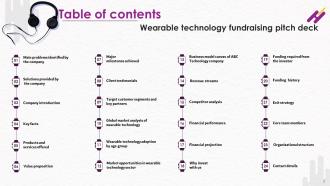
Slide 2: The slide displays Table of contents for presentation.
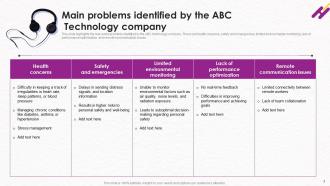
Slide 3: This slide highlights the real-world problems identified by the ABC technology company.
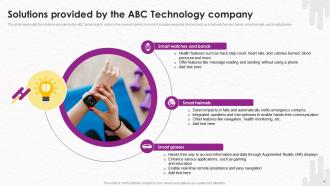
Slide 4: This slide demonstrates the solutions provided by the ABC technology to address the several market concerns.
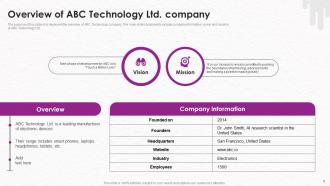
Slide 5: The purpose of this slide is to represent the overview of ABC Technology company.
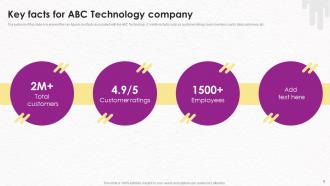
Slide 6: The purpose of this slide is to present the key figures and facts associated with the ABC Technology.
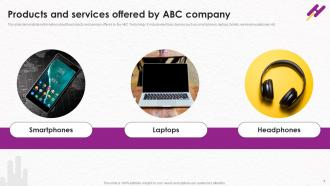
Slide 7: This slide demonstrates information about the products and services offered by the ABC Technology.
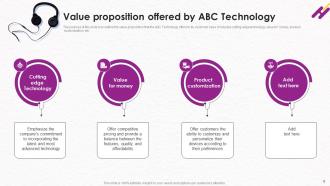
Slide 8: The purpose of this slide is to outline the value proposition that the ABC Technology offers to its customer base.
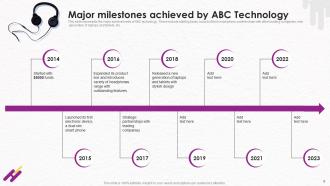
Slide 9: This slide renders the major achievements of ABC technology.
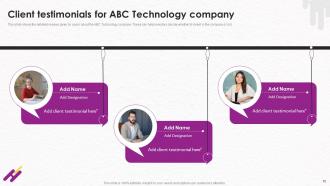
Slide 10: This slide shows the detailed reviews given by users about the ABC Technology company.
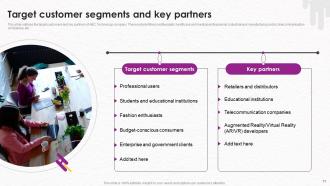
Slide 11: This slide outlines the target customers and key partners of ABC Technology company.
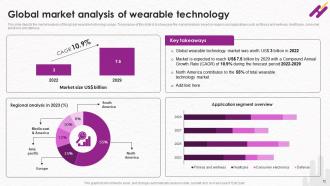
Slide 12: This slide depicts the market analysis of the global wearable technology usage.
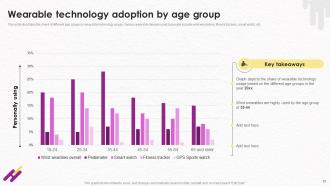
Slide 13: This slide illustrates the share of different age groups in wearable technology usage.
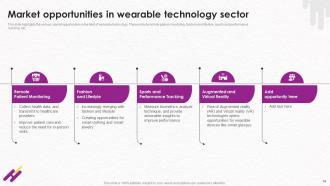
Slide 14: This slide shows the various market opportunities in the field of wearable technology.
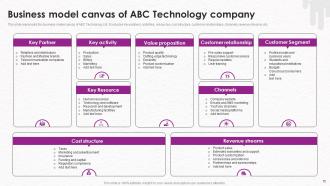
Slide 15: This slide represents the business model canvas of ABC Technology Ltd.
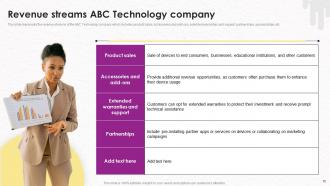
Slide 16: This slide highlights the revenue streams of the ABC Technology company.
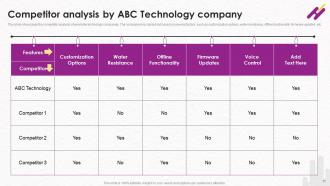
Slide 17: This slide showcases the competitor analysis of wearable technology companies.
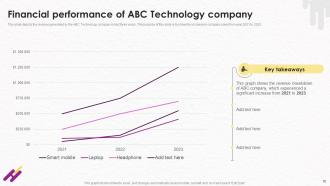
Slide 18: This slide depicts the revenue generated by the ABC Technology company in last three years.
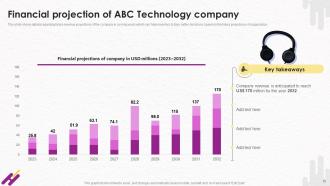
Slide 19: This slide shows details regarding future revenue projections of the company in coming years which can help investors to take better decisions.
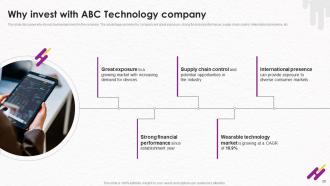
Slide 20: This slide discusses why should businesses invest in the company.
Slide 21: This slide shows the contact details for ABC Technology company.
Slide 22: This slide shows all the icons included in the presentation.
Slide 23: This slide is titled as Additional Slides for moving forward.
Slide 24: This is an Idea Generation slide to state a new idea or highlight information, specifications etc.
Slide 25: This is a Timeline slide. Show data related to time intervals here.
Slide 26: This is Our Target slide. State your targets here.
Slide 27: This slide showcases Magnifying Glass to highlight information, specifications etc
Slide 28: This slide provides 30 60 90 Days Plan with text boxes.
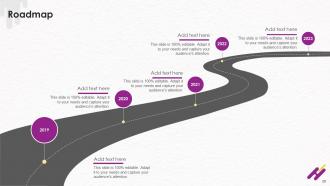
Slide 29: This slide presents Roadmap with additional textboxes.
Slide 30: This is a Thank You slide with address, contact numbers and email address.
Wearable Technology Fundraising Pitch Deck Ppt Template with all 38 slides:
Use our Wearable Technology Fundraising Pitch Deck Ppt Template to effectively help you save your valuable time. They are readymade to fit into any presentation structure.










FAQs for Wearable Technology Fundraising Pitch
The most significant advancements in wearable technology include smartwatches with health monitoring capabilities, fitness trackers with advanced biometric sensors, augmented reality glasses, smart clothing with embedded sensors, and continuous glucose monitors for medical applications. These innovations have revolutionized healthcare delivery, workplace productivity, and personal wellness management, with hospitals, fitness centers, and corporate wellness programs increasingly leveraging these technologies to enhance patient outcomes, employee health, and operational efficiency.
Wearable devices revolutionize personal health monitoring by continuously tracking vital signs, activity levels, sleep patterns, and biometric data, enabling real-time health insights and early detection of potential issues. Through seamless data collection and AI-powered analytics, these technologies empower individuals to make informed lifestyle decisions, improve chronic disease management, and enhance preventive care, ultimately delivering personalized healthcare experiences and reducing long-term medical costs.
Smartwatches are integrating advanced sensors for ECG monitoring, blood oxygen measurement, sleep tracking, stress detection, and blood glucose monitoring capabilities. These devices increasingly function as comprehensive health hubs, with many healthcare providers and fitness professionals finding that continuous biometric monitoring enables early health intervention, personalized wellness programs, and ultimately delivers more proactive patient care.
Wearable technology privacy concerns include data collection without explicit consent, unauthorized sharing with third parties, inadequate encryption protocols, location tracking vulnerabilities, and potential surveillance misuse. While these devices enhance health monitoring and operational efficiency, organizations implementing wearables increasingly find that transparent data policies and robust security measures ultimately deliver user trust and regulatory compliance advantages.
Wearable technology improves workplace productivity by monitoring employee health metrics, tracking activity levels, providing real-time feedback, and facilitating seamless communication through smart notifications. These devices enable organizations to reduce healthcare costs, minimize workplace injuries, and enhance employee engagement, with many companies in manufacturing and logistics finding that wellness programs ultimately deliver higher productivity and lower absenteeism rates.
Wearable technology revolutionizes sports performance by providing real-time biometric monitoring, movement analysis, fatigue assessment, injury prevention alerts, and personalized training insights. These devices enable athletes and coaches to optimize training regimens, reduce injury risks, and enhance competitive performance through data-driven decisions, with professional teams and fitness enthusiasts increasingly finding measurable improvements in outcomes.
User interfaces of wearable devices enhance experiences through intuitive touchscreens, voice commands, gesture controls, haptic feedback, and simplified navigation systems. These interfaces streamline interactions by minimizing cognitive load, providing instant access to critical information, and enabling hands-free operation, with healthcare professionals and fitness enthusiasts finding that seamless connectivity ultimately delivers greater engagement and operational efficiency.
Future wearable technology trends include advanced health monitoring with continuous glucose and blood pressure tracking, seamless smart clothing integration, enhanced AR/VR experiences, and sophisticated AI-powered personal assistants. These innovations streamline healthcare delivery, workplace productivity, and consumer experiences by enabling real-time health insights, hands-free computing, and personalized recommendations, ultimately delivering competitive advantages for healthcare providers, employers, and technology companies seeking deeper customer engagement.
Wearable technology aids mental health management by continuously monitoring stress indicators, sleep patterns, heart rate variability, and activity levels, providing real-time insights into emotional well-being. These devices enable healthcare providers and individuals to track mood fluctuations, detect early warning signs, and implement timely interventions, ultimately delivering personalized mental health support and improved treatment outcomes.
Wearables integrate into smart home ecosystems through biometric authentication, environmental control automation, presence detection, health monitoring alerts, and voice command interfaces. Through smartwatches and fitness trackers, homeowners seamlessly adjust lighting, temperature, and security systems while receiving personalized notifications, with many finding that this integration streamlines daily routines and enhances energy efficiency.
Wearable devices face significant battery challenges including limited physical space for larger batteries, power-intensive sensors and displays, frequent wireless connectivity demands, and varying usage patterns across users. These constraints require manufacturers to balance functionality with efficiency, leading many companies to develop specialized low-power processors, optimize software algorithms, and implement adaptive charging solutions that extend device longevity while maintaining performance.
Wearable data advances medical research by enabling large-scale population studies, tracking disease progression in real-time, and identifying health patterns previously impossible to detect. Through continuous monitoring of heart rates, sleep cycles, and activity levels, researchers can analyze cardiovascular diseases, diabetes management, and mental health trends, ultimately delivering more personalized treatments and preventive care strategies.
**INPUT**: What are the ethical considerations surrounding data ownership for wearable tech users? **OUTPUT**: Ethical considerations include user consent transparency, data monetization rights, third-party sharing boundaries, health information privacy, and long-term storage accountability. These concerns present both challenges and opportunities for companies, with many healthcare providers, fitness platforms, and insurance firms finding that clear ownership frameworks enhance user trust while enabling strategic data partnerships, ultimately delivering competitive advantage through responsible innovation. [Word count: 58 words]
Fashion and technology converge in wearable devices through aesthetic integration, functional materials, customizable interfaces, smart textiles, and seamless form factors. Luxury brands collaborate with tech companies to create sophisticated smartwatches and fitness trackers, while innovative fabrics incorporate sensors and connectivity, ultimately delivering personalized experiences that enhance both style and functionality.
Wearable technology enables elderly individuals to maintain independence while providing caregivers real-time health monitoring, fall detection, medication reminders, and emergency alerts. These devices streamline care coordination by tracking vital signs, activity levels, and behavioral patterns, with many assisted living facilities and home healthcare providers finding that wearables reduce emergency interventions while enhancing quality of life.
-
It makes easy work of my work presentations. I’ve never had to be nervous about my presentations for meetings.
-
SlideTeam’s readymade presentations have landed my unique images with my bosses in the past and it continues to reward me.