


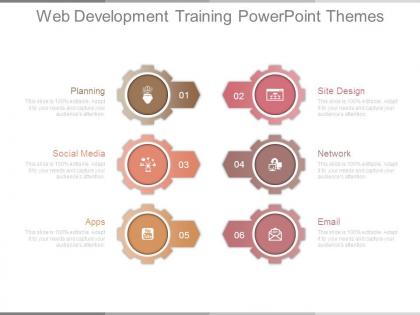
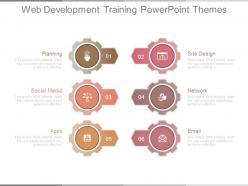
Web development training powerpoint themes




Try Before you Buy Download Free Sample Product
 Impress Your
 Audience
 100%
100% Editable
 Save Hours
 of Time


Attempt a fresh approach with our Web Development Training Powerpoint Themes. They embolden you to experiment.
People who downloaded this PowerPoint presentation also viewed the following :
Web development training powerpoint themes with all 7 slides:
Be in control at the helm with our Web Development Training Powerpoint Themes. Establish the course you desire to follow.

FAQs for Web development
Essential programming languages for web development beginners include HTML for structure, CSS for styling, JavaScript for interactivity, Python or PHP for server-side logic, and SQL for database management. These languages work together to create complete web applications, with many developers finding that mastering this foundation enables them to build responsive websites, dynamic user interfaces, and scalable backend systems that deliver enhanced user experiences and competitive advantages.
Responsive design principles enhance user experience by ensuring seamless functionality across devices, optimizing loading speeds, and providing intuitive navigation regardless of screen size. These approaches streamline content accessibility, reduce bounce rates, and increase engagement, with many e-commerce and service companies finding that responsive implementations ultimately deliver higher conversion rates and customer satisfaction.
Version control enables multiple developers to work simultaneously on web projects by tracking code changes, managing different versions, and preventing conflicts through branching and merging capabilities. Through systems like Git, development teams streamline collaboration, maintain project history, and coordinate feature development across different modules, with many organizations finding that version control ultimately reduces deployment errors and accelerates development cycles.
Understanding web accessibility fundamentally transforms design and development by requiring inclusive planning, semantic HTML structure, keyboard navigation support, and comprehensive testing protocols from project inception. This approach enables organizations to reach broader audiences, reduce legal risks, and deliver superior user experiences, with many companies finding that accessibility-first development ultimately streamlines workflows while enhancing overall product quality.
Front-end development benefits from interactive platforms like freeCodeCamp, React documentation, and CSS-Tricks, while back-end development leverages resources like Node.js guides, database tutorials, and API documentation. These complementary learning paths enable developers to master client-side interfaces and server-side architecture, with many organizations finding that full-stack knowledge ultimately delivers enhanced project versatility and career advancement opportunities.
Frameworks like React and Angular streamline web development by providing pre-built components, automated testing capabilities, and structured coding patterns that reduce development time significantly. These frameworks enable developers to create scalable applications more efficiently through reusable code libraries, component-based architecture, and integrated development tools, ultimately delivering faster project completion and enhanced maintainability for organizations.
Web performance optimization includes minimizing HTTP requests, compressing images and files, leveraging browser caching, optimizing code structure, and implementing content delivery networks. These practices streamline loading speeds by reducing server response times, enhancing user experiences, and improving search rankings, with many e-commerce and service platforms finding that faster sites deliver significantly higher conversion rates and customer retention.
Mentorship and networking opportunities significantly accelerate web developers' career growth by providing industry insights, technical guidance, code reviews, and access to job opportunities within professional circles. Through developer meetups, online communities, and senior developer relationships, professionals gain exposure to emerging technologies, best practices, and strategic career advice, ultimately delivering faster skill development and enhanced market positioning.
Emerging web development trends include progressive web applications, serverless architecture, artificial intelligence integration, voice user interfaces, and low-code development platforms. These technologies streamline development processes by reducing deployment complexity, enhancing user experiences, and accelerating time-to-market, with many organizations finding that developers skilled in these areas deliver significant competitive advantages in increasingly digital business environments.
A portfolio is essential for demonstrating practical web development skills, showcasing completed projects, clean code architecture, responsive design capabilities, and problem-solving approaches that employers actively seek. It should highlight diverse projects like e-commerce sites, interactive applications, and mobile-responsive designs, with many developers finding that well-documented GitHub repositories and live deployment links significantly enhance their competitive advantage in today's market.
SEO knowledge enables web developers to create websites with optimized site structure, faster loading speeds, mobile responsiveness, and clean code architecture from the ground up. This expertise allows developers to deliver enhanced search rankings, improved user experiences, and better conversion rates, with many agencies and freelance developers finding that SEO-savvy skills command higher project rates and client retention.
APIs facilitate communication between web applications and external services by establishing standardized protocols, enabling data exchange through HTTP requests, and providing secure authentication mechanisms. Through REST and GraphQL architectures, companies in banking, e-commerce, and healthcare streamline operations, integrate third-party services, and enhance customer experiences, ultimately delivering faster development cycles and competitive advantage.
Developers transitioning to single-page applications face challenges including state management complexity, SEO optimization difficulties, initial load time increases, routing implementation, and browser history handling. These technical hurdles require mastering new frameworks like React or Vue, implementing client-side routing solutions, and optimizing bundle sizes, with many developers finding that structured training accelerates proficiency and reduces development bottlenecks.
Essential web development tools include code editors like VS Code, version control systems like Git, package managers like npm, build tools like Webpack, and browser developer tools for debugging and testing. These technologies streamline development workflows by automating repetitive tasks, managing dependencies, and enabling collaborative coding, with many development teams finding that integrated toolchains ultimately deliver faster deployment cycles and enhanced code quality.
Project-based learning enhances web development skills by providing hands-on coding experience, real-world problem-solving scenarios, and portfolio development opportunities that mirror actual industry challenges. Through building applications, e-commerce sites, and interactive platforms, trainees develop technical proficiency, debugging capabilities, and client communication skills, while ultimately gaining practical experience that employers increasingly value over theoretical knowledge alone.
-
Editable templates with innovative design and color combination.
-
Very unique, user-friendly presentation interface.