


Weekly assignment agenda meeting schedule ppt images




Try Before you Buy Download Free Sample Product
 Impress Your
 Audience
 100%
100% Editable
 Save Hours
 of Time


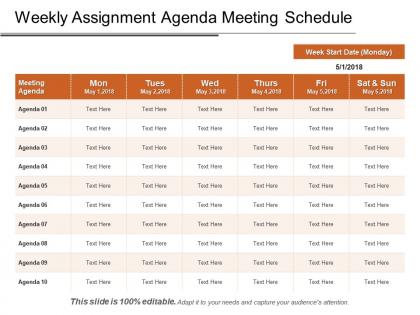
Break down your hours systematically with this Weekly Assignment Agenda Meeting Schedule PPT template. This weekly planner slide can be used in schools for students to record the tasks that need to be done on each day of the week. Also, the teachers can use this slide to set targets for the students that should be completed within the week. Also, the template can be used to assign weekly tasks. It can help you organize your weekly schedule in the best possible way. Get this slide to present your schedule in which each activity has been mentioned. The template will work as the backbone of your project. This way, an individual can mention every activity in the schedule and can work accordingly. Organize your appointments with this accessible weekly assignment template. It helps you in maintaining a proper record of each day spent in school, colleges, offices, and meetings. Easily organize the sequence of the events on a weekly basis, without having to spend time on designing and creating a schedule.
People who downloaded this PowerPoint presentation also viewed the following :
Weekly assignment agenda meeting schedule ppt images with all 5 slides:
Encourage intrepid individuals with our Weekly Assignment Agenda Meeting Schedule Ppt Images. Enable them to chart an independent course.


FAQs for Weekly assignment agenda meeting
Key components of an effective weekly assignment agenda meeting include task priority review, resource allocation assessment, deadline tracking, progress updates, and obstacle identification. These elements streamline project management by ensuring clear accountability, optimizing team coordination, and maintaining strategic focus, with many organizations finding that structured weekly reviews enhance productivity, reduce miscommunication, and ultimately deliver improved project outcomes.
Presentation templates enhance weekly assignment agenda discussions by standardizing information flow, organizing priorities systematically, and ensuring consistent visual communication across all team members. Through structured slides featuring progress tracking, deadline visibility, and resource allocation sections, teams streamline decision-making processes, minimize meeting duration, and improve accountability, with many organizations finding that templated agendas increase productivity and reduce miscommunication significantly.
**INPUT**: What strategies can be employed to ensure all team members contribute to the agenda? **OUTPUT**: Effective contribution strategies include pre-meeting agenda templates, rotating facilitation roles, structured brainstorming sessions, anonymous input systems, and deadline-driven submissions. These approaches streamline participation by eliminating contribution barriers, encouraging diverse perspectives, and creating accountability frameworks, with many organizations finding that structured input processes ultimately deliver more comprehensive agendas and enhanced team engagement. [Word count: 54 words]
Prioritize assignments by evaluating urgency, impact on strategic goals, resource requirements, and deadline proximity during your weekly meetings. This systematic approach enables teams to tackle high-impact tasks first, allocate resources effectively, and maintain clear accountability, with many organizations finding that structured prioritization reduces project bottlenecks and enhances overall productivity.
Technology streamlines remote weekly agenda meetings through video conferencing platforms, collaborative document sharing, automated scheduling tools, real-time polling features, and cloud-based project management systems. These solutions enhance participation by enabling seamless screen sharing, instant feedback collection, and centralized agenda tracking, with many organizations finding that digital tools ultimately deliver improved meeting efficiency and stronger team engagement across distributed workforces.
Managing time effectively during weekly assignment meetings requires structured agendas with allocated timeframes, designated discussion leaders for each topic, and clear action item documentation. Organizations streamline these sessions by implementing time-boxed updates, priority-based topic sequencing, and follow-up accountability systems, ultimately delivering improved project visibility and enhanced team productivity across departments.
Common pitfalls include overloading agendas with too many topics, failing to prioritize urgent assignments, skipping stakeholder input, and neglecting time allocation for each item. These oversights streamline by creating focused discussions, ensuring critical deadlines receive attention, and incorporating diverse perspectives, with many organizations finding that structured preparation ultimately delivers more productive meetings and clearer assignment accountability across teams.
Incorporating previous meeting feedback involves reviewing action items, unresolved issues, recurring themes, and participant suggestions to prioritize current agenda topics. This strategic approach enables teams to address lingering concerns, track progress on commitments, and refine meeting effectiveness, with many organizations finding that systematic feedback integration ultimately delivers improved accountability and more focused discussions.
Progress tracking methods include status reports, project management software, milestone checklists, percentage completion updates, and deadline monitoring systems. These approaches enhance accountability by providing real-time visibility, streamlining communication between team members, and enabling proactive issue resolution, with many organizations finding that systematic tracking ultimately delivers improved project outcomes and team efficiency.
**INPUT**: How do we balance individual accountability and team collaboration in assignment discussions? **OUTPUT**: Balancing individual accountability and team collaboration requires establishing clear ownership while maintaining open dialogue, structured peer feedback sessions, and shared goal alignment. Through rotating discussion leadership and transparent progress tracking, teams can enhance individual responsibility while fostering collective problem-solving, ultimately delivering stronger project outcomes and improved team dynamics.
**INPUT**: What metrics can be used to assess the effectiveness of our weekly agenda meetings? **OUTPUT**: Effectiveness metrics include meeting duration vs. planned time, action item completion rates, participant engagement scores, decision-making speed, and follow-up task adherence. These measurements streamline agenda optimization by identifying bottlenecks, enhancing accountability, and improving resource allocation, with many organizations finding that consistent tracking ultimately delivers faster project completion and stronger team alignment. **Word count: 56 words**
Visual aids improve engagement and understanding by simplifying complex information, maintaining audience attention, and enhancing information retention through multiple sensory channels. Through strategically designed slides, charts, and infographics, weekly assignment meetings deliver clearer progress updates, streamline task prioritization, and facilitate faster decision-making, with many teams finding that visual presentations reduce meeting duration while increasing actionable outcomes.
Tailoring assignment agendas involves customizing meeting formats, discussion priorities, timeline structures, and progress tracking methods to match each team's workflow, project complexity, and deliverable requirements. Different teams benefit from varied approaches, with creative teams often needing brainstorming time, technical teams requiring detailed status updates, and client-facing teams focusing on deadline coordination, ultimately delivering more relevant discussions and improved project outcomes.
Setting clear outcomes for weekly assignment meetings ensures focused discussions, accountability, and measurable progress toward project goals, while preventing unproductive tangents and miscommunication. These defined objectives enable teams to allocate resources strategically, track deliverables efficiently, and maintain momentum across departments, with many organizations finding that structured outcome-based agendas ultimately deliver improved project completion rates and enhanced team alignment.
**INPUT**: How can we encourage a culture of open communication and transparency in these meetings? **OUTPUT**: Open communication culture develops through structured feedback mechanisms, rotating discussion leadership, anonymous input channels, and clear psychological safety protocols that encourage diverse perspectives. These approaches streamline decision-making by eliminating information silos, enhancing cross-departmental collaboration, and building trust, with many organizations finding that transparent weekly agendas ultimately deliver faster project resolution and improved team engagement. **Word count: 56 words**
-
Editable templates with innovative design and color combination.
-
Graphics are very appealing to eyes.