


What Is NLP And How It Works Powerpoint Presentation Slides AI CD V




Try Before you Buy Download Free Sample Product
 Impress Your
 Audience
 100%
100% Editable
 Save Hours
 of Time


Explore our comprehensive guide on What is NLP and how it works template. This Transformer Models PowerPoint resource delves deeply into Natural Language Processing NLP, catering to the increased demand for NLP solutions. Moreover, the Tokenization deck thoroughly explores NLP, covering its historical evolution, fundamental concepts, applications, model training, and future advancements. Furthermore, our Text Summarization PPT elaborates on NLP subsegments like NLU Natural Language Understanding and NLG Natural Language Generation. Also, this Sentiment Analysis presentation focuses on core functionalities within NLP, including data preprocessing, sentiment analysis, named entity recognition, and machine translation. Lastly, Language Modeling PowerPoint highlights the application of NLP across various sectors such as marketing, finance, legal, healthcare, education, and government, emphasizing customer feedback management and sector specific use cases. Unlock access to this comprehensive resource to gain insights into the workings and applications of NLP.
People who downloaded this PowerPoint presentation also viewed the following :
Content of this Powerpoint Presentation
Slide 1: This slide introduces What is NLP and how it works. Commence by stating Your Company Name.
Slide 2: This slide depicts the Agenda of the presentation.
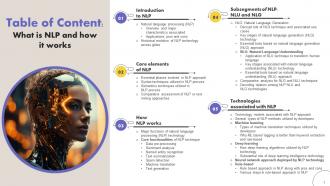
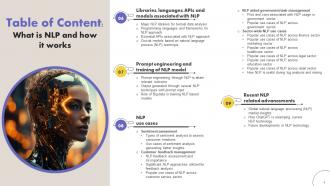
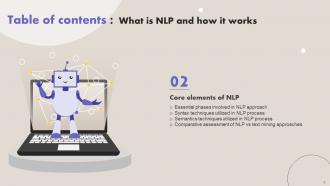
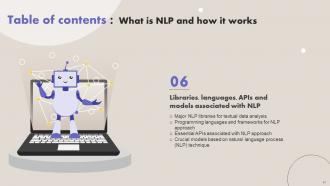
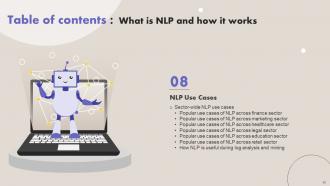
Slide 3: This slide includes the Table of contents.
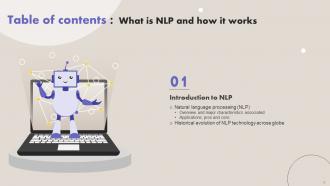
Slide 4: This slide further includes the Table of contents.
Slide 5: This slide highlights the Title for the Topics to be discussed further.
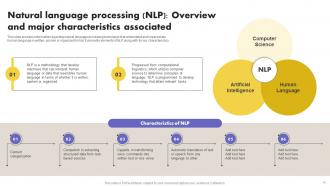
Slide 6: This slide provides information regarding natural language processing techniques.
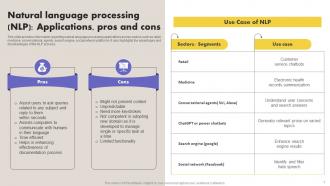
Slide 7: This slide states the natural language processing applications.
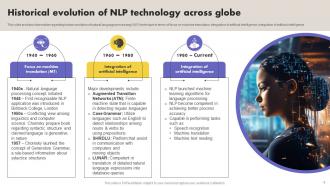
Slide 8: This slide reveals the Historical evolution of NLP technology across globe.
Slide 9: This slide indicates the Heading for the Contents to be covered further.
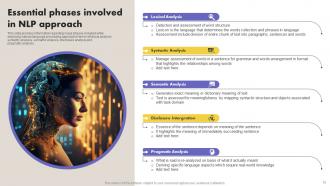
Slide 10: This slide showcases the Essential phases involved in NLP approach.
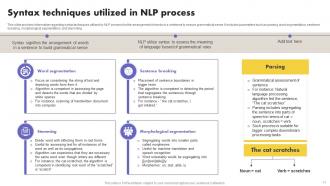
Slide 11: This slide highlights the Syntax techniques utilized in NLP process.
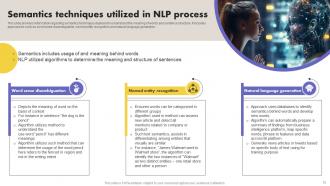
Slide 12: This slide reveals the Semantics techniques utilized in NLP process.
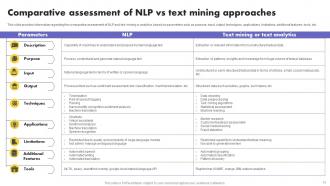
Slide 13: This slide shows the Comparative assessment of NLP vs text mining approaches.
Slide 14: This slide includes the Title for the Ideas to be discussed next.
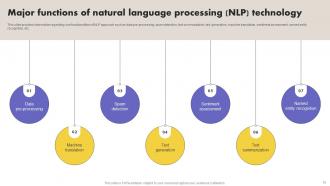
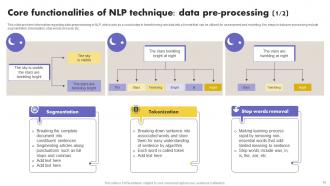
Slide 15: This slide exhibits the Major functions of natural language processing.
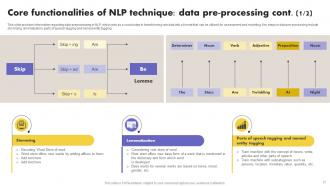
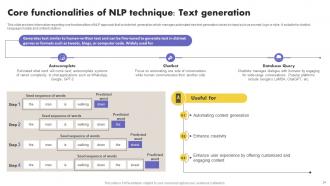
Slide 16: This slide shows the Core functionalities of NLP technique.
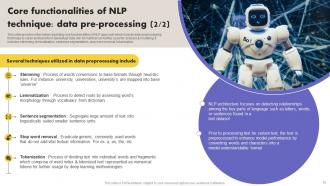
Slide 17: This slide continues the Core functionalities of NLP technique.
Slide 18: This slide continues the Core functionalities of NLP technique.
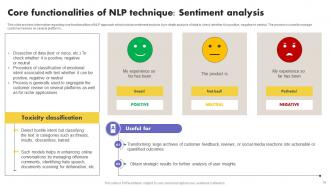
Slide 19: This slide highlights the Core functionalities of NLP technique.
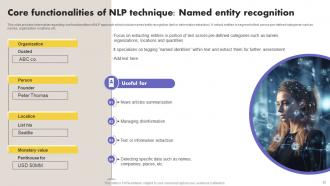
Slide 20: This slide portrays the Core functionalities of NLP technique.
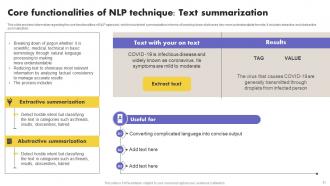
Slide 21: This slide exhibits the core functionalities of NLP approach.
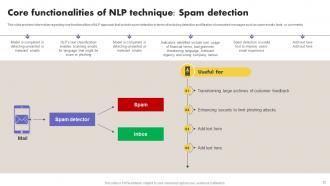
Slide 22: This slide displays the Core functionalities of NLP technique.
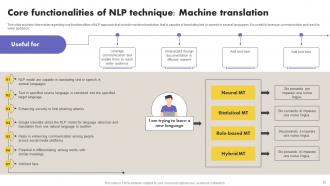
Slide 23: This slide provides information regarding core functionalities of NLP approach.
Slide 24: This slide exhibits the Core functionalities of NLP technique.
Slide 25: This slide contains the Heading for the Ideas to be covered further.
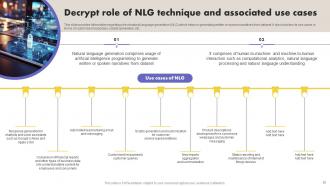
Slide 26: This slide showcases the Decrypt role of NLG technique and associated use cases.
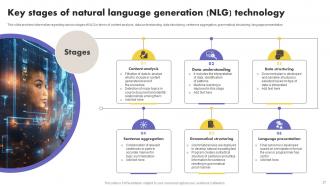
Slide 27: This slide highlights the Key stages of natural language generation (NLG) technology.
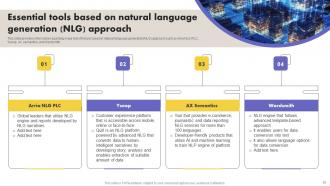
Slide 28: This slide displays the Essential tools based on natural language generation (NLG) approach.
Slide 29: This slide contains the Title for the Contents to be discussed next.
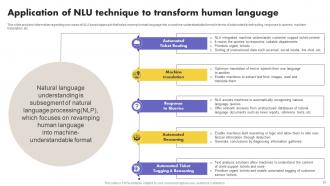
Slide 30: This slide presents the Application of NLU technique to transform human language.
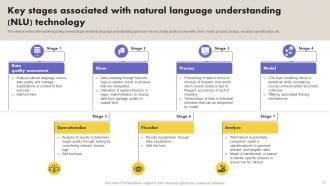
Slide 31: This slide states the Key stages associated with natural language understanding (NLU) technology.
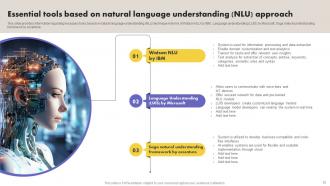
Slide 32: This slide depicts the Essential tools based on natural language understanding (NLU) approach.
Slide 33: This slide indicates the Heading for the Topics to be covered in the upcoming template.
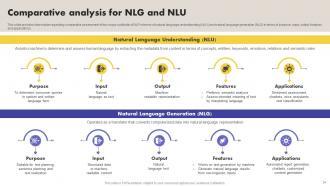
Slide 34: This slide reveals the Comparative analysis for NLG and NLU.
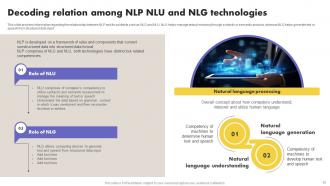
Slide 35: This slide talks about Decoding relation among NLP NLU and NLG technologies.
Slide 36: This slide exhibits the Title for the Topics to be discussed next.
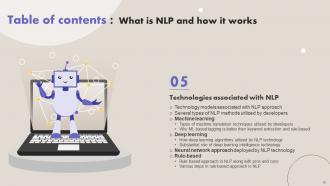
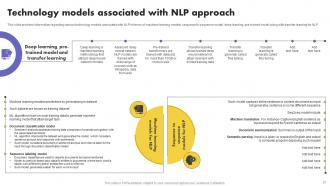
Slide 37: This slide provides information regarding various technology models associated with NLP.
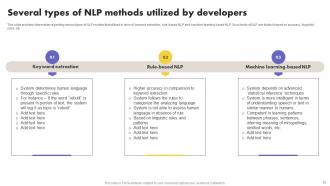
Slide 38: This slide depicts the Several types of NLP methods utilized by developers.
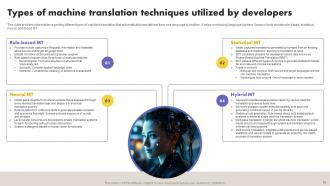
Slide 39: This slide provides information regarding different types of machine translation that automatically translate text from one language to another.
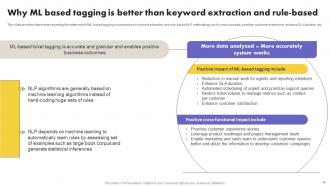
Slide 40: This slide shows the betterment of ML-based tagging in comparison to keyword extraction and rule-based NLP methodology.
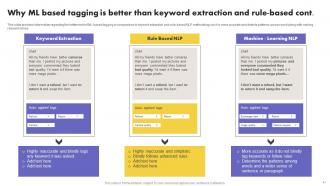
Slide 41: This slide continues the comparison and betterment of ML tagging over keyword extraction.
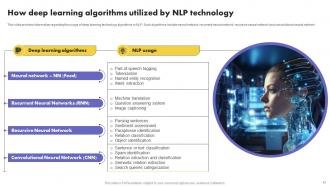
Slide 42: This slide provides information regarding the usage of deep learning technology algorithms in NLP.
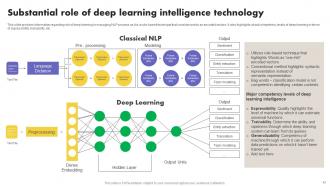
Slide 43: This slide highlights the Substantial role of deep learning intelligence technology.
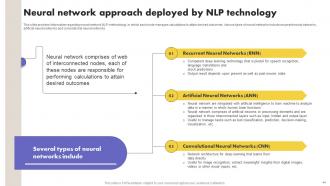
Slide 44: This slide contains the Neural network approach deployed by NLP technology.
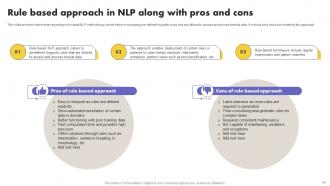
Slide 45: This slide talks about the Rule based approach in NLP along with pros and cons.
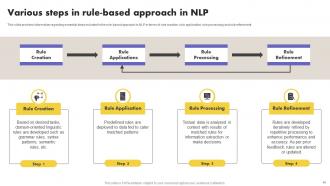
Slide 46: This slide states the Various steps in rule-based approach.
Slide 47: This slide indicates the Heading for the Contents to be covered further.
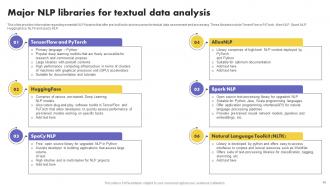
Slide 48: This slide exhibits the Major NLP libraries for textual data analysis.
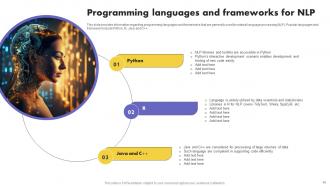
Slide 49: This slide deals with Programming languages and frameworks for NLP.
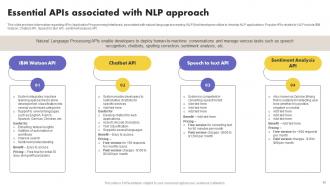
Slide 50: This slide highlights the Essential APIs associated with NLP approach.
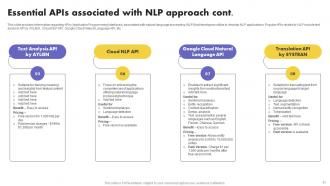
Slide 51: This slide continues the Essential APIs associated with NLP approach.
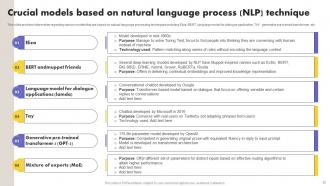
Slide 52: This slide shows the Crucial models based on natural language process (NLP) technique.
Slide 53: This slide portrays the Title for the Ideas to be discussed next.
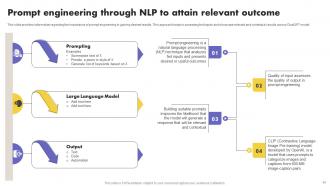
Slide 54: This slide talks about Prompt engineering through NLP to attain relevant outcome.
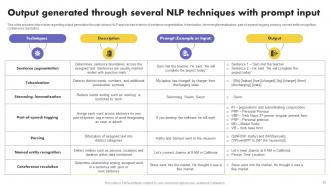
Slide 55: This slide provides information regarding output generation through various NLP approaches.
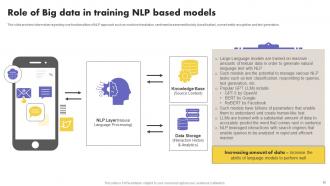
Slide 56: This slide shows the Role of Big data in training NLP based models.
Slide 57: This slide includes the Heading for the Ideas to be covered in the upcoming template.
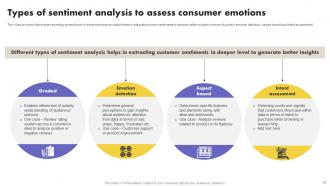
Slide 58: This slide states the Types of sentiment analysis to assess consumer emotions.
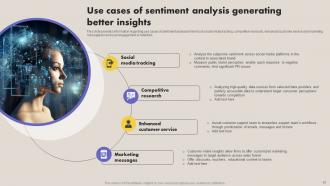
Slide 59: This slide represents the Use cases of sentiment analysis generating.
Slide 60: This slide includes the Title for the Contents to be discussed next.
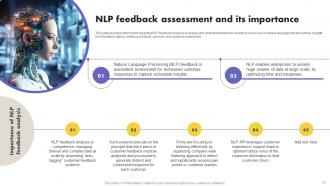
Slide 61: This slide provides information regarding NLP feedback analysis.
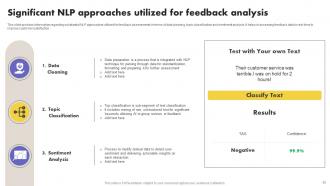
Slide 62: This slide presents the Significant NLP approaches utilized for feedback analysis.
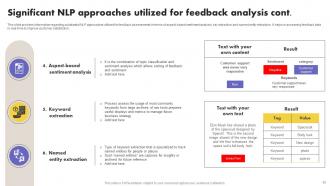
Slide 63: This slide continues the Significant NLP approaches utilized for feedback analysis.
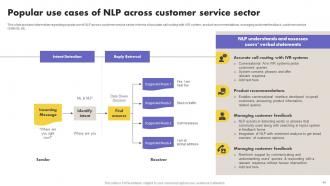
Slide 64: This slide reveals the Popular use cases of NLP across customer service sector.
Slide 65: This slide exhibits the Heading for the Topics to be coveerd further.
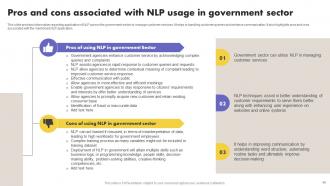
Slide 66: This slide highlights the Pros and cons associated with NLP usage in government sector.
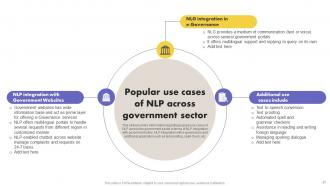
Slide 67: This slide provides information regarding popular use cases of NLP across the government sector.
Slide 68: This slide includes the Title for the Topics to be discussed next.
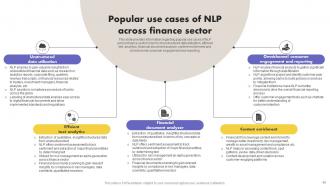
Slide 69: This slide talks about the Popular use cases of NLP across finance sector.
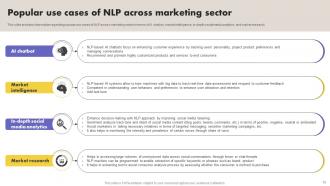
Slide 70: This slide deals with Popular use cases of NLP across marketing sector.
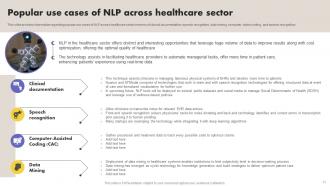
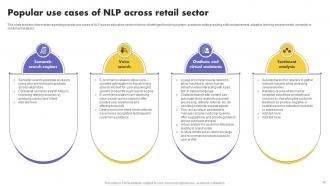
Slide 71: This slide shows the Popular use cases of NLP across healthcare sector.
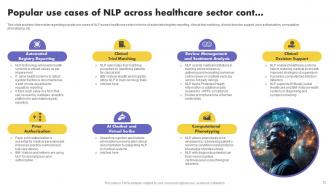
Slide 72: This slide continues the Popular use cases of NLP across healthcare sector.
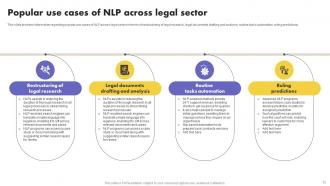
Slide 73: This slide provides information regarding popular use cases of NLP across legal sector.
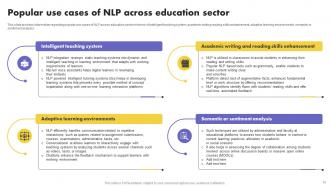
Slide 74: This slide indicates the Popular use cases of NLP across education sector.
Slide 75: This slide reveals the Popular use cases of NLP across.
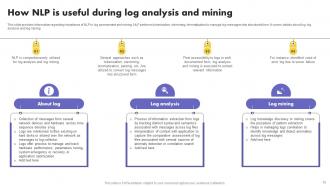
Slide 76: This slide provides information regarding importance of NLP in log assessment and mining.
Slide 77: This slide states the Heading for the Contents to be covered further.
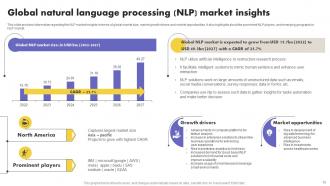
Slide 78: This slide portrays the Global natural language processing (NLP) market insights.
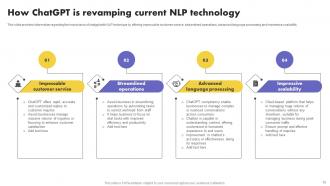
Slide 79: This slide provides information regarding the improvision of chatgpt with NLP technique.
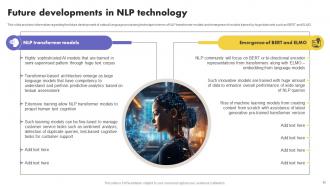
Slide 80: This slide talks about the Future developments in NLP technology.
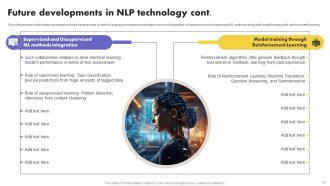
Slide 81: This slide continues the Future developments in NLP technology.
Slide 82: This is the Icons slide containing all the Icons used in the plan.
Slide 83: This slide is used for depicting some Additional information.
Slide 84: This is the About us slide. State your company-related information here.
Slide 85: This is Meet our team slide. State your team-related ifnormation here.
Slide 86: This slide incorporates the organization's mission, vision, and goals.
Slide 87: This is the Puzzle slide with related imagery.
Slide 88: This slide showcases the company's Roadmap.
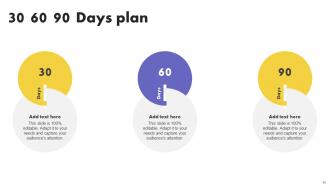
Slide 89: This is the 30 60 90 Days plan slide for effective planning.
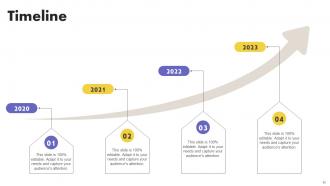
Slide 90: This slide presents the firm's Timeline.
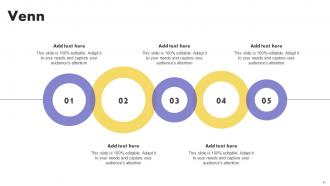
Slide 91: This is the Venn diagram slide.
Slide 92: This is the Thank you slide for acknowledgement.
What Is NLP And How It Works Powerpoint Presentation Slides AI CD V with all 100 slides:
Use our What Is NLP And How It Works Powerpoint Presentation Slides AI CD V to effectively help you save your valuable time. They are readymade to fit into any presentation structure.










FAQs for What Is NLP And How It Works Powerpoint Presentation Slides
Key NLP components include tokenization, part-of-speech tagging, named entity recognition, syntactic parsing, semantic analysis, and sentiment analysis. These technologies streamline text processing by breaking down language structure, identifying meaning, and extracting insights, with many organizations finding that strategic NLP implementation enhances customer service automation, content analysis, and decision-making processes.
NLP integration has revolutionized customer service chatbots by enabling natural language understanding, contextual awareness, sentiment analysis, and multi-turn conversations. These advanced capabilities allow chatbots to handle complex customer inquiries, provide personalized responses, and seamlessly escalate issues when needed, with many organizations finding significantly improved customer satisfaction and reduced operational costs.
Machine learning enhances NLP capabilities by enabling systems to learn from data patterns, automatically extract features, and continuously improve accuracy through training. These algorithms power sentiment analysis in customer service, language translation for global businesses, and chatbots for automated support, ultimately delivering faster response times and more personalized customer experiences.
Sentiment analysis algorithms interpret emotional tone by analyzing lexical patterns, contextual relationships, and linguistic indicators like adjectives, adverbs, and negation markers. Through machine learning models and natural language processing techniques, organizations in customer service, social media monitoring, and market research can automatically categorize feedback as positive, negative, or neutral, ultimately enabling faster response times and data-driven decision making.
Common challenges in training NLP models include data quality issues, computational resource requirements, handling linguistic ambiguity, managing multilingual complexities, and addressing bias in datasets. These obstacles significantly impact model performance, with many organizations finding that preprocessing inconsistencies, limited training data, and context understanding difficulties ultimately require strategic resource allocation and specialized expertise for successful implementation.
NLP revolutionizes social media monitoring by analyzing sentiment, detecting trending topics, identifying influencers, extracting customer insights, and automating content categorization across platforms. Through advanced text processing algorithms, businesses streamline brand reputation management, enhance customer engagement strategies, and accelerate market research processes, with many companies finding that real-time social intelligence delivers significant competitive advantages.
**INPUT**: What ethical considerations arise in the use of NLP technologies? **OUTPUT**: NLP ethical considerations include data privacy concerns, algorithmic bias in language processing, consent for voice and text analysis, transparency in automated decisions, and cultural sensitivity in language interpretation. These challenges present opportunities for organizations to build trust through responsible AI practices, with many financial services and healthcare institutions finding that ethical NLP frameworks ultimately enhance customer relationships and regulatory compliance. **Word count: 60 words**
Language models like GPT-3 revolutionize content generation by automating writing processes, enhancing creativity through intelligent suggestions, and scaling personalized content across multiple channels simultaneously. These AI systems streamline marketing campaigns, customer communications, and technical documentation, with businesses in e-commerce, publishing, and financial services finding significantly faster content production and improved engagement rates.
Named entity recognition identifies and classifies key entities like people, organizations, locations, and dates within text, forming the foundation for structured information extraction. This capability enables businesses to automatically process contracts, legal documents, and customer communications, with financial institutions and healthcare organizations finding that NER significantly streamlines compliance reporting and data analysis workflows.
NLP enhances healthcare documentation by automatically extracting clinical insights from unstructured notes, standardizing medical terminology, and identifying critical patient information that might be missed. Through intelligent text analysis, hospitals and clinics streamline record-keeping, reduce documentation errors, and enable faster clinical decision-making, ultimately delivering improved patient care and operational efficiency.
**INPUT**: What are the current trends and future predictions for the development of NLP? **OUTPUT**: Current NLP trends include transformer architectures, multimodal AI integration, conversational AI advancement, low-code development platforms, and enhanced multilingual capabilities. These technologies streamline customer service automation, content generation, and real-time translation services, with many organizations finding that strategic NLP implementation delivers faster response times, reduced operational costs, and significantly improved user experiences across global markets. [Word count: 60 words]
Multilingual NLP processes and understands multiple languages simultaneously, while monolingual approaches focus on single languages with specialized models and datasets. Through cross-lingual transfer learning and shared representations, organizations streamline global operations, enhance customer experiences across diverse markets, and reduce resource allocation costs, with many multinational companies finding that multilingual systems deliver significantly better scalability and operational efficiency.
Essential NLP tools and libraries include NLTK, spaCy, Transformers by Hugging Face, TensorFlow, and PyTorch for development frameworks. These technologies streamline text processing, sentiment analysis, and language understanding by automating tokenization, entity recognition, and model deployment, with many organizations finding that strategic combinations ultimately deliver faster customer insights and enhanced user experiences.
NLP enhances accessibility through voice recognition systems, text-to-speech conversion, language translation services, predictive text input, and automated captioning technologies. These technologies streamline communication barriers by enabling hands-free device control, converting written content to audio formats, and facilitating real-time transcription services, ultimately delivering more inclusive digital experiences and greater independence for users with diverse accessibility needs.
NLP intersects with data science through statistical modeling, machine learning algorithms, and large dataset analysis, while connecting to AI via neural networks, deep learning, and cognitive computing frameworks. These interdisciplinary combinations enable organizations to automate customer service, analyze market sentiment, and extract business insights from unstructured text, ultimately delivering enhanced decision-making capabilities and competitive advantages across industries.
-
The best part about SlideTeam is their meticulously prepared presentations (complete-decks and single-slides both), infused with high-quality graphics and easy to edit. All-in-all worthy products.
-
A big thanks to SlideTeam! An incredible and diverse library of templates helped me with my business project presentation.