


How retail banking is different from wholesale financial services




Try Before you Buy Download Free Sample Product
 Impress Your
 Audience
 100%
100% Editable
 Save Hours
 of Time


Our How Retail Banking Is Different From Wholesale Financial Services are topically designed to provide an attractive backdrop to any subject. Use them to look like a presentation pro.
People who downloaded this PowerPoint presentation also viewed the following :
How retail banking is different from wholesale financial services with all 6 slides:
Use our How Retail Banking Is Different From Wholesale Financial Services to effectively help you save your valuable time. They are readymade to fit into any presentation structure.





FAQs for How retail banking is different from
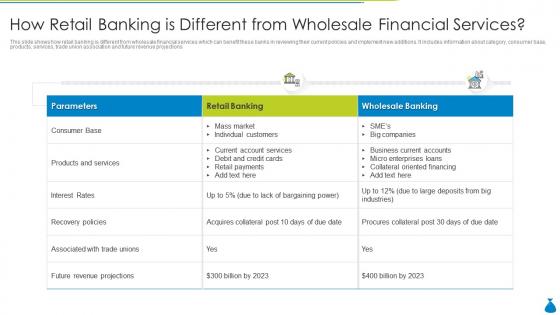
Retail banking serves individual consumers and small businesses with services like savings accounts, personal loans, mortgages, and credit cards, while wholesale banking focuses on large corporations and institutions offering treasury management, trade finance, and complex commercial lending. These distinct approaches enable banks to streamline operations by specializing in either high-volume consumer transactions or sophisticated corporate financial solutions, ultimately delivering tailored experiences across different market segments.
Retail banks generate revenue through individual customer services like personal loans, mortgages, credit cards, and deposit account fees, while wholesale banks focus on large-scale corporate financing, investment banking, trade finance, and institutional lending. Through these distinct approaches, retail banks benefit from high-volume, lower-margin transactions across broad customer bases, while wholesale banks leverage fewer, higher-value relationships with corporations and institutions, ultimately delivering specialized financial solutions.
Customer relationships in retail banking emphasize high-volume, standardized interactions through digital channels, branch networks, and self-service options, while wholesale banking focuses on personalized, relationship-driven service with dedicated account managers and tailored solutions. Retail banks prioritize efficiency and accessibility for millions of customers, whereas wholesale banking delivers customized financial strategies, with many institutions finding that deeper corporate relationships ultimately generate higher per-client profitability and long-term strategic partnerships.
Regulatory compliance differs significantly between retail and wholesale banks, with retail banks facing stricter consumer protection requirements, deposit insurance mandates, and branch licensing regulations, while wholesale banks encounter more complex capital adequacy rules, derivatives oversight, and systemic risk assessments. These varying frameworks reflect each sector's distinct risk profiles, with retail banks prioritizing customer safeguards and wholesale banks emphasizing market stability and institutional oversight.
Technology streamlines retail banking through mobile apps, ATMs, online platforms, and automated customer service systems for individual consumers. In wholesale banking, technology enables high-frequency trading systems, blockchain for large transactions, advanced risk management platforms, and AI-driven credit analysis, with both sectors finding that digital transformation ultimately delivers faster services, reduced operational costs, and enhanced competitive advantage.
Retail banking emphasizes standardized risk assessment through credit scoring, automated loan approvals, and diversified consumer portfolios, while wholesale banking requires customized due diligence, relationship-based evaluations, and concentrated exposure management. Banks like JPMorgan and Wells Fargo leverage technology-driven models for retail clients and specialized teams for corporate accounts, ultimately delivering scalable consumer services and tailored institutional solutions.
Current retail banking trends include digital-first customer experiences, personalized financial products, mobile payment integration, AI-driven customer service, and enhanced cybersecurity measures. These consumer-focused innovations differ significantly from wholesale banking trends, which emphasize regulatory compliance automation, trade finance digitization, and institutional risk management solutions, with retail banks prioritizing customer convenience while wholesale institutions focus on operational efficiency and regulatory adherence.
Retail banks cater to individual consumers through personal checking accounts, savings products, mortgages, credit cards, and consumer loans, while wholesale banks serve businesses with corporate lending, cash management, trade finance, and investment banking services. These distinct approaches reflect different operational scales and client needs, with retail banks focusing on high-volume, standardized services and wholesale banks delivering customized financial solutions for complex business requirements.
Retail banking lending focuses on individual consumers through standardized processes for mortgages, personal loans, and credit cards, while wholesale banking serves corporations with complex, customized financing solutions. Through automated credit scoring and streamlined approvals, retail banks deliver faster consumer services, whereas wholesale banking emphasizes relationship management and tailored deal structuring, ultimately enabling both sectors to optimize their respective market advantages.
Retail banks primarily serve individual consumers, small businesses, families, and local communities seeking personal loans, mortgages, savings accounts, and everyday banking services. Wholesale banks focus on large corporations, institutional investors, government entities, and high-net-worth individuals requiring complex financial solutions, with many finding that this segmentation enables specialized service delivery and operational efficiency.
Retail banks focus on mass marketing through digital channels, branch networks, and consumer-targeted campaigns to attract individual customers and small businesses. Wholesale banks emphasize relationship-based marketing, leveraging personal networks, industry expertise, and tailored solutions to acquire corporate clients, with many finding that trust-building and specialized knowledge ultimately deliver higher-value, long-term partnerships.
Economic fluctuations impact retail banks through consumer spending changes, loan defaults, and deposit volatility, while wholesale banks face corporate credit risks, market volatility, and capital market disruptions. Retail banks typically show more stability during downturns with diversified consumer bases, whereas wholesale banks experience amplified effects through large corporate exposures, ultimately requiring different risk management strategies.
Retail banking uses high-volume, low-value payment systems like ACH and card networks for consumer transactions, while wholesale banking employs specialized platforms like SWIFT and Fedwire for large-value interbank transfers. These distinct systems enable retail banks to process millions of small payments efficiently, whereas wholesale operations facilitate complex corporate transactions, trade finance, and institutional settlements, ultimately delivering faster services and reduced operational costs across different market segments.
The global market affects wholesale banking more significantly through currency fluctuations, international trade financing, cross-border capital flows, and geopolitical events that impact large corporate clients and institutional investors. While retail banking remains largely domestic, wholesale banks face greater exposure to global economic volatility, regulatory changes across jurisdictions, and international credit risks, with many institutions finding that diversified geographic presence becomes essential for competitive advantage.
Retail banks face unique challenges including massive customer volume management, complex regulatory compliance for consumer protection, extensive branch network maintenance, and intense competition for deposits and loans. Unlike wholesale banks serving corporate clients, retail institutions must deliver personalized customer experiences across thousands of daily transactions while managing credit risks from individual borrowers, ultimately requiring sophisticated technology and operational efficiency to maintain profitability.
-
Perfect template with attractive color combination.
-
Great experience, I would definitely use your services further.