


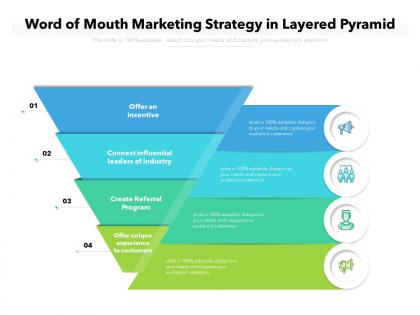
Word of mouth marketing strategy in layered pyramid




Try Before you Buy Download Free Sample Product
 Impress Your
 Audience
 100%
100% Editable
 Save Hours
 of Time


Our Word Of Mouth Marketing Strategy In Layered Pyramid are explicit and effective. They combine clarity and concise expression.
People who downloaded this PowerPoint presentation also viewed the following :
Word of mouth marketing strategy in layered pyramid with all 2 slides:
Give your audience a fulfilling experience. They will find our Word Of Mouth Marketing Strategy In Layered Pyramid elevating.
FAQs for Word of mouth marketing strategy
Key elements include authentic customer experiences, social media amplification, influencer partnerships, user-generated content, and seamless sharing mechanisms. These strategies leverage digital platforms by encouraging genuine testimonials, creating viral content opportunities, and enabling instant peer-to-peer recommendations, with many brands finding that authentic storytelling combined with strategic digital touchpoints delivers exponential reach and enhanced customer trust.
Businesses can leverage social media to amplify word of mouth marketing by encouraging user-generated content, creating shareable experiences, implementing referral programs, partnering with micro-influencers, and fostering community engagement. These strategies work by transforming satisfied customers into brand advocates, with retail and hospitality companies finding that authentic social sharing significantly increases reach and drives measurably higher conversion rates.
Customer experience serves as the primary catalyst for organic word of mouth referrals by creating memorable interactions, exceeding expectations, and delivering consistent value across all touchpoints. Exceptional experiences in retail, hospitality, and financial services naturally compel customers to share recommendations with their networks, ultimately driving acquisition costs down while building authentic brand advocacy and sustainable competitive advantage.
Brands can encourage customer sharing through exceptional service experiences, referral incentive programs, user-generated content campaigns, personalized follow-up communications, and social media engagement strategies. These approaches work by creating memorable moments worth discussing, rewarding advocacy behavior, and making sharing seamless, with many retail and hospitality brands finding that authentic experiences naturally drive word-of-mouth recommendations.
Businesses should track referral conversion rates, customer lifetime value from referred customers, Net Promoter Score (NPS), social media mentions, and share of voice metrics. These measurements enable organizations to quantify advocacy impact, with retail and hospitality sectors finding that referred customers demonstrate 25% higher retention rates, ultimately delivering enhanced ROI and sustainable growth momentum.
Influencer marketing amplifies word of mouth by leveraging trusted voices with established audiences to generate authentic conversations and recommendations. Through strategic partnerships with micro-influencers and industry experts, brands create organic advocacy that spreads naturally across social networks, ultimately delivering enhanced credibility and expanded reach compared to traditional advertising approaches.
**INPUT**: What are some innovative tactics to spark genuine conversations about a brand? **OUTPUT**: Innovative word-of-mouth tactics include creating experiential pop-ups, leveraging user-generated content campaigns, partnering with micro-influencers, gamifying customer referrals, and developing shareable behind-the-scenes content. These approaches enhance brand authenticity by encouraging organic storytelling, building community engagement, and delivering memorable experiences, with many retail and hospitality brands finding that authentic interactions ultimately drive stronger customer loyalty and sustainable growth.
Small businesses can leverage word of mouth marketing through exceptional customer service, referral incentive programs, social media engagement, community partnerships, and personalized follow-ups with satisfied customers. These cost-effective strategies enable restaurants, local retailers, and service providers to amplify their reach organically, ultimately delivering increased customer acquisition and brand loyalty without significant advertising expenditure.
Word of mouth marketing tools include social media management platforms, referral program software, influencer marketing platforms, review management systems, and customer advocacy solutions. These technologies streamline campaigns by automating referral tracking, incentivizing customer sharing, and amplifying positive testimonials across channels, with many businesses finding that strategic combinations ultimately deliver measurable engagement growth and enhanced brand credibility.
Trust psychology drives word of mouth recommendations by leveraging emotional connection, social proof, and perceived credibility to influence purchasing decisions. People inherently trust personal recommendations over advertisements because they view friends and family as unbiased sources, with many businesses finding that trusted referrals convert at significantly higher rates, ultimately delivering authentic customer acquisition and enhanced brand credibility.
Brands face challenges including controlling message consistency, avoiding overly promotional content, managing fake reviews, balancing incentives with genuine advocacy, and ensuring transparency in sponsored recommendations. These authenticity concerns require strategic oversight through careful influencer vetting, transparent disclosure practices, and authentic customer relationship building, with many organizations finding that genuine engagement ultimately delivers stronger trust and sustainable competitive advantage.
Customer testimonials enhance word of mouth strategies by serving as authentic social proof across multiple touchpoints, including websites, social media campaigns, email marketing, and sales presentations. Strategic placement of compelling customer stories, video testimonials, and case studies amplifies organic conversations, with many brands finding that peer recommendations drive significantly higher conversion rates than traditional advertising approaches.
Ethical word of mouth marketing considerations include transparency about brand relationships, authentic customer experiences, honest disclosure of incentives, respect for customer privacy, and avoiding manipulation or deception. These principles enhance brand credibility by building genuine trust, fostering long-term customer loyalty, and creating sustainable advocacy programs, with many organizations finding that ethical approaches ultimately deliver stronger competitive advantage.
Brands can harness online reviews by actively encouraging satisfied customers to share experiences, responding professionally to all feedback, and showcasing positive testimonials across marketing channels. Companies like Amazon and TripAdvisor demonstrate how strategic review management amplifies authentic recommendations, ultimately building trust, increasing conversions, and creating sustainable competitive advantage through genuine customer advocacy.
Successful word-of-mouth campaigns include Dropbox's referral program, Tesla's customer advocacy approach, Airbnb's social sharing features, and Dollar Shave Club's viral content strategy. These campaigns demonstrate that authentic customer experiences, strategic incentives, and shareable moments drive organic growth, with many companies finding that combining product excellence with referral mechanisms delivers exponential reach and significantly lower customer acquisition costs.
No Reviews