


Work breakdown structure for construction repairing




Try Before you Buy Download Free Sample Product
 Impress Your
 Audience
 100%
100% Editable
 Save Hours
 of Time


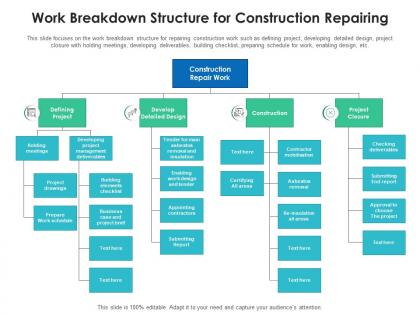
This slide focuses on the work breakdown structure for repairing construction work such as defining project, developing detailed design, project closure with holding meetings, developing deliverables, building checklist, preparing schedule for work, enabling design, etc.
People who downloaded this PowerPoint presentation also viewed the following :
Work breakdown structure for construction repairing with all 2 slides:
Use our Work Breakdown Structure For Construction Repairing to effectively help you save your valuable time. They are readymade to fit into any presentation structure.

FAQs for Work breakdown structure
Key components of a construction WBS include project phases, deliverables, work packages, activities, and resource allocations, typically organized hierarchically from major phases to specific tasks. These components enable project managers to streamline scheduling, cost estimation, and resource planning, with construction teams finding that detailed WBS structures ultimately deliver better budget control, timeline adherence, and enhanced coordination across trades.
A WBS facilitates better resource allocation by breaking complex repair projects into specific tasks, enabling precise estimation of labor, materials, and equipment needs for each component. This detailed breakdown allows construction managers to optimize scheduling, prevent resource conflicts, and allocate specialized crews more efficiently, ultimately reducing project delays and costs while improving repair quality.
Common pitfalls include insufficient detail in task breakdown, overlooking dependencies between repair phases, underestimating material procurement timelines, and failing to account for unforeseen structural issues. These oversights can derail projects by creating scheduling conflicts, resource shortages, and cost overruns, with many construction firms finding that thorough upfront planning ultimately delivers smoother execution and enhanced project profitability.
A WBS improves communication among construction repair stakeholders by creating standardized terminology, defining clear responsibilities across subcontractors and project teams, and establishing transparent progress tracking mechanisms. Through detailed task hierarchies, contractors, engineers, and facility managers can seamlessly coordinate material deliveries, scheduling conflicts, and quality checkpoints, ultimately delivering faster project completion and reduced miscommunication costs.
A WBS serves as the foundation for project scheduling by breaking down construction repair work into manageable tasks that can be sequenced, estimated, and tracked systematically. This structured approach enables project managers to identify critical path activities, allocate resources efficiently, and establish realistic timelines, with many construction teams finding that detailed work breakdowns reduce scheduling conflicts and improve on-site coordination.
Technology enhances WBS creation and management for construction repairs through digital project management platforms, mobile inspection apps, drone surveying, IoT sensors, and AI-powered scheduling tools. These technologies streamline repair assessments, automate task breakdowns, and enable real-time progress tracking, with many construction firms finding that integrated systems deliver faster project completion, improved resource allocation, and enhanced client transparency.
New construction WBS focuses on sequential building phases like site preparation, foundation, framing, and finishing, while repair WBS emphasizes assessment, diagnostics, selective demolition, and integration challenges. Repair projects require extensive condition analysis, structural evaluations, and coordination around occupied spaces, with construction teams finding that retrofit work involves more unknowns, specialized materials, and phased approaches to minimize disruption while maintaining structural integrity.
Determining WBS detail levels for repair projects depends on project complexity, stakeholder requirements, resource allocation needs, and risk assessment factors. Construction teams typically find that smaller repairs require task-level breakdown while major renovations need subtask granularity, with many organizations balancing management oversight against operational efficiency to optimize project tracking and cost control.
A WBS significantly enhances risk management during construction repairs by breaking complex projects into manageable components, enabling systematic hazard identification, resource allocation planning, and dependency mapping across all work packages. Through detailed task decomposition, construction teams can proactively assess structural risks, safety concerns, and material availability issues at each level, ultimately delivering more predictable timelines and cost controls while minimizing unexpected complications.
**INPUT**: What techniques can be employed to effectively decompose tasks within a WBS for repairs? **OUTPUT**: Effective WBS decomposition techniques include system-based breakdown, sequential phasing, resource clustering, priority-driven grouping, and dependency mapping approaches. These methods streamline repair projects by organizing tasks around building systems, construction phases, and resource availability, with many construction teams finding that strategic decomposition ultimately delivers faster completion times and enhanced project transparency.
WBS adaptation involves scaling complexity and detail levels, with small projects using simplified phase-based breakdowns focusing on essential tasks like assessment, materials, and execution, while large projects require multi-tiered hierarchies with specialized trade coordination. Through strategic task granularity, small contractors streamline resource allocation and timeline management, whereas large-scale operations enhance cross-team collaboration, risk mitigation, and progress tracking across multiple work packages, ultimately delivering optimized project control regardless of scale.
Best practices for maintaining a WBS throughout construction repair projects include regular progress reviews, stakeholder feedback integration, change control documentation, risk assessment updates, and resource reallocation tracking. These practices enhance project visibility by enabling real-time adjustments, streamlining communication across teams, and maintaining accurate cost controls, with many construction firms finding that systematic WBS updates reduce project delays and ultimately deliver improved budget accuracy.
A WBS enhances team collaboration in construction repairs by creating shared visibility into task dependencies, clarifying individual responsibilities, and establishing clear communication channels between trades and specialists. This structured approach enables contractors, engineers, and subcontractors to coordinate workflows more effectively, minimize conflicts over resource allocation, and maintain synchronized project timelines, ultimately delivering faster repair completion and reduced operational disruptions.
Stakeholders' needs significantly influence WBS structure by determining priority levels, resource allocation, communication requirements, and deliverable definitions across project phases. Construction repair stakeholders, including property owners, contractors, regulatory bodies, and tenants, drive specific breakdown approaches that emphasize safety compliance, budget transparency, timeline coordination, and quality assurance, ultimately delivering stakeholder-aligned project outcomes and enhanced collaboration.
A well-defined WBS significantly enhances project budgeting accuracy by breaking repair work into granular components, enabling precise cost allocation for materials, labor, equipment, and overhead expenses. This detailed structure allows construction managers to identify potential cost overruns early, optimize resource allocation, and provide stakeholders with transparent budget justifications, ultimately delivering more competitive bids and improved profit margins across repair projects.
-
Wonderful templates design to use in business meetings.