


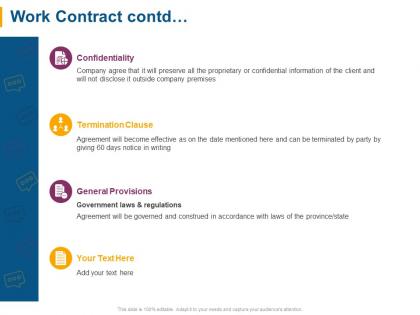
Work contract contd termination clause ppt powerpoint presentation file brochure




Try Before you Buy Download Free Sample Product
 Impress Your
 Audience
 100%
100% Editable
 Save Hours
 of Time


Make good headway with our Work Contract Contd Termination Clause Ppt Powerpoint Presentation File Brochure. Get across all the hurdles that emerge.
People who downloaded this PowerPoint presentation also viewed the following :
Work contract contd termination clause ppt powerpoint presentation file brochure with all 5 slides:
Get across all hurdles that emerge with our Work Contract Contd Termination Clause Ppt Powerpoint Presentation File Brochure. They allow you to make good headway.




FAQs for Work contract contd termination clause ppt powerpoint
A termination clause defines the conditions, procedures, and notice requirements for ending employment relationships, protecting both employers and employees through clear legal frameworks. It establishes grounds for dismissal, severance obligations, and transition processes, with many organizations finding that well-structured clauses minimize disputes, ensure compliance with labor laws, and ultimately deliver smoother workforce management and reduced legal risks.
A termination clause protects both parties by establishing clear exit procedures, notice requirements, severance obligations, and grounds for dismissal, while preventing costly legal disputes. This structured approach enables employers to manage workforce changes efficiently and provides employees with predictable compensation timelines, ultimately delivering operational certainty and reduced litigation risks for organizations across industries.
Common reasons for invoking termination clauses include breach of contract, non-performance of duties, violation of company policies, budget constraints, and project completion. These contractual provisions enable organizations to manage workforce changes strategically, protect business interests, and maintain operational efficiency, with many companies finding that clear termination criteria streamline HR processes while ensuring legal compliance.
Notice period significantly affects termination timing, legal compliance, transition planning, and financial obligations outlined in work contracts. Through structured advance notification, organizations can ensure proper knowledge transfer, project completion, and replacement hiring, while employees secure alternative employment opportunities, ultimately minimizing operational disruption and maintaining professional relationships during workforce transitions.
Terminating a contract without valid cause typically results in breach of contract claims, potential damages including compensatory and consequential losses, possible injunctive relief, and liability for the non-breaching party's legal costs. These violations can lead to significant financial exposure, damaged business relationships, and reputational harm, with many organizations finding that proper contract structuring and legal consultation ultimately protect against costly litigation and preserve strategic partnerships.
Termination clauses can absolutely be negotiated through reviewing notice periods, severance terms, cause definitions, and non-compete restrictions before contract signing. Both parties can propose modifications regarding compensation packages, transition timelines, and specific termination triggers, with many organizations finding that customized clauses ultimately deliver clearer expectations and reduced legal disputes.
Employers should include notice periods meeting local requirements, severance payment calculations, grounds for immediate dismissal, progressive discipline procedures, and final pay timelines in termination clauses. These provisions ensure compliance by clearly defining termination processes, protecting both parties' rights, and minimizing legal disputes, with many organizations finding that comprehensive clauses streamline HR operations while maintaining regulatory adherence.
Mutual termination occurs when both parties agree to end the contract through consensus, negotiation, and shared decision-making, while unilateral termination allows one party to end the agreement independently. These approaches deliver different outcomes, with mutual termination typically ensuring smoother transitions and preserved relationships, while unilateral termination enables faster resolution but may involve penalties or disputes.
Termination clauses vary significantly across industries, with healthcare and finance requiring longer notice periods due to regulatory compliance, while tech and consulting often feature shorter, more flexible terms. Construction contracts typically include project-specific milestones for termination, retail emphasizes seasonal adjustments, and manufacturing focuses on supply chain continuity, ultimately reflecting each sector's operational demands and risk profiles.
Documentation serves as critical legal evidence when enforcing termination clauses, including performance records, violation notices, correspondence trails, and compliance tracking that substantiate the grounds for termination. Proper documentation enables organizations to defend termination decisions in legal disputes, ensures regulatory compliance, and streamlines the termination process, with many companies finding that comprehensive record-keeping significantly reduces litigation risks.
Poorly drafted termination clauses can result in legal disputes, unexpected financial obligations, prolonged notice periods, difficulty enforcing confidentiality agreements, and challenges recovering company property. These issues often lead to costly litigation, operational disruptions, and potential breaches of employment law, with many organizations finding that unclear termination language ultimately exposes them to significant legal and financial risks.
Employees can safeguard their interests by carefully reviewing notice periods, severance packages, non-compete restrictions, and termination conditions before signing contracts, while negotiating favorable terms where possible. Through legal consultation and understanding of local employment laws, workers can ensure adequate protection against unfair dismissal, secure reasonable compensation packages, and maintain career flexibility, ultimately delivering greater job security and financial stability in an increasingly dynamic employment landscape.
Overly restrictive termination clauses include excessive notice periods beyond industry standards, broad non-compete agreements preventing employment in entire sectors, unreasonable penalty fees for early termination, and vague performance metrics that favor employers. These clauses can limit career mobility and create financial hardship, with many professionals finding that overly restrictive terms ultimately discourage talent retention and damage employer reputation in competitive markets.
Breach of termination clause consequences include financial penalties, legal disputes, damage to professional reputation, loss of benefits or severance, and potential litigation costs. These violations can result in employers withholding final payments, pursuing contractual damages, or initiating legal proceedings, while employees may face restricted future employment opportunities, ultimately creating costly complications that many organizations and professionals find significantly impact their strategic relationships and operational continuity.
A termination clause can significantly impact future opportunities by affecting reference quality, non-compete restrictions, severance timing, and industry reputation. While restrictive clauses may limit immediate mobility, employees with favorable termination terms often transition more smoothly to new roles, with many finding that transparent departure processes and positive reference arrangements ultimately enhance their professional credibility and market positioning.
No Reviews