


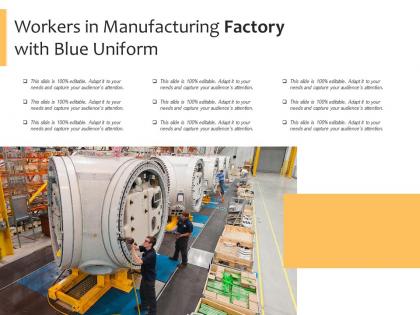
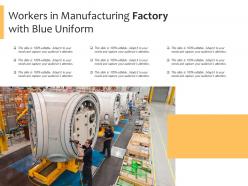
Workers in manufacturing factory with blue uniform




Try Before you Buy Download Free Sample Product
 Impress Your
 Audience
 100%
100% Editable
 Save Hours
 of Time


Our Workers In Manufacturing Factory With Blue Uniform are topically designed to provide an attractive backdrop to any subject. Use them to look like a presentation pro.
People who downloaded this PowerPoint presentation also viewed the following :
Workers in manufacturing factory with blue uniform with all 2 slides:
Use our Workers In Manufacturing Factory With Blue Uniform to effectively help you save your valuable time. They are readymade to fit into any presentation structure.
FAQs for Workers in manufacturing factory
Today's manufacturing workers need technical skills like equipment operation and digital literacy, problem-solving abilities, quality control expertise, safety awareness, and adaptability to new technologies. These competencies enable workers to operate automated systems, troubleshoot complex machinery, and maintain production standards, while many manufacturers finding that cross-trained employees deliver greater operational efficiency and competitive advantage.
Manufacturing workers have transitioned from primarily manual labor to technology-enabled roles involving equipment monitoring, data analysis, predictive maintenance, and quality control oversight. While automation handles repetitive tasks, workers increasingly focus on problem-solving, system optimization, and collaborative robotics management, with many factories finding that this evolution enhances job satisfaction, reduces workplace injuries, and ultimately delivers higher productivity and competitive manufacturing capabilities.
Manufacturing workers should be trained in lockout/tagout procedures, personal protective equipment usage, hazardous material handling, emergency evacuation protocols, and machine-specific safety operations. These comprehensive training programs enhance workplace safety by reducing accidents, ensuring regulatory compliance, and building safety awareness, with many manufacturing facilities finding that well-trained workers significantly minimize operational disruptions while improving overall productivity.
Manufacturing workers can adapt to evolving supply chain dynamics through cross-training in multiple production areas, developing digital literacy for automated systems, and enhancing problem-solving skills for real-time adjustments. These adaptations enable workers to pivot between roles seamlessly, respond to demand fluctuations effectively, and collaborate with AI-driven logistics platforms, ultimately delivering greater operational resilience and career security.
Worker well-being significantly enhances manufacturing productivity by reducing absenteeism, minimizing workplace injuries, and increasing employee engagement and retention rates. Companies prioritizing comprehensive wellness programs, ergonomic workstations, and mental health support find that healthier workers deliver higher quality output, faster production times, and lower operational costs, ultimately creating sustainable competitive advantages in manufacturing operations.
Emerging trends in manufacturing training include digital simulations, augmented reality instruction, microlearning modules, cross-functional skill development, and AI-powered personalized learning paths. These approaches enhance worker adaptability by delivering hands-on experience, reducing training costs, and accelerating skill acquisition, with many manufacturing organizations finding that strategic upskilling programs ultimately improve operational efficiency and competitive positioning.
Workforce diversity drives manufacturing innovation by combining varied perspectives, problem-solving approaches, and cultural insights that spark creative solutions and process improvements. Teams with diverse backgrounds, experiences, and skill sets identify opportunities others might miss, develop more comprehensive approaches to complex challenges, and ultimately deliver enhanced product development, operational efficiency, and competitive advantage in increasingly global markets.
Manufacturing workers play crucial roles in sustainability initiatives through waste reduction, energy conservation, equipment optimization, process improvement, and environmental compliance monitoring. These frontline professionals enable companies to identify inefficiencies, implement green practices, and maintain sustainable operations, with many organizations finding that worker-driven initiatives significantly reduce environmental impact while delivering cost savings and operational excellence.
Manufacturers can ensure continuous improvement culture through regular skills training, employee feedback systems, cross-functional collaboration opportunities, performance recognition programs, and data-driven decision making processes. These approaches streamline operations by empowering workers with problem-solving capabilities, enhancing communication across departments, and ultimately delivering increased productivity and innovation, with many organizations finding that engaged employees drive sustainable operational excellence.
Manufacturing workers face challenges including automation displacing traditional roles, skills gaps requiring continuous retraining, wage stagnation despite increased productivity demands, workplace safety concerns, and irregular scheduling affecting work-life balance. However, these challenges present opportunities for upskilling into technical roles, with many manufacturers investing in worker development programs, ultimately creating pathways to higher-skilled positions and enhanced career stability.
Cross-training is essential for manufacturing workers in rapidly changing environments because it enhances operational flexibility, reduces production downtime, and builds workforce resilience against technological shifts. This approach enables manufacturers to adapt quickly to equipment changes, product variations, and skill shortages, while workers gain job security and career advancement opportunities, ultimately delivering improved productivity and competitive advantage.
Remote monitoring technologies present both challenges and opportunities for manufacturing workers, including enhanced safety through predictive maintenance, real-time performance insights, and reduced manual inspections, while requiring new digital skills and adaptation to data-driven workflows. These systems enable workers to focus on higher-value tasks like problem-solving and quality optimization, with many factories finding that workers become strategic partners in operational efficiency rather than just equipment operators.
Collaboration between workers and management improves operational efficiency by combining frontline insights with strategic oversight, streamlining communication channels, and fostering shared problem-solving approaches. This partnership enables faster identification of bottlenecks, reduces downtime through proactive maintenance scheduling, and enhances quality control processes, with many manufacturing organizations finding that collaborative cultures deliver significantly higher productivity and employee engagement levels.
**INPUT**: What strategies can be implemented to attract younger workers to the manufacturing sector? **OUTPUT**: Effective strategies include modernizing facilities with advanced technologies, offering competitive digital-first benefits packages, emphasizing career advancement opportunities, showcasing innovation through automation and AI, and partnering with educational institutions for apprenticeships. These approaches help manufacturing companies rebrand themselves as tech-forward employers, ultimately delivering enhanced workplace appeal and long-term talent retention in an increasingly competitive labor market. [Word count: 60 words]
Technology enhances manufacturing workers' skill sets through digital literacy training, automation programming, data analysis capabilities, predictive maintenance expertise, and quality control systems management. These technological integrations enable workers to transition from manual tasks to strategic oversight roles, with many manufacturing facilities finding that upskilled employees deliver improved operational efficiency, reduced downtime, and enhanced production quality.
-
Understandable and informative presentation.
-
Unique and attractive product design.
-
Informative presentations that are easily editable.
-
Very unique, user-friendly presentation interface.