


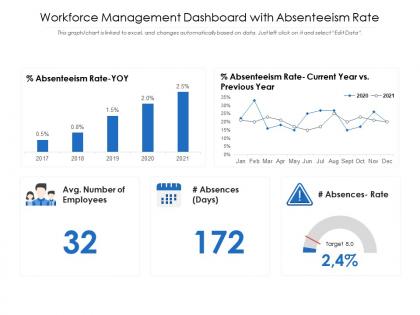
Workforce management dashboard with absenteeism rate




Try Before you Buy Download Free Sample Product
 Impress Your
 Audience
 100%
100% Editable
 Save Hours
 of Time


Our Workforce Management Dashboard With Absenteeism Rate are topically designed to provide an attractive backdrop to any subject. Use them to look like a presentation pro.
People who downloaded this PowerPoint presentation also viewed the following :
Workforce management dashboard with absenteeism rate with all 2 slides:
Use our Workforce Management Dashboard With Absenteeism Rate to effectively help you save your valuable time. They are readymade to fit into any presentation structure.
FAQs for Workforce management dashboard
Effective workforce management dashboards should include employee productivity metrics, attendance and scheduling data, labor cost analysis, performance indicators, and resource allocation tracking. These comprehensive metrics enable organizations to streamline operations, optimize staffing levels, and reduce operational costs, with many companies finding that integrated dashboard visibility ultimately delivers enhanced workforce efficiency and strategic competitive advantage.
Real-time data enhances workforce management decision-making by providing instant visibility into staffing levels, performance metrics, and operational bottlenecks, enabling immediate adjustments rather than reactive responses. Through live dashboards, managers can optimize shift scheduling, reduce overtime costs, and address productivity gaps as they occur, with many organizations finding that this immediate insight ultimately delivers improved efficiency and enhanced employee satisfaction.
Technology serves as the foundation for workforce management dashboards, enabling real-time data integration, automated analytics, cloud-based accessibility, and mobile functionality. These technological capabilities streamline scheduling processes, enhance performance tracking, and deliver predictive insights, with many organizations finding that advanced dashboard technologies ultimately reduce operational costs while improving employee productivity and strategic decision-making across departments.
Organizations can tailor workforce management dashboards by configuring industry-specific metrics, customizing KPI displays, integrating sector-relevant data sources, and adapting visualization formats to match operational priorities. Healthcare systems might emphasize patient-to-staff ratios and compliance tracking, while manufacturing facilities focus on shift efficiency and safety metrics, ultimately delivering targeted insights that enhance decision-making and operational performance.
Workforce management dashboards enhance employee engagement by providing real-time performance visibility, transparent goal tracking, recognition opportunities, personalized development insights, and direct feedback channels. These systems streamline communication between managers and teams while delivering actionable data on productivity metrics, ultimately enabling organizations to create more responsive work environments that boost retention and job satisfaction.
Visualization techniques improve workforce data understanding by transforming complex metrics into intuitive charts, graphs, and heat maps that reveal patterns, trends, and anomalies at a glance. These visual representations enable HR leaders and managers to quickly identify performance gaps, resource allocation opportunities, and staffing needs across departments, ultimately delivering faster decision-making and more strategic workforce planning.
Common pitfalls include overwhelming users with excessive data, neglecting mobile optimization, poor visual hierarchy, inadequate user training, and ignoring stakeholder feedback during development. These design challenges can significantly impact adoption rates and decision-making effectiveness, with many organizations finding that iterative testing, clear metrics prioritization, and intuitive navigation ultimately deliver better user engagement and operational outcomes.
Historical data trends can be incorporated through predictive analytics modules, seasonal pattern recognition, trend visualization tools, and automated forecasting algorithms that analyze past performance metrics. These technologies streamline workforce planning by identifying staffing cycles, predicting demand fluctuations, and optimizing resource allocation, with many organizations finding that data-driven forecasting reduces scheduling costs while enhancing operational efficiency.
Best practices for ensuring data accuracy in workforce management dashboards include automated data validation, real-time synchronization with HR systems, regular audit protocols, standardized data entry processes, and comprehensive user training programs. These methods streamline operations by minimizing human error, enhancing reporting reliability, and improving decision-making capabilities, with many organizations finding that consistent data governance ultimately delivers better workforce insights and operational efficiency.
Mobile access to workforce management dashboards improves operational efficiency by enabling real-time decision-making, instant schedule adjustments, and immediate response to staffing challenges from anywhere. Field managers in retail, healthcare, and manufacturing can quickly approve time-off requests, reassign tasks, and monitor productivity metrics on-the-go, ultimately reducing delays and streamlining workforce coordination across distributed operations.
A well-designed workforce management dashboard accelerates HR decision-making by providing real-time analytics, predictive insights, automated reporting, and centralized data visualization in one accessible interface. Through comprehensive dashboards, HR teams streamline talent acquisition, optimize resource allocation, and enhance employee engagement strategies, while reducing time-to-decision by up to 40%, ultimately delivering faster strategic responses and improved organizational agility.
Workforce management dashboards support compliance by automatically tracking labor law adherence, overtime regulations, break requirements, and certification renewals through real-time monitoring and alert systems. These platforms enable organizations to generate audit trails, manage documentation requirements, and ensure regulatory compliance across multiple locations, with many companies finding that automated compliance tracking reduces violations and streamlines regulatory reporting processes.
Operational workforce management dashboards focus on real-time metrics like scheduling, attendance, productivity tracking, and immediate staffing adjustments, while strategic dashboards emphasize long-term trends, workforce planning, talent analytics, and organizational capacity forecasting. Strategic dashboards enable executives to make informed decisions about resource allocation, skills development, and competitive positioning, ultimately delivering enhanced operational efficiency and strategic workforce optimization.
Organizations can leverage employee feedback through surveys, focus groups, usability testing, and iterative design sessions to identify essential metrics, preferred visualizations, and workflow requirements. This user-centric approach enables companies to create more intuitive, actionable dashboards that enhance productivity and engagement, with many finding that employee-informed designs deliver significantly higher adoption rates and operational effectiveness.
Key productivity metrics include task completion rates, hours worked versus output delivered, employee utilization rates, project timeline adherence, and quality scores across departments. These dashboards enable managers to identify bottlenecks, optimize resource allocation, and track performance trends, with many organizations finding that real-time visibility ultimately enhances operational efficiency and strategic workforce planning.
-
Really like the color and design of the presentation.
-
Commendable slides with attractive designs. Extremely pleased with the fact that they are easy to modify. Great work!
-
Graphics are very appealing to eyes.
-
Good research work and creative work done on every template.