


Workplace Resources For Conflict Resolution Training Ppt




Try Before you Buy Download Free Sample Product
 Impress Your
 Audience
 100%
100% Editable
 Save Hours
 of Time


This set of slides in detail discusses conflict resolution resources at the workplace, which are internal expertise human resources, an ombudsman, and shared neutrals and external expertise conflict coaches, dispute resolution centers, and mediators. Further, in-depth, it covers the mediation strategy for resolving workplace conflict.
People who downloaded this PowerPoint presentation also viewed the following :
Content of this Powerpoint Presentation
Slide 1
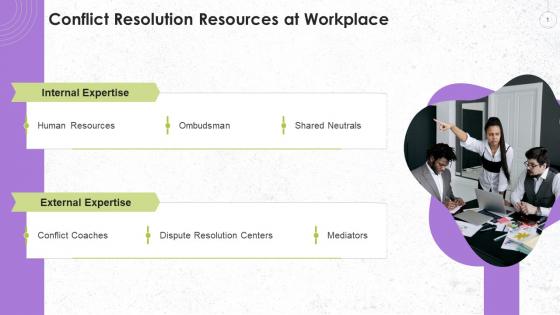
This slide highlights multiple conflict resolution resources at the workplace, i.e., internal and external expertise. Internal expertise includes human resources, an ombudsman, and shared neutrals. External expertise consists of conflict coaches, dispute resolution centers, and mediators.
Slide 2
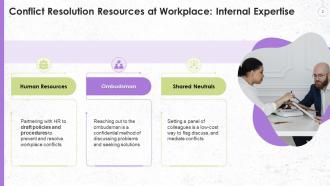
This slide provides information on internal resources in the organization that help resolve workplace conflicts. The multiple resources are HRs, ombudsman, and shared neutrals.
Slide 3
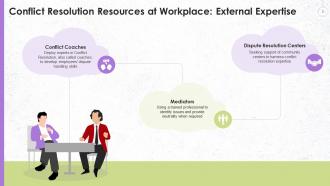
This slide provides information on multiple sources outside the organization to help resolve workplace conflicts, such as conflict coaches, mediators, and dispute resolution centers.
Slide 4
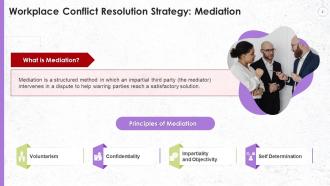
This slide is a comprehensive, but succinct source of information on mediation, i.e., a structured method in which an impartial third party (the mediator) intervenes in a dispute to help parties to a conflict reach a satisfactory solution. The slide also covers details of multiple principles associated with mediation These are voluntarism, confidentiality, impartiality and objectivity, and self-determination.
Instructor's Notes:
A brief on multiple principles associated with mediation are:
- Voluntarism: The warring parties enter the mediation process according to their own will and have the right to exit the process at any stage or time
- Confidentiality: Any information shared during the mediation process remains confidential, giving employees in conflict the freedom to express themselves without any fear or reservation
- Impartiality and Objectivity: Mediators take a neutral stance to ensure that the mediation process remains impartial and objective
- Self-Determination: In the mediation process, it is the parties to a conflict that reach an agreement. A mediator guides them to a solution with his/her skill in asking the parties to think deeply about solutions
Slide 5
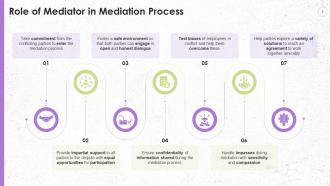
This slide list the responsibilities of a mediator in the mediation process, such as providing impartial support to all parties to the dispute, fostering a safe environment so that both parties can engage in open and honest dialogue and helping parties explore a variety of solutions to reach an agreement to work together.
Slide 6
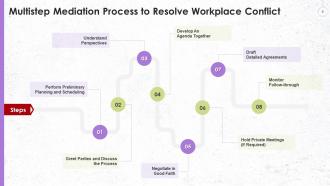
This slide showcases the multistep mediation process to resolve workplace disputes. The major steps to be executed in order are: preliminary planning, scheduling, and room setup, greet parties and discuss the process, It also involves sharing perspectives, build an agenda together, negotiate in good faith, hold private meetings if necessary, draft agreements with details, and monitor follow-through
Instructor's Notes:
- Step1 - Perform Preliminary Planning and Scheduling: Calling the right people at the right time in the right room is the first step to resolving a workplace conflict. Do research upfront to identify who is involved in a conflict and then create an inviting environment for conflict resolution talks
- Step 2- Greet Parties and Discuss Process: Set ground rules, discuss your role as a neutral facilitator, and assure parties to the conflict that you will help them resolve their differences, and reach an amicable solution
- Step 3 - Understand Perspectives: Neutralize emotional language, reflect and reframe conflict points to demonstrate active listening towards each party's point of view for a better understanding of their respective perspectives
- Step 4 - Develop An Agenda Together: Post-hearing each party's perspective, prepare a cooperative agenda by guiding employees to build a list of topics to be discussed in the conflict resolution meeting
- Step 5 - Negotiate in Good Faith: As a silent player, provide employees the required space to brainstorm and prepare a proposal to create long-lasting and durable solutions
- Step 6 - Hold Private Meetings (If Required): Meeting privately will allow each employee to share sensitive information and ask for what they need. Connecting with both parties independently can help the mediator find common ground around which a consensus can be developed and shared with the disputing parties
- Step 7 - Draft Detailed Agreements: Draft detailed agreements with well-defined roles and responsibilities of each employee ensure that agreed-upon solutions are implemented, with commitment solutions
- Step 8 - Monitor Follow-through: Maintain a follow-through to ensure employees walk the talk on the agreed-upon points of the conflict agreement. Also, check for any signs of brewing resentment and coach employees to resolve issues amicably
Slide 7
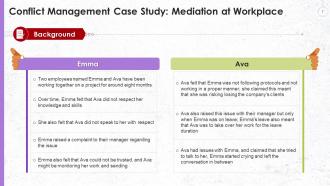
This slide provides background of the case study on conflict management mediation at workplace. The major cause of conflict mentioned is unclear communication between two employees.
Slide 8
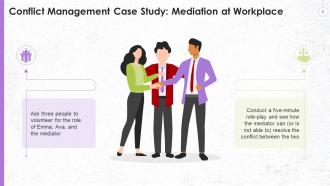
This slide showcases the question for workplace conflict management mediation case study. A trainer can use this question to conduct a roleplay during a conflict management mediation training session.
Slide 9
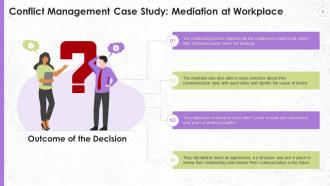
This slide showcases the outcome of the workplace conflict management mediation case study. It explains that mediation process helps both employees understand how and why was their communication style causing conflict.
Workplace Resources For Conflict Resolution Training Ppt with all 25 slides:
Use our Workplace Resources For Conflict Resolution Training Ppt to effectively help you save your valuable time. They are readymade to fit into any presentation structure.








FAQs for Workplace Resources For Conflict
Effective conflict resolution training encompasses active listening, emotional intelligence, problem-solving techniques, communication skills, and mediation strategies. These principles work together by fostering understanding between parties, identifying root causes rather than symptoms, and creating collaborative solutions, with many organizations finding that structured training programs significantly reduce workplace disputes while enhancing team productivity and employee satisfaction.
Organizations can assess conflict resolution training needs through employee surveys, exit interview analysis, performance review patterns, HR incident reports, and 360-degree feedback assessments. These evaluation methods help identify communication gaps, recurring workplace tensions, and skill deficiencies across departments, while many companies find that proactive assessment ultimately reduces turnover costs and enhances overall productivity.
Common workplace conflicts include interpersonal disagreements, resource allocation disputes, communication breakdowns, role clarity issues, and performance-related tensions. Targeted training addresses these through active listening workshops, mediation techniques, and structured dialogue frameworks, enabling teams to resolve disputes constructively while enhancing collaboration, with many organizations finding that proactive conflict resolution ultimately delivers improved productivity and stronger workplace relationships.
Emotional intelligence enhances conflict resolution training by developing self-awareness, empathy, and emotional regulation skills that enable participants to manage tensions constructively. Through EI-focused modules, organizations in healthcare, finance, and customer service find that employees can de-escalate disputes more effectively, communicate with greater clarity, and ultimately build stronger collaborative relationships while reducing workplace friction.
Effective techniques include creating safe spaces for dialogue, using active listening protocols, implementing structured turn-taking, establishing ground rules for respectful interaction, and employing neutral facilitation methods. These approaches streamline communication by reducing defensive responses, encouraging transparency, and building trust between parties, with many organizations finding that structured dialogue processes ultimately deliver faster resolution times and stronger working relationships.
Trainers can tailor conflict resolution strategies by conducting cultural assessments, adapting communication styles to match cultural norms, incorporating diverse case studies, and offering multilingual resources. Through customized role-playing scenarios and culturally relevant examples, organizations in sectors like international banking and global manufacturing enhance team collaboration, reduce workplace tensions, and ultimately deliver more inclusive, effective conflict resolution outcomes.
Mediation serves as a cornerstone of conflict resolution training programs, teaching participants structured dialogue techniques, neutral facilitation skills, active listening methods, and collaborative problem-solving approaches. Through hands-on mediation practice, organizations enhance workplace communication, reduce costly disputes, and build internal capacity for resolving conflicts, with many companies finding that mediation-trained employees significantly improve team dynamics and operational efficiency.
Virtual conflict resolution training can be equally effective as in-person sessions through interactive simulations, real-time role-playing exercises, breakout room discussions, and video-based scenario analysis. Many organizations find that virtual platforms enhance accessibility and participation, while features like chat functions and screen sharing facilitate deeper engagement, ultimately delivering consistent learning outcomes and improved workplace communication skills.
Conflict resolution training programs include role-playing scenarios, case study analysis, active listening exercises, negotiation simulations, and communication skills workshops. These activities enhance learning by providing hands-on practice with real workplace situations, enabling participants to develop practical mediation techniques, emotional intelligence, and collaborative problem-solving skills that ultimately improve team dynamics and organizational productivity.
Conflict resolution training enhances team dynamics by teaching active listening, empathy development, and constructive communication techniques that address workplace tensions before they escalate. Through structured workshops and role-playing scenarios, teams develop skills for managing disagreements productively, building trust, and fostering collaborative problem-solving, ultimately delivering improved project outcomes and stronger working relationships across departments.
Long-term benefits of conflict resolution training include enhanced workplace communication, reduced employee turnover, increased productivity, improved team collaboration, and stronger organizational culture. Organizations investing in these programs experience significantly lower litigation costs, faster project completion rates, and higher employee satisfaction scores, with many companies finding that improved conflict management skills ultimately deliver sustainable competitive advantage and measurable cost savings.
Trainers can measure effectiveness through pre- and post-training assessments, participant feedback surveys, behavioral observation checklists, role-play evaluations, and workplace incident tracking. These measurement approaches enable organizations to quantify skill development, monitor real-world application of conflict resolution techniques, and demonstrate tangible improvements in team dynamics, ultimately delivering reduced workplace tensions and enhanced collaborative productivity.
Ethical considerations in conflict resolution training include maintaining confidentiality, ensuring cultural sensitivity, avoiding bias, respecting participant autonomy, and establishing clear boundaries between training and actual mediation. These principles enhance trust and effectiveness by creating safe learning environments, promoting inclusive practices, and ensuring participants develop skills responsibly, ultimately delivering more credible conflict resolution capabilities across diverse organizational settings.
Leaders sustain conflict resolution cultures by modeling collaborative behavior, providing regular training opportunities, establishing clear communication protocols, and creating psychological safety for open dialogue. Through consistent reinforcement and recognition of constructive conflict management, organizations enhance team cohesion, reduce workplace tension, and improve decision-making processes, with many finding that sustained leadership commitment ultimately drives long-term cultural transformation.
Resources for developing conflict resolution training materials include interactive case studies, role-playing scenarios, communication frameworks, mediation simulations, and assessment tools. These materials enhance learning by providing real-world workplace situations, structured dialogue techniques, and measurable outcomes, with many organizations finding that comprehensive training resources significantly improve team dynamics and reduce workplace disputes.
-
The way SlideTeam professionals work is exceptional. Thanks for being so helpful!
-
Topic best represented with attractive design.