


Year based timeline for business flat powerpoint design





Try Before you Buy Download Free Sample Product
 Impress Your
 Audience
 100%
100% Editable
 Save Hours
 of Time


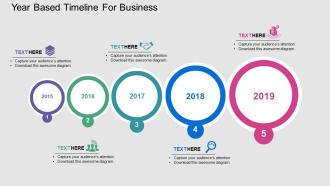
Creating a project timeline requires coordinating project activities in conjunction with the ongoing business activities. So, here is our year based timeline for business flat PowerPoint design slide. This PowerPoint template diagram has been crafted with graphic of year based timeline diagram. This slide visual contains the concept of business time management and success representation. A good time management plan identifies anticipated costs early on to develop a realistic budget. By utilizing our slide, a project manager will identify and detail activities required in each phase of a project and lead teams with members of your staff to carry out each phase. Working within the parameters of a project management plan, a schedule sets out target dates for completion of tasks within each phase. The time line is directly correlated to the scope of a project. Understanding effective time management techniques helps organizations carry out large-scale projects on time, on budget and with minimal disruption to the rest of the business. So, keeping all these aspects in mind, download and use our slide. Assets expand with our Year Based Timeline For Business Flat Powerpoint Design. You will acquire a bigger footprint.
People who downloaded this PowerPoint presentation also viewed the following :
Year based timeline for business flat powerpoint design with all 4 slides:
Thousands of Year Based Timeline For Business Flat Powerpoint Design designs are waiting to make your presentations sparkle. Make sure you get the attention you deserve.

FAQs for Year based timeline for business
Key components include strategic objectives, quarterly milestones, product launches, financial targets, team expansions, and market entry plans. These elements streamline organizational alignment by establishing clear deadlines, resource allocation phases, and performance metrics, with many companies finding that comprehensive timelines enhance cross-departmental coordination and ultimately deliver improved project execution and competitive positioning.
A yearly business timeline enables strategic planning by providing structured milestone mapping, resource allocation scheduling, performance tracking intervals, and deadline accountability across quarters. This systematic approach helps organizations coordinate cross-departmental initiatives, anticipate market opportunities, and maintain competitive momentum, with many companies finding that visual timeline planning significantly enhances execution consistency and strategic goal achievement.
Effective tools for creating yearly business timelines include Microsoft Project, Visio, Lucidchart, Canva, and PowerPoint, each offering distinct visualization capabilities and customization options. These platforms streamline timeline creation through drag-and-drop functionality, professional templates, and collaborative features, with many organizations finding that combining visual appeal with clear milestone tracking ultimately enhances stakeholder communication and project transparency.
Businesses integrate financial forecasts by aligning revenue projections, budget allocations, and cash flow predictions with quarterly milestones, seasonal trends, and strategic initiatives throughout their timeline. This integration enables organizations to synchronize marketing campaigns with revenue targets, coordinate product launches with budget cycles, and adjust resource allocation based on projected performance, ultimately delivering improved financial planning and operational efficiency.
A yearly business timeline serves as the strategic foundation for project management by establishing project sequencing, resource allocation windows, milestone coordination, and deadline dependencies across all initiatives. Through comprehensive annual planning, organizations streamline project prioritization, minimize resource conflicts, and enhance cross-departmental collaboration, while enabling proactive risk management and ultimately delivering improved operational efficiency and strategic alignment.
Seasonal trends can be effectively highlighted through color-coded quarters, visual markers for peak periods, integrated sales data overlays, and comparative year-over-year sections within your timeline design. By incorporating these elements, retailers, hospitality businesses, and financial services can better anticipate demand fluctuations, optimize inventory management, and align marketing campaigns, ultimately delivering more strategic resource allocation and improved operational efficiency.
Common mistakes include setting unrealistic deadlines, failing to account for dependencies between tasks, neglecting buffer time for unexpected challenges, and creating overly rigid schedules without flexibility for market changes. Many organizations find that inadequate stakeholder input, insufficient resource allocation planning, and lack of regular review checkpoints ultimately undermine timeline effectiveness, leading to missed opportunities and operational inefficiencies.
A yearly business timeline enhances team collaboration and communication by providing shared visibility into project dependencies, milestone alignments, and resource allocation across departments. This strategic planning tool enables teams to coordinate efforts more effectively, anticipate bottlenecks before they occur, and maintain consistent progress tracking, ultimately delivering improved project outcomes and stronger cross-functional partnerships.
Crucial visual elements include color-coded milestones, clear chronological markers, progress indicators, achievement icons, and strategic spacing between phases. These design components enhance comprehension by distinguishing quarterly goals, highlighting key deliverables, and creating visual hierarchy, with many organizations finding that well-designed timelines improve stakeholder engagement and facilitate strategic planning discussions.
Businesses use yearly business timelines to track performance metrics by establishing quarterly milestones, monthly KPI checkpoints, and annual review cycles that monitor revenue growth, operational efficiency, and strategic goal completion. This structured approach enables organizations to identify trends, adjust strategies mid-course, and benchmark progress against industry standards, ultimately delivering enhanced accountability and competitive advantage.
Sharing yearly business timelines with stakeholders enhances transparency, aligns expectations, facilitates resource planning, improves accountability, and strengthens strategic communication across organizations. This approach enables investors, employees, and partners to synchronize their efforts with business milestones, ultimately delivering improved collaboration and stakeholder confidence while supporting more effective decision-making throughout the year.
Small organizations can adapt yearly business timelines through simplified milestone tracking, quarterly reviews, and flexible resource allocation, while large organizations require detailed departmental coordination, multi-layered approval processes, and complex integration points. Through scalable planning approaches, small businesses streamline decision-making and pivot quickly, whereas enterprises leverage structured governance and cross-functional alignment, ultimately enabling both to achieve strategic objectives efficiently.
Missing key milestones on your yearly business timeline creates cascading effects including delayed product launches, budget overruns, missed market opportunities, reduced investor confidence, and compromised competitive positioning. These disruptions ripple through departments like marketing, sales, and operations, ultimately affecting revenue targets and strategic growth initiatives, with many organizations finding that milestone delays compound throughout the remaining fiscal year.
Businesses should review their yearly timeline quarterly to ensure alignment with market changes, resource availability, and strategic priorities, while conducting comprehensive annual updates during planning cycles. This approach enables organizations to adapt to evolving conditions, capitalize on emerging opportunities, and maintain operational efficiency, with many companies finding that regular reviews significantly improve goal achievement and competitive positioning.
Present your yearly business timeline using clear visual hierarchy, consistent formatting, and milestone-based sections that highlight key deliverables, dependencies, and resource requirements. Incorporate quarterly progress checkpoints, risk mitigation strategies, and flexible buffer periods while emphasizing cross-functional collaboration points. This approach enables stakeholders to quickly grasp strategic priorities, identify potential bottlenecks, and align resources effectively, ultimately delivering enhanced project transparency and improved decision-making capabilities throughout the organization.
-
Awesome use of colors and designs in product templates.
-
Excellent design and quick turnaround.