


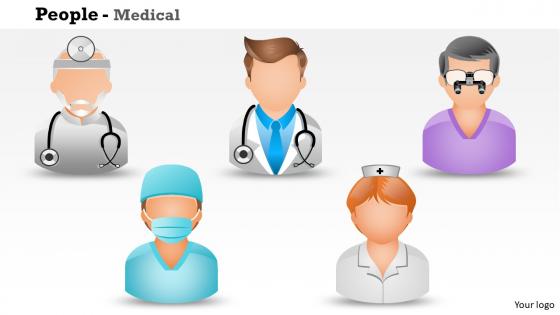
0514 3d graphic of medical people medical images for powerpoint




Try Before you Buy Download Free Sample Product
 Impress Your
 Audience
 100%
100% Editable
 Save Hours
 of Time


Are you looking for doctor images? Then our 0514 3d graphic of medical people medical images for PowerPoint will help you greatly. This PowerPoint image template is dedicated to medical staff like doctors and its involvement in medical field. This Business Power Point template is designed with unique graphic with 3d effect of medical peoples. To show the value of medical peoples you can use this template in medical presentation. Use this template in your presentation to show the contribution of staff in hospitals, dentistry, emergency rooms, clinics and medical profession. Besides this, the PPT template also beneficial for the students studying medical science. This PPT model having nurse graphics is perfect for the health care experts as this will assist them to make their spectators recognize the functionality of people working in medical assistance. The presentation diagram is suitable for the medicinal authorities as there is design available for them to present the information related to their industry. Therefore you are just a click away! Start downloading and work over an extraordinary PPT presentation to showcase the topic. Go great guns with our 0514 3d Graphic Of Medical People Medical Images For Powerpoint. Advance ahead with full aplomb.
People who downloaded this PowerPoint presentation also viewed the following :
0514 3d graphic of medical people medical images for powerpoint with all 5 slides:
Explain your assessment in a genial atmosphere. Our 0514 3d Graphic Of Medical People Medical Images For Powerpoint avoid aggressiveness.



FAQs for 0514 3d graphic of medical people medical
Dude, real-time rendering is everywhere now - doctors can actually rotate 3D models while they're operating. Wild stuff. AI is handling all that tedious segmentation work too, which used to take hours. VR training is getting crazy popular - surgeons practice entire procedures before the real thing. Honestly makes total sense when you think about it. Volumetric rendering got way faster recently, and AR integration is blowing up. If you want to stay relevant, definitely check out Unity or Unreal for medical apps. That's where everything's heading.
Dude, 3D medical graphics are a game changer for getting patients to actually understand what's wrong with them. Like, instead of describing a torn meniscus with confusing medical jargon, you just show them this rotating model and boom - they get it. Patient compliance shoots way up when people can visualize what's happening inside their body. I've seen docs use even basic 3D animations during consultations (nothing fancy) and patients suddenly start asking way smarter questions. They're more engaged with treatment too. Honestly beats drawing stick figures on napkins, which I've definitely seen happen.
So for 3D medical graphics, **3D Slicer** is your best bet to start - it's free and built specifically for medical imaging. **OsiriX** if you're on Mac, **ImageJ** with plugins for basic stuff. **Blender** is actually really solid for this kind of work, plus the community is massive so you'll find help everywhere. The fancy stuff like **Materialise Mimics** and **Amira** are what the pros use but they'll cost you. **ParaView** handles simulation data well if that's your thing. Honestly though, just grab 3D Slicer first since it won't cost anything and see how you like it.
Dude, the 3D stuff is a game changer. You can literally spin around a patient's anatomy before surgery and spot all the tricky bits ahead of time. Way better than squinting at flat scans, honestly. Your whole team can look at the same model too, so nobody's confused about the plan. I've heard it cuts down OR time pretty significantly - fewer "oh shit" moments mid-procedure. My buddy in cardiothoracic swears by it now. Next complex case you get, just bug radiology to make you a 3D model. Seriously, once you try it you won't go back.
Dude, 3D medical graphics are insane for teaching. Students can actually rotate organs and peel back layers instead of staring at boring textbook diagrams. The spatial understanding they get is so much better - like night and day difference. Plus you can practice procedures virtually before working on real patients, which is pretty clutch. Retention rates go way up too. Honestly, I still remember being amazed the first time I saw a beating heart in VR. Anyway, if you're training people, definitely check out those VR anatomy platforms or 3D simulation software. Saves teaching time and students actually get it.
Dude, 3D models are a game changer for complex anatomy stuff. When you've got tangled blood vessels or weird tumor boundaries, flat scans just don't cut it. Being able to rotate and slice through layers? Amazing. I swear, once you can virtually "hold" someone's heart or brain, everything clicks differently. The spatial thing makes such a difference for tricky diagnoses - especially when multiple structures are involved. Honestly, I was skeptical at first, but now I pull up 3D reconstructions whenever I'm stuck on a case. You'll probably spot details you'd totally miss otherwise.
Honestly, 3D medical graphics are a total game-changer for getting your whole team aligned. When everyone can look at the same 3D model instead of trying to decipher radiology reports, communication gets so much clearer. Surgeons, oncologists, nurses - they can all point to exactly what they're talking about. The spatial relationships just click instantly when you can rotate and highlight specific structures. I've seen teams waste way too much time in meetings talking past each other. Pull up a 3D reconstruction in your next case review and watch how fast everyone gets on the same page - it's pretty wild.
Honestly, consent is your biggest headache here. Patients need to know exactly how you're using their medical data for these 3D models - especially if it's going beyond their own treatment into research or teaching. Privacy's another nightmare because these detailed visualizations can be super identifying, so your security has to be bulletproof. Accuracy matters too since surgical planning errors could literally kill someone. I'd validate everything against multiple sources and be upfront about any limitations. Oh, and definitely have solid protocols for both consent and data handling from day one.
Honestly, 3D printing has completely changed how we approach medical graphics. Your models need to actually work in the real world now - accounting for material thickness, support structures, all that technical stuff. Pretty wild shift from just making things look good. Surgeons are using these printed models for surgery prep, so internal geometries have to be crystal clear. I mean, you're literally creating blueprints for things that could save someone's life instead of just nice visuals. Design with printability in mind from the start, not as an afterthought. It's way more responsibility but also way cooler.
Honestly, 3D medical animations are a total game-changer for getting patients to actually understand their procedures. Like, who can really picture what's happening from those generic pamphlets? When patients see a realistic visualization of what's going down in their body, they retain so much more info than just nodding along to confusing medical jargon. Plus it cuts down on anxiety big time. Studies back this up too - patients feel way more confident about their decisions when they actually get what they're signing up for. Better understanding means more genuine consent and realistic expectations about recovery. It's pretty much a win-win for everyone involved.
So AR lets you overlay 3D medical stuff right onto real environments - it's honestly pretty crazy. Instead of staring at flat screens, you can project a patient's actual 3D anatomy onto their body during surgery. Way more intuitive than traditional displays, and it cuts down on errors too. You can control everything with hand gestures or just talk to it. Oh, and the spatial context thing is huge - like, you finally get proper depth perception. If you're building anything in this space, definitely mess around with ARKit or ARCore first. Start simple with basic overlays and see where it goes.
Honestly, the spatial reasoning thing trips up a lot of people - you're basically trying to mentally rotate these 3D structures in your head, which is weird at first. All that visual detail can be overwhelming too. Like, there's so much info packed in there that you miss the important stuff sometimes. Different software systems have totally different interfaces, so you're always figuring out new controls. Oh, and the hardware demands are no joke. My advice? Start simple with basic 3D cases and keep those 2D images handy when you're working through the complex reconstructions. Trust me on that one.
So you'd basically adjust the skin tones, body types, and anatomical stuff to match your actual patients. For kids, go colorful and simple - they love that. Older patients need bigger text and better contrast though. The language thing matters too, obviously. What's crazy is how much more patients pay attention when they actually see themselves in the graphics. Makes such a difference. Oh, and definitely think about cultural stuff around body representation - some groups are way more sensitive about that. I'd start by just asking your patients what they'd prefer. Survey them or whatever works.
Dude, this stuff is gonna be huge for remote medicine. Doctors will finally be able to show patients their actual CT scans and MRIs as 3D models during video calls - way better than squinting at flat images together. Some hospitals are already testing AR/VR for surgery planning, which is honestly pretty wild. Remote consultations will actually feel useful once you can rotate and zoom through someone's brain scan in real-time. Bandwidth keeps getting better too, so the tech won't be laggy forever. I'd mess around with 3D visualization tools now if I were you - get ahead of the curve before everyone's doing it.
Dude, regulatory stuff is no joke for medical 3D graphics. FDA and CE marking require tons of documentation proving your visuals won't mess up a diagnosis. You'll need validation studies, risk assessments, the whole nine yards. Different rules apply depending if it's diagnostic software vs patient education materials - which is annoying but makes sense I guess. My advice? Start planning compliance from day one. Trust me, trying to add it later is absolute hell and costs way more. Budget extra time and money upfront.
-
Awesome presentation, really professional and easy to edit.
-
Excellent work done on template design and graphics.