


0914 cirrhosis of the liver and normal liver structure medical images for powerpoint




Try Before you Buy Download Free Sample Product
 Impress Your
 Audience
 100%
100% Editable
 Save Hours
 of Time


Each presentation has a goal. Meet those goals more efficiently with classic 0914 Cirrhosis Of The Liver And Normal Liver Structure Medical Images For PowerPoint design.
People who downloaded this PowerPoint presentation also viewed the following :
Content of this Powerpoint Presentation
Description:
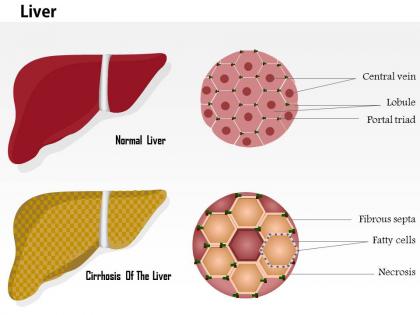
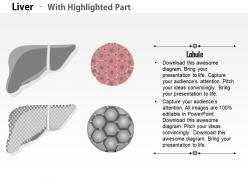
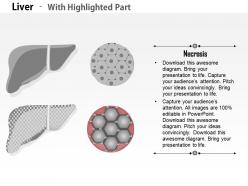
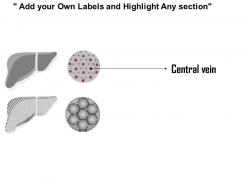
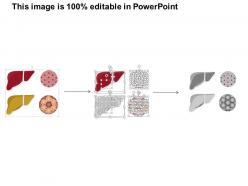
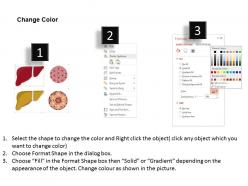
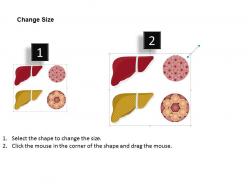
The image provides a comparative visualization between a healthy liver and one affected by cirrhosis. On the top left, there's an illustration of a normal liver with a deep red color, indicative of a healthy organ. Adjacent to it is a microscopic representation of the liver tissue, highlighting the organized structure of liver lobules with central veins and portal triads, which are essential for blood supply and bile production.
Below, the image contrasts this with a liver suffering from cirrhosis, depicted in a mottled yellow-brown color, signifying damage and disease. The corresponding microscopic view shows disorganized liver architecture with fibrous septa, which are bands of scar tissue resulting from long-term inflammation and injury. Also evident are fatty cells, associated with conditions like fatty liver disease, and areas of necrosis, where liver cells have died.
This educational graphic is useful for medical professionals to explain the pathophysiology of liver diseases to students or patients, emphasizing the impact of conditions like alcohol abuse, hepatitis, or fatty liver disease on liver structure and function.
Use Cases:
Educational visuals like this liver diagram are invaluable across various sectors, particularly where health education and patient care are involved.
1. Medical Education:
Use: Teaching students about liver anatomy and pathology
Presenter: Medical professors
Audience: Medical students, residents
2. Healthcare:
Use: Explaining liver conditions to patients
Presenter: Physicians, nurses
Audience: Patients, family members
3. Pharmaceuticals:
Use: Discussing drug effects on liver health
Presenter: Medical science liaisons, researchers
Audience: Healthcare professionals, sales teams
4. Biotechnology:
Use: Illustrating research findings in hepatology
Presenter: Research scientists
Audience: Investors, regulatory agencies
5. Public Health:
Use: Educating on liver disease prevention
Presenter: Health educators
Audience: General public, community groups
6. Health Insurance:
Use: Informing about coverages for liver diseases
Presenter: Insurance agents
Audience: Policyholders, brokers
7. Corporate Wellness Programs:
Use: Promoting liver health in the workplace
Presenter: Wellness coordinators
Audience: Employees, HR managers
0914 cirrhosis of the liver and normal liver structure medical images for powerpoint with all 10 slides:
Chronicle your thoughts with our 0914 Cirrhosis Of The Liver And Normal Liver Structure Medical Images For PowerPoint. They will remain an inspiration for years to come.

FAQs for 0914 cirrhosis of the liver and normal liver structure medical
Alcohol abuse and hepatitis B/C are the big ones - they cause most cases. But fatty liver disease is exploding now because everyone's getting heavier. You've also got autoimmune stuff, certain meds that mess with your liver, and genetic things like Wilson's disease. Honestly the alcohol and hepatitis cases are what you see most often though. Here's the thing - it takes years to develop, so if you catch whatever's causing it early enough, you can actually stop it from getting worse. That's why people should get checked if they're worried.
Dude, alcohol basically poisons your liver cells - there's this nasty stuff called acetaldehyde that builds up and causes inflammation. Your liver tries to repair itself but can't keep up with constant drinking. Scar tissue starts replacing the healthy parts, and boom - cirrhosis. The messed up thing? You won't feel it happening for years. My uncle went through this actually. Look, if you're hitting it hard regularly, get some blood work done. Seriously consider cutting back before the damage becomes permanent. Your liver's tougher than you think but it's not invincible.
So yeah, Hep B and C are behind like 60% of liver cirrhosis cases globally - pretty wild numbers. What happens is these viruses cause ongoing inflammation that just wears down your liver cells over years. Your body keeps trying to patch things up with scar tissue, but it's honestly terrible at the job. More scars mean your liver works worse and worse until you hit cirrhosis territory. Hep C is the worst because you won't even know you have it until your liver's already pretty damaged. Seriously though, if you think you might've been exposed to either one, just get tested. The antiviral treatments actually work really well if you catch it early enough.
Yeah, NAFLD can totally turn into cirrhosis - it's becoming super common actually. Basically your liver goes from just being fatty to NASH, where inflammation starts wrecking liver cells. Pretty wild how you won't even feel it happening at first. The damage keeps building up until you get scarring, then full-blown cirrhosis if nothing changes. Main culprits are being overweight, diabetes, that whole metabolic mess. Oh and routine blood work can catch it early - my doctor's always harping about that. Bottom line is fixing your diet and metabolism before the scarring gets bad.
So cirrhosis symptoms are pretty rough - your patients feel exhausted, weak, nauseous, zero appetite. Jaundice shows up with that classic yellow tint to skin and eyes. Abdominal swelling happens from fluid retention, plus they bruise super easily since clotting's all messed up. Those weird spider veins on the skin are a dead giveaway too. Mental confusion kicks in later when toxins build up - honestly that's when things get really concerning. Early stages though? Sometimes zero symptoms, which is annoying. If labs or history make you suspicious, definitely get imaging or push for biopsy.
So they'll start with basic blood work - liver function tests like ALT, AST, bilirubin levels. Physical exam too, checking for jaundice or belly swelling. Usually an ultrasound comes next, though CT or MRI show more detail if needed. The blood results can actually tell you a lot right off the bat. Biopsy used to be the gold standard but now they're doing more elastography - way less invasive and patients prefer it obviously. Early cirrhosis is tricky though since it doesn't always show clear symptoms. That's why docs won't diagnose based on just one test result.
So you'll mostly use Child-Pugh classification - it scores five things: bilirubin, albumin, PT/INR, ascites, and hepatic encephalopathy. Each criterion gets 1-3 points. Class A is 5-6 points, B is 7-9, C is 10-15. Basically goes from compensated to totally decompensated. MELD score exists too and uses just lab values (bilirubin, creatinine, INR), but that's more for transplant lists honestly. For regular patient care, Child-Pugh is way better since it actually tells you how the patient's functioning clinically, not just numbers on paper.
Honestly, nutrition with cirrhosis is way trickier than people think. Your patients actually need MORE protein - like 1.2-1.5g/kg - not less (that old restriction thing is mostly BS unless they're in hepatic encephalopathy). Sodium's the real enemy for fluid retention though. Malnutrition happens constantly with these folks, so calories matter big time. B vitamins get weird too since absorption goes haywire. The whole thing's a balancing act - you're trying to get enough food in them while keeping sodium low for ascites. Get a dietitian involved early if you can. They're seriously worth their weight in gold for figuring out meal plans that don't suck.
Yeah, you can definitely slow it down with the right changes. First thing - gotta cut alcohol completely. I know that's rough, but it's literally the worst thing for more scarring. Watch your sodium too since it makes you retain water. Keep your weight in check and ditch acetaminophen - that stuff's brutal on your liver. Even just walking regularly helps more than you'd think. The tricky part is doing this stuff consistently, but if you catch it early enough you can actually stop it from getting worse. Makes a huge difference in how you feel day-to-day.
Okay so cirrhosis gets really messy fast. Portal hypertension is probably the scariest part - those varices can bleed out massively, plus you get ascites and the spleen gets huge. Mental status changes from hepatic encephalopathy because ammonia builds up. Higher infection risk too since the liver can't keep up. Kidney function tanks (hepatorenal syndrome), liver cancer rates go up obviously. The whole synthetic function falls apart so clotting gets weird and albumin drops. Once they hit decompensated cirrhosis honestly it's a completely different situation. I'd refer to hepatology way earlier rather than later.
So it really comes down to what's causing it and how far along things are. First priority is stopping the damage - quit drinking, lose weight if it's fatty liver disease, treat the hepatitis. Once you hit decompensated cirrhosis though, you're basically playing whack-a-mole with complications. Lactulose for brain fog, diuretics for fluid buildup, beta-blockers for those gnarly varices. The new hep C drugs are honestly incredible compared to the old interferon nightmare. Portal hypertension gets messy quick. Transplant evaluation becomes the conversation for end-stage cases. Catching it early makes all the difference.
So basically you're looking at MELD scores of 15+ or when they start getting nasty complications - ascites that won't budge, encephalopathy, bleeding varices that keep coming back. Portal hypertension causing real problems is another red flag. They've gotta be stable enough for surgery too (no active drinking, heart's not totally shot). Here's the thing though - don't wait until they're super sick because the waiting lists are brutal. I'd start the evaluation process as soon as you see decompensation starting. Better to be on the list early than scrambling later.
So basically when your liver's scarred up from cirrhosis, it can't break down meds properly anymore. Everything just sits in your system way longer than it should - kinda like that clogged sink analogy but worse. The enzymes that normally clear drugs out are barely functioning. Standard doses become dangerous because nothing's getting processed efficiently. You have to adjust almost everything, especially stuff like Tylenol, pain meds, antidepressants - anything the liver handles. Honestly, hepatic dosing is such a pain but you really can't skip checking those guidelines. It's not worth the risk.
Yeah there's actually decent psych support for cirrhosis patients! Most liver centers have counselors who get the whole chronic illness thing. Support groups are huge too - way better than general therapy sometimes because people actually understand what you're dealing with. The anxiety piece is no joke, honestly that's probably the hardest part. Your liver clinic's social worker is gold though, start there. They know all the local resources and can skip you ahead in line for referrals. Hospital-based therapists are another solid option since they're used to the medical complexity stuff.
Oh totally! Anti-fibrotic drugs like cenicriviroc and selonsertib are showing they can actually reverse liver scarring - crazy considering we used to think cirrhosis was a one-way street. Stem cell therapies are getting tested too, plus some wild bioengineered tissue stuff. Most research is targeting those inflammatory pathways that make fibrosis worse. If you've got early-stage cirrhosis patients, definitely check ClinicalTrials.gov since there's active enrollment happening. Honestly feels like we're finally getting somewhere with this after years of just managing symptoms.
-
Content of slide is easy to understand and edit.
-
It saves your time and decrease your efforts in half.