


120 day action plan of employee employee professional growth ppt guidelines




Try Before you Buy Download Free Sample Product
 Impress Your
 Audience
 100%
100% Editable
 Save Hours
 of Time


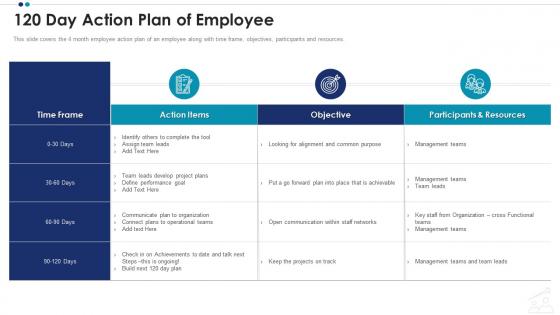
This slide covers the 4 month employee action plan of an employee along with time frame, objectives, participants and resources.
People who downloaded this PowerPoint presentation also viewed the following :
120 day action plan of employee employee professional growth ppt guidelines with all 6 slides:
Use our 120 Day Action Plan Of Employee Employee Professional Growth Ppt Guidelines to effectively help you save your valuable time. They are readymade to fit into any presentation structure.





FAQs for 120 day action plan of employee employee professional
Initial assessment steps include conducting comprehensive skills evaluations, 360-degree feedback sessions, performance data analysis, one-on-one meetings with direct reports, and competency gap identification through standardized assessments. These evaluation methods enable managers to establish baseline capabilities, identify development priorities, and create personalized growth trajectories, ultimately delivering targeted training programs and strategic resource allocation for maximum employee advancement.
Goals for professional growth can be effectively communicated through structured one-on-one meetings, clear written documentation, regular check-ins, and collaborative goal-setting sessions that align individual aspirations with organizational objectives. These communication strategies streamline the development process by ensuring transparency, accountability, and mutual understanding, with many organizations finding that consistent dialogue and documented milestones ultimately deliver enhanced employee engagement and accelerated career progression.
Mentorship serves as a critical guidance mechanism in 120-day action plans, providing personalized coaching, skill development feedback, career pathway insights, and accountability partnerships that accelerate professional growth. Through structured weekly check-ins, goal-setting sessions, and skill-building workshops, mentors help employees navigate challenges, identify opportunities, and achieve measurable progress, with many organizations finding that formal mentorship programs deliver enhanced retention and faster competency development.
Performance metrics can be established through weekly check-ins, monthly goal assessments, skill development tracking, and 360-degree feedback collection, creating measurable benchmarks for growth progress. These monitoring systems enable managers to identify improvement areas, celebrate achievements, and adjust development strategies in real-time, ultimately delivering enhanced employee engagement and accelerated professional advancement across organizations.
Essential resources include mentorship programs, online learning platforms, industry certifications, cross-departmental project opportunities, and professional networking events. These resources work together by providing structured guidance, skill-building capabilities, and real-world application experiences, with many organizations finding that employees who actively engage with multiple development channels achieve faster career progression and deliver enhanced value to their teams.
Feedback integration involves establishing regular check-ins with supervisors, implementing peer review sessions, creating mentorship partnerships, and scheduling quarterly progress assessments throughout the 120-day timeline. These structured touchpoints enable employees to adjust their development strategies based on real-time insights, identify blind spots more effectively, and accelerate skill acquisition, with many organizations finding that consistent feedback loops ultimately deliver faster professional growth and stronger workplace relationships.
**INPUT**: What specific training programs are most beneficial for diverse employee skill sets and career paths? **OUTPUT**: Effective training programs include leadership development workshops, technical skill certifications, cross-functional project management courses, digital literacy training, and mentorship programs tailored to individual career trajectories. These comprehensive approaches enhance employee capabilities by addressing both hard and soft skills, promoting internal mobility, and fostering adaptive learning, with many organizations finding that personalized development paths significantly improve retention while building competitive workforce advantages. **Word count: 60 words**
Potential barriers to professional growth can be identified through comprehensive skills assessments, manager feedback sessions, resource availability audits, and employee self-evaluations that reveal skill gaps, time constraints, and development obstacles. These insights enable organizations to proactively mitigate challenges by providing targeted training resources, flexible scheduling options, mentorship programs, and clear career pathways, ultimately delivering enhanced employee engagement and retention while building stronger internal talent pipelines.
**INPUT**: What strategies can be implemented to ensure employee engagement and accountability throughout the 120 days? **OUTPUT**: Effective engagement strategies include regular check-ins, milestone celebrations, peer mentoring, skill-building workshops, and transparent progress tracking systems. These approaches enhance accountability by establishing clear expectations, providing consistent feedback, and creating collaborative learning environments, with many organizations finding that structured touchpoints and recognition programs ultimately deliver higher completion rates and sustained professional development outcomes.
Cross-functional collaborations can be encouraged through structured project teams, mentorship programs across departments, regular interdepartmental meetings, job rotation opportunities, and cross-training initiatives. These approaches enable employees to build diverse professional relationships, gain broader business perspectives, and develop versatile skill sets, while organizations benefit from enhanced communication, knowledge sharing, and ultimately stronger innovation capacity across all business functions.
Effective techniques include regular feedback sessions, skill-building workshops, mentorship programs, goal-setting frameworks, and celebrating learning milestones. These approaches enhance employee engagement by encouraging continuous learning, promoting resilience through challenges, and creating collaborative environments, with many organizations finding that structured growth initiatives ultimately deliver improved performance and stronger retention rates.
**INPUT**: How can the impact of the 120-day plan on employee performance be measured after its completion? **OUTPUT**: Impact measurement involves performance metrics comparison, skill assessments, goal achievement analysis, 360-degree feedback, and productivity benchmarking against pre-plan baselines. Through systematic evaluation tools, managers can track competency improvements, project outcomes, and behavioral changes, while employees demonstrate enhanced capabilities, ultimately delivering measurable ROI and strategic workforce development across organizations.
Company culture serves as the foundation for professional growth by fostering psychological safety, encouraging continuous learning, celebrating achievements, and providing mentorship opportunities that enable skill development. Organizations with growth-oriented cultures see employees actively pursuing development goals, with many finding that supportive environments accelerate career advancement, improve retention rates, and ultimately deliver stronger business performance through enhanced employee engagement and capability.
Action plans for remote and hybrid environments require flexible delivery methods, virtual collaboration tools, digital learning platforms, regular video check-ins, and asynchronous communication channels. These adaptations enable seamless professional development by accommodating different time zones, work schedules, and home office setups, while maintaining accountability through cloud-based tracking systems, ultimately delivering consistent growth opportunities regardless of physical location.
Successful 120-day plans include healthcare organizations implementing mentorship programs with quarterly skill assessments, tech companies establishing coding bootcamps with project milestones, and financial services creating cross-departmental rotations with competency tracking. These strategic approaches streamline professional development by combining structured learning, measurable outcomes, and practical application, with many organizations finding that employees show 40% faster skill acquisition and significantly improved retention rates.
-
Informative design.
-
Unique research projects to present in meeting.