

1G To 5G Evolution Powerpoint Presentation Slides





Try Before you Buy Download Free Sample Product
 Impress Your
Audience
 100%
Editable
 Save Hours
of Time


Grab our effectively curated 1G to 5G Evolution template. It provides a brief overview of the development and background of the first mobile phone and the evolution of 5G technology over time. We have covered the development of the 5G technology system in wireless telecommunication in our 1G to 5G deck. It exhibits an overview, a list of its main features, and a discussion of its drawbacks. Our 1G to 5G Evolution PPT also includes a summary of the 2.5G and 2.75G systems and information on the main characteristics and disadvantages of the GSM, a second generation communication system. An introduction to the third generation of communication systems is given in the PPT presentation, followed by a discussion of its main benefits, drawbacks, and 3.5G to 3.75G generation systems. Additionally, our 1G to 5G Technology Presentation incorporates a summary of 4G and 5G and information on their key characteristics, advantages, use cases, security features, and present 5G network rollout status. Further, it includes a timeline and a roadmap for the development of wireless telecommunication and contrasts 1st generation to 5th generation telecommunication technologies. Get access now.
People who downloaded this PowerPoint presentation also viewed the following :
Content of this Powerpoint Presentation
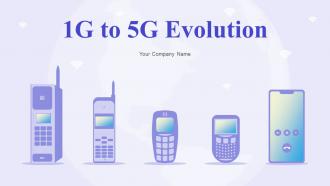
Slide 1: This slide introduces 1G to 5G Evolution. Commence by stating Your Company Name.
Slide 2: This slide depicts the Agenda of the presentation.
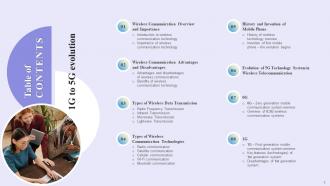
Slide 3: This slide incorporates the Table of Contents.
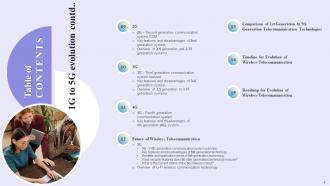
Slide 4: This is yet another slide continuing the Table of Contents.
Slide 5: This slide highlights the Title for the Topics to be discussed further.
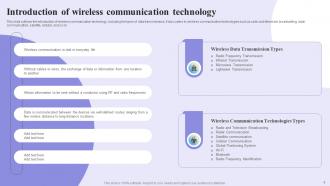
Slide 6: This slide outlines the introduction of wireless communication technology.
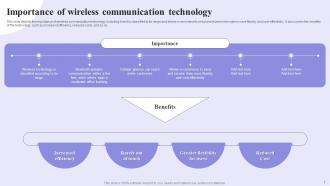
Slide 7: This slide depicts the importance of wireless communication technology.
Slide 8: This slide displays the Heading for the Components to be covered in the next template.
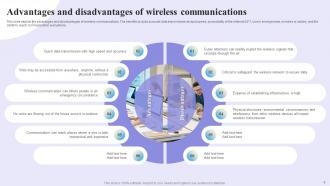
Slide 9: This slide depicts the advantages and disadvantages of wireless communications.
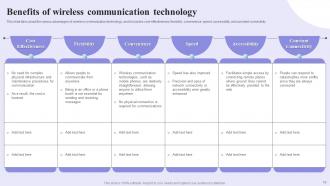
Slide 10: This slide exhibits the Benefits of wireless communication technology.
Slide 11: This slide mentions the Title for the Ideas to be discussed in teh forth-coming template.
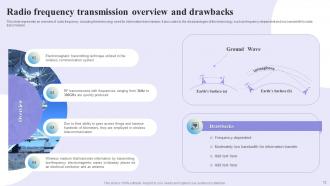
Slide 12: This slide highlights the Radio frequency transmission overview and drawbacks.
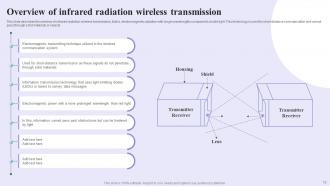
Slide 13: This slide describes the overview of infrared radiation wireless transmission.
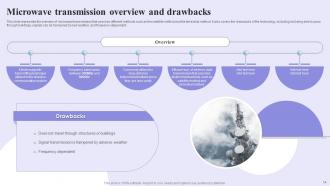
Slide 14: This slide represents the overview of microwave transmission that uses two different methods.
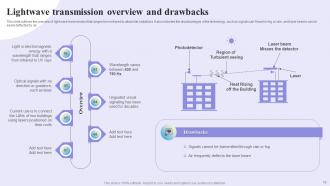
Slide 15: This slide outlines the overview of light wave transmission that ranges from infrared to ultraviolet radiations.
Slide 16: This slide displays the Heading for the Ideas to be covered next.
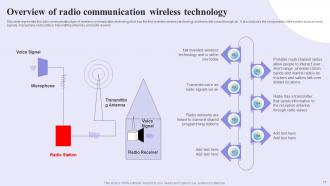
Slide 17: This slide presents the radio communication type of wireless communication technology.
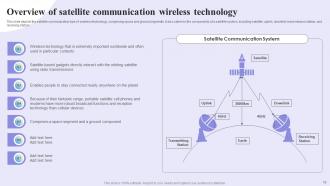
Slide 18: This slide depicts the satellite communication type of wireless technology, comprising space and ground segments.
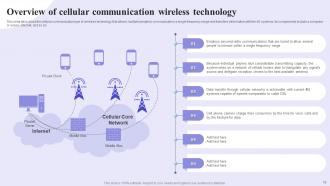
Slide 19: This slide talks about the cellular communication type of wireless technology.
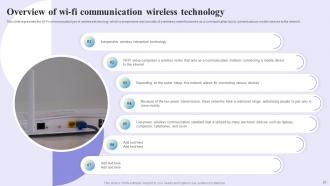
Slide 20: This slide represents the Wi-Fi communication type of wireless technology.
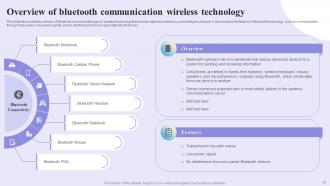
Slide 21: This slide talks about the overview of Bluetooth communication type of wireless technology.
Slide 22: This slide elucidates the Title for the Topics to be covered in the following template.
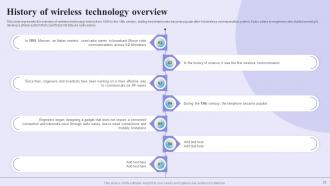
Slide 23: This slide represents the overview of wireless technology history from 1895 to the 19th century.
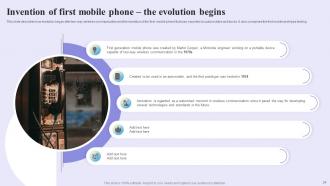
Slide 24: This slide describes how evolution began after two-way wireless communication and the invention of the first mobile phone that was mounted on automobiles and trucks.
Slide 25: This slide includes the Heading for the Contents to be discussed next.
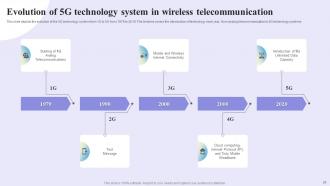
Slide 26: This slide depicts the evolution of the 5G technology system from 1G to 5G from 1979 to 2019.
Slide 27: This slide reveals the Title for the Ideas to be covered in the following template.
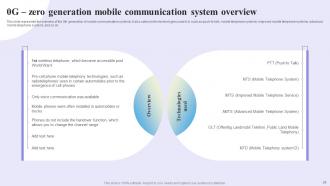
Slide 28: This slide represents the overview of the 0th generation of mobile communication systems.
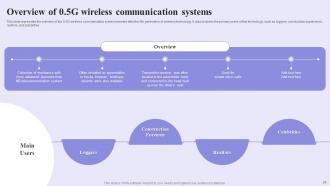
Slide 29: This slide showcases the Overview of 0.5G wireless communication systems.
Slide 30: This slide elucidates the Heading for the Ideas to be discussed further.
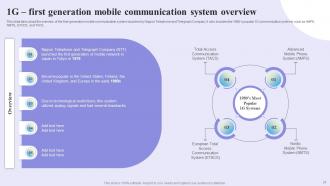
Slide 31: This slide talks about the overview of the first-generation mobile communication system launched by Nippon Telephone and Telegraph Company.
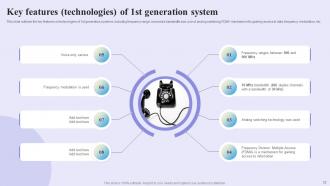
Slide 32: This slide outlines the key features or technologies of 1st generation systems.
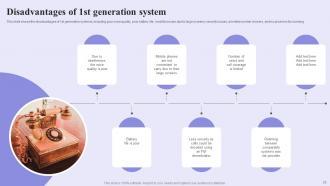
Slide 33: This slide exhibits the Disadvantages of 1st generation system.
Slide 34: This slide reveals the Title for the Topics to be covered in the following template.
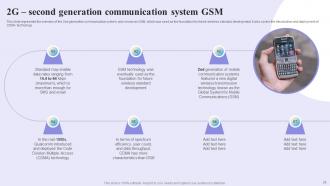
Slide 35: This slide represents the overview of the 2nd generation communication system.
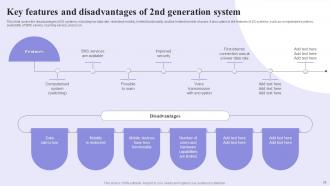
Slide 36: This slide states the Key features and disadvantages of 2nd generation system.
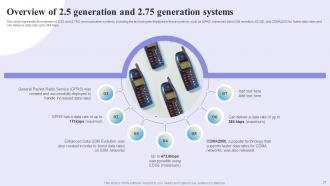
Slide 37: This slide mentions the overview of 2.5G and 2.75G communication systems.
Slide 38: This sldie highlights the Heading for the Components to be discussed next.
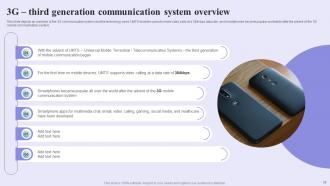
Slide 39: This slide depicts an overview of the 3G communication system and the technology used.
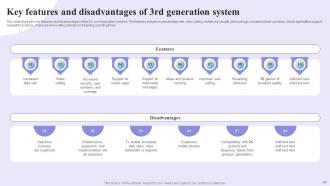
Slide 40: This slide states the Key features and disadvantages of 3rd generation system.
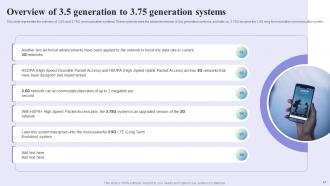
Slide 41: This slide represents the overview of 3.5G and 3.75G communication systems.
Slide 42: This slide indicates the Tite for the Contents to be covered in the following template.
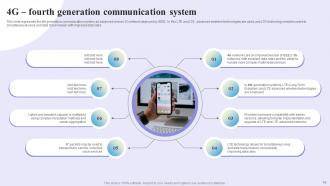
Slide 43: This slide reveals the 4th generation communication system, an advanced version 3G network deployed by IEEE.
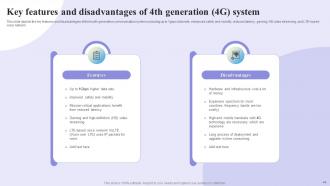
Slide 44: This slide depicts the key features and disadvantages of the fourth-generation communication system.
Slide 45: This slide presents the Heading for the Topics to be covered in the forth-coming template.
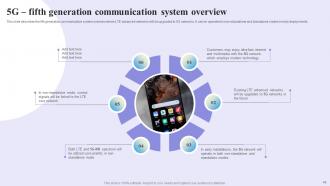
Slide 46: This slide describes the 5th generation communication system overview where LTE advanced networks will be upgraded to 5G networks.
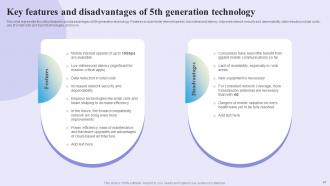
Slide 47: This slide exhibits the Key features and disadvantages of 5th generation technology.
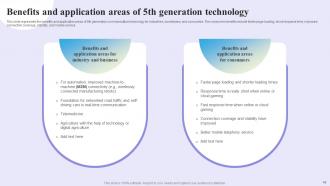
Slide 48: This slide shows the Benefits and application areas of 5th generation technology.
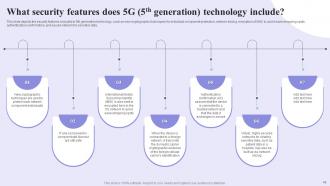
Slide 49: This slide displays the security features included in 5th generation technology.
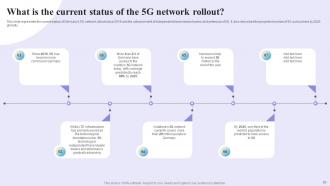
Slide 50: This slide represents the current status of Germany's 5G network rollout.
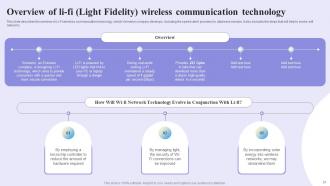
Slide 51: This slide describes the overview of Li-Fi wireless communication technology.
Slide 52: This slide indicates the Title for the Ideas to be covered in the following template.
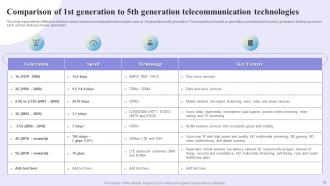
Slide 53: This slide represents the difference between various wireless communication technologies.
Slide 54: This slide includes the Heading for the Ideas to be covered next.
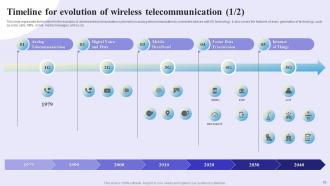
Slide 55: This slide portrays the Timeline for evolution of wireless telecommunication.
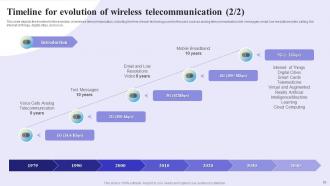
Slide 56: This slide continues the Timeline for evolution of wireless telecommunication.
Slide 57: This slide depicts the Title for the Topics to be discussed next.
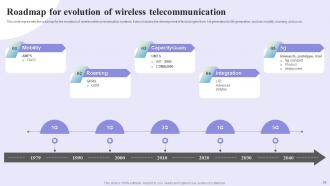
Slide 58: This slide presents the Roadmap for evolution of wireless telecommunication.
Slide 59: This is the Icons slide containing all the Icons used in the plan.
Slide 60: This slide reveals Additional information.
Slide 61: This slide is used for showcasing the organization's mission, vision, and values.
Slide 62: This is Our goal slide. State your company goals here.
Slide 63: This is the Venn diagram slide.
Slide 64: This is the Puzzle slide with related imagery.
Slide 65: This slide elucidates the organizational Timeline.
Slide 66: This is Our team slide. State your team-related information here.
Slide 67: This slide contains the Post it notes for reminders and deadlines.
Slide 68: This is the Thank You slide for acknowledgement.
1G To 5G Evolution Powerpoint Presentation Slides with all 73 slides:
Use our 1G To 5G Evolution Powerpoint Presentation Slides to effectively help you save your valuable time. They are readymade to fit into any presentation structure.









FAQs for 1G To 5G Evolution
So the big thing with 5G is millimeter wave spectrum and these massive MIMO antenna arrays - that's where the insane speeds come from, like 10-100x faster than 4G. Network slicing is wild too, basically carriers can create dedicated lanes for different apps. Edge computing moves all the processing closer to you, which is why latency drops under 1ms. Sure, faster Netflix is nice, but honestly the real game-changer is enabling real-time AR, self-driving cars, and IoT at crazy scale. These fundamentals matter since they'll completely reshape how we build connected stuff.
So 5G is pretty sick for IoT - way faster speeds, almost zero lag, and you can connect like millions of devices instead of just thousands. Your sensors basically send data in real-time now instead of that annoying delay we're used to. Only downside is you need new hardware and honestly, coverage is still kinda spotty depending where you are. I'd figure out which of your current setups would actually benefit from instant responses first. No point upgrading everything at once, you know?
Dude, the money alone is insane - we're talking massive infrastructure costs for new towers and upgrades everywhere. Each country has totally different regulations too, which is a nightmare. Spectrum allocation? Good luck, every government wants their piece. You'll need specialized gear and techs who are already stretched thin. Rural rollouts barely make financial sense tbh. Honestly, I'd hit the dense urban markets first and get cozy with local governments early. Trust me, those regulatory headaches will eat you alive if you don't have the right connections from day one.
Dude, 5G is pretty sick for mobile gaming. Latency drops to like under 20ms, which is crazy good for competitive stuff. Downloads are way faster too - we're talking 100x faster than 4G. Cloud gaming actually works without those annoying stutters now. Your connection stays solid so you won't randomly disconnect mid-match (hate when that happens). Plus streaming gameplay is smooth, and AR/VR stuff doesn't make you want to throw your phone. Honestly if you're serious about mobile gaming, see if your carrier has 5G coverage and maybe upgrade your device.
Dude, smart cities literally can't function without 5G - it's like the backbone for everything. All those sensors tracking traffic, air quality, energy stuff? They need crazy fast speeds to actually sync up in real time. Without it, you'd have this weird delay where nothing connects properly. Autonomous cars talking to traffic lights, emergency systems responding instantly to crashes - that all breaks down with slow networks. Oh and if you're planning any of these projects, definitely build in solid 5G coverage from the start. Trust me, trying to retrofit it later is a nightmare.
So 5G latency drops to like 1-10 milliseconds compared to 4G's 30-50ms. Pretty crazy difference. Your phone will feel faster, sure, but the real magic happens with stuff like remote surgery or self-driving cars - things that need instant response times. I mean, AR finally won't feel laggy anymore which is honestly about time. The industrial side is where it gets interesting though. IoT sensors, factory automation, all that mission-critical stuff where even tiny delays can mess things up. If you're building anything real-time, this basically opens up possibilities that just weren't there before.
Honestly, 5G security is kinda messy right now. Network slicing is a big issue - if hackers breach one slice, they might access others too. Plus all these IoT devices everywhere? That's like giving attackers a million more doors to try. The supply chain stuff gets political fast - nobody agrees on which vendors we should actually trust with our infrastructure. Speed makes detection harder since attacks happen so quickly. Oh, and nation-states are definitely trying to mess with the infrastructure itself. Just keep checking what your company's doing about their 5G policies because this stuff changes constantly.
So 5G basically turbocharges your data processing and makes everything happen in real-time. Your inventory updates instantly, IoT devices connect without hiccups, and cloud access gets way snappier. The latency drop is insane - we're talking milliseconds instead of waiting around forever. Automation and remote monitoring see the biggest improvements since everything just responds immediately. Oh, and collaborative stuff works so much smoother too. I'd honestly start by figuring out where your connectivity is currently screwing you over, then test 5G there first.
Honestly, 5G is kinda complicated environmentally. Sure, it's way more efficient per data bit than 4G, but we're talking about building a massive amount of new infrastructure. Think thousands more small cells and base stations everywhere - that's a lot of manufacturing and e-waste down the line. Energy use actually increases overall because of all this extra equipment. Don't even get me started on all the concrete needed for new towers. The upside though? Smart city tech and IoT stuff that could save energy in other ways. My take: we better power all this with renewables from the start or we're screwed.
Honestly, healthcare's gonna be huge - remote surgeries in real-time, which is wild if you think about it. Manufacturing will get crazy precise with automation. Those self-driving cars might actually happen now too lol. Gaming and VR will be insane since there's basically zero lag. Smart cities are another big one - traffic systems and emergency response will be instant. But here's the thing: any industry dealing with massive data or needing split-second decisions will get completely transformed. You should probably start looking at where those slowdowns are happening in your field right now.
Dude, 5G is a game changer for healthcare. You can finally do HD video calls with patients without that annoying lag. Doctors are even doing remote surgeries with robots now - sounds like sci-fi but it's actually happening. For day-to-day stuff though, you'll love how fast you can upload those massive medical files. AR training becomes way smoother too. Oh, and those monitoring devices? They'll stay connected 24/7 without killing the battery. Honestly think it's gonna flip remote care on its head - what kind of workflows are you dealing with right now?
Dude, 5G is going to be insane economically. The infrastructure buildout alone is creating jobs everywhere, but that's just the start. We're talking remote surgery happening in real time, cars driving themselves, factories that adjust production instantly. Remember how 4G basically created Uber and Netflix? This is gonna be way bigger. Healthcare and logistics are already scrambling to figure out how to use it. The productivity gains will be nuts - though honestly I'm still trying to wrap my head around what "ultra-low latency" even means in practice. But yeah, definitely worth thinking about how this affects whatever you're working on.
Honestly, 5G is a game changer for AR/VR. The crazy low latency means no more motion sickness from that annoying delay when you turn your head in VR - you know that gross feeling? Plus the bandwidth lets you stream insane resolution without those pixelated artifacts that totally kill the vibe. AR gets way better too since it can handle real-time object recognition and all that heavy processing in the cloud. Best part? Those chunky processing boxes attached to headsets become obsolete. Everything just happens instantly through the cloud connection. My friend tried a 5G VR setup last month and said it felt completely different.
Yeah so Asia-Pacific is crushing everyone right now with 5G. South Korea made it like a national mission - their coverage is insane. China's throwing massive money at infrastructure and it's working. Meanwhile the US and Europe are stuck dealing with red tape and everyone doing their own thing instead of coordinating. Honestly, it's kinda embarrassing how far behind we are. You need government support from day one, plus streamlined permits and serious upfront investment. If your area wants to catch up, they've gotta stop this fragmented approach and actually work together on a real strategy.
Ugh, 5G is honestly kind of a privacy nightmare. Yeah, it's faster, but your data bounces through way more network spots and edge servers - basically more places for hackers to grab it. The location tracking is insane too, like down to a few meters. That's creepy precise. All those smart devices that work better with 5G? They're hoovering up your personal info constantly. I mean, privacy laws are trying to catch up, but you should definitely be picky about what you connect. Just saying.
-
Delighted to see unique and eye-catching PowerPoint designs that are so easy to customize.
-
The way SlideTeam professionals work is exceptional. Thanks for being so helpful!