


Road To 5G Era Technology And Architecture Powerpoint Presentation Slides
The Road to 5G Era Technology and Architecture PowerPoint template is a valuable tool in presenting 5G technology guidelines for telecom operators considering implementing the latest 5G technology across various geographical locations. It will allow telecom operators to deploy 5G by assessing different parameters such as cost, market, and technology readiness. This template covers slides depicting uniqueness related to 5G in terms of its design specifications, comparative assessment, and unique features such as latency, speed, intelligent connectivity, heterogeneous network, and use cases in the context of 5G. Policy readiness caters slides about 5G regulatory costs and flexibility policies, 5G era spectrum bands, access, and pricing consideration. Market readiness addresses the competitive landscape of 5G, success factors related to 5G handsets, and new skills requirements for 5G deployment. It also shows slides on various 5G value enablers such as resilient networks, horizontal APIs, operator cloud, network slicing, etc. Lastly, It covers slides about cost determination for 5G by assessing cost impacting factors such as network capacity, network coverage, network flexibility, network energy efficiency, and network equipment sourcing for 5G. Get access to our powerful 5g technology ppt templates now.














































You must be logged in to download this presentation.


Do you want to remove this product from your favourites?
PowerPoint presentation slides
Enthrall your audience with this Road To 5G Era Technology And Architecture Powerpoint Presentation Slides. Increase your presentation threshold by deploying this well-crafted template. It acts as a great communication tool due to its well-researched content. It also contains stylized icons, graphics, visuals etc, which make it an immediate attention-grabber. Comprising seventy two slides, this complete deck is all you need to get noticed. All the slides and their content can be altered to suit your unique business setting. Not only that, other components and graphics can also be modified to add personal touches to this prefabricated set.

People who downloaded this PowerPoint presentation also viewed the following :
Content of this Powerpoint Presentation
Slide 1: This slide introduces Road to 5G Era – Technology and Architecture. State Your Company Name and begin.
Slide 2: This slide states Agenda of the presentation.
Slide 3: This slide presents Table of Content for the presentation.
Slide 4: This slide highlights title for topics that are to be covered next in the template.
Slide 5: This slide displays 5G as next generation mobile technology and emerging as network of opportunity.
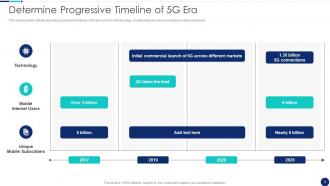
Slide 6: This slide represents details regarding progressive timeline of 5G era.
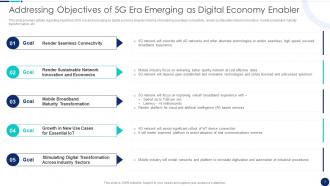
Slide 7: This slide showcases Objectives of 5G Era Emerging as Digital Economy Enabler.
Slide 8: This slide shows Industry Expectations from 5G Era.
Slide 9: This slide presents Contribution of 5G to Global Economy.
Slide 10: This slide highlights title for topics that are to be covered next in the template.
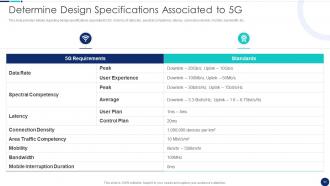
Slide 11: This slide displays Determine Design Specifications Associated to 5G.
Slide 12: This slide represents details regarding comparative assessment of broadband technologies.
Slide 13: This slide showcases unique features of 5G in terms of reduced latency.
Slide 14: This slide shows unique features of 5G in terms of heterogeneous networks at premises.
Slide 15: This slide presents unique features of AI enabled 5G for intelligent connectivity.
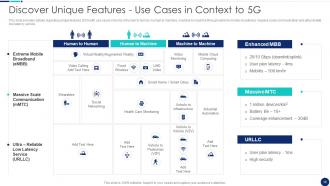
Slide 16: This slide displays unique features of 5G with use cases.
Slide 17: This slide highlights title for topics that are to be covered next in the template.
Slide 18: This slide represents Various Deployment Models Associated to 5G Network.
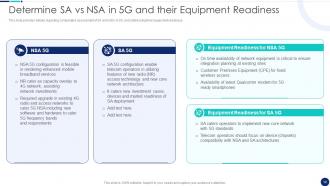
Slide 19: This slide showcases Determine SA vs NSA in 5G and their Equipment Readiness.
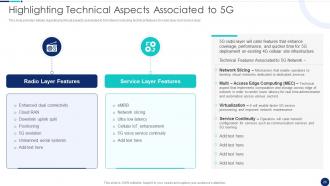
Slide 20: This slide shows Highlighting Technical Aspects Associated to 5G.
Slide 21: This slide presents details regarding voice and messaging capability of 5G network.
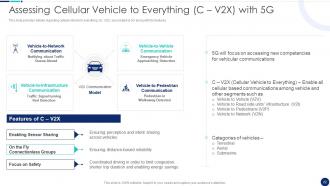
Slide 22: This slide displays Cellular Vehicle to Everything (C – V2X) with 5G.
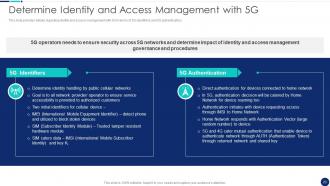
Slide 23: This slide represents Determine Identity and Access Management with 5G.
Slide 24: This is another slide continuing Determine Identity and Access Management with 5G.
Slide 25: This slide showcases role of eSIM in 5G networks and act as enabler to connect various devices.
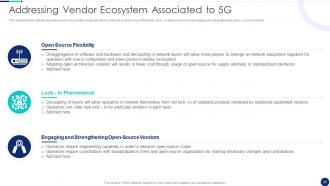
Slide 26: This slide shows Vendor Ecosystem Associated to 5G.
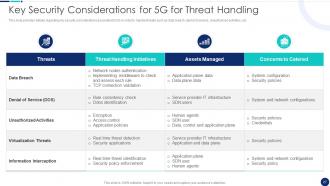
Slide 27: This slide presents Key Security Considerations for 5G for Threat Handling.
Slide 28: This slide highlights title for topics that are to be covered next in the template.
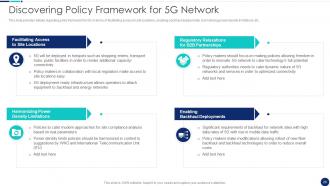
Slide 29: This slide displays Discovering Policy Framework for 5G Network.
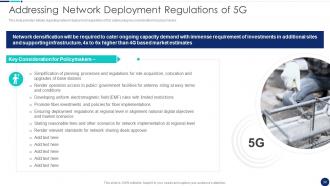
Slide 30: This slide represents Addressing Network Deployment Regulations of 5G.
Slide 31: This slide showcases Determine 5G Regulatory Costs and Flexibility Policies.
Slide 32: This slide shows Addressing 5G Era Spectrum-Bands, Access and Pricing.
Slide 33: This slide highlights title for topics that are to be covered next in the template.
Slide 34: This slide presents Determine Competitive Landscape of 5G.
Slide 35: This slide displays Identifying Success Factors Associated to 5G Handsets.
Slide 36: This slide represents Determine Collaboration and New Skills Requirement for 5G Deployment.
Slide 37: This slide showcases BECEMS framework for 5G market readiness assessment.
Slide 38: This slide highlights title for topics that are to be covered next in the template.
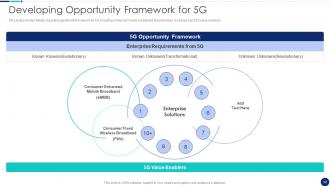
Slide 39: This slide shows details regarding opportunity framework for 5G.
Slide 40: This slide presents economic benefits associated to 5G in terms of indirect impact.
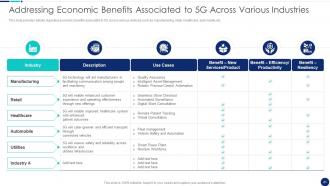
Slide 41: This slide displays Economic Benefits Associated to 5G Across Various Industries.
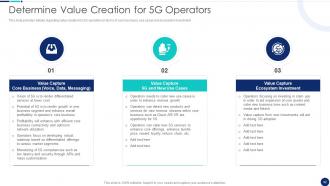
Slide 42: This slide represents value creation for 5G operators in terms of core business.
Slide 43: This slide showcases details regarding enterprise opportunity and engagement.
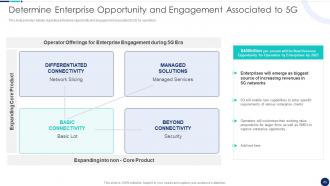
Slide 44: This slide shows Enterprise Opportunity and Engagement Associated to 5G.
Slide 45: This slide presents enhanced mobile broadband (eMBB) opportunity and drivers.
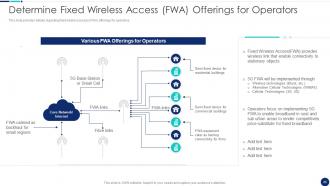
Slide 46: This slide displays fixed wireless access (FWA) offerings for operators.
Slide 47: This slide highlights title for topics that are to be covered next in the template.
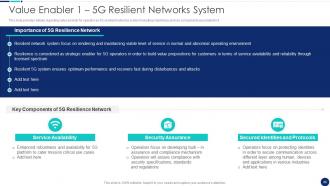
Slide 48: This slide represents value enabler for operator as 5G resilient networks system.
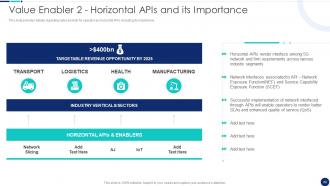
Slide 49: This slide showcases value enabler for operator as horizontal APIs including its importance.
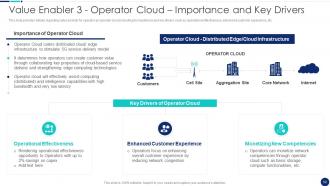
Slide 50: This slide shows value enabler as operator cloud including its importance and key drivers.
Slide 51: This slide presents value enabler for network slicing including its importance.
Slide 52: This slide displays various business models for 5G operators.
Slide 53: This slide highlights title for topics that are to be covered next in the template.
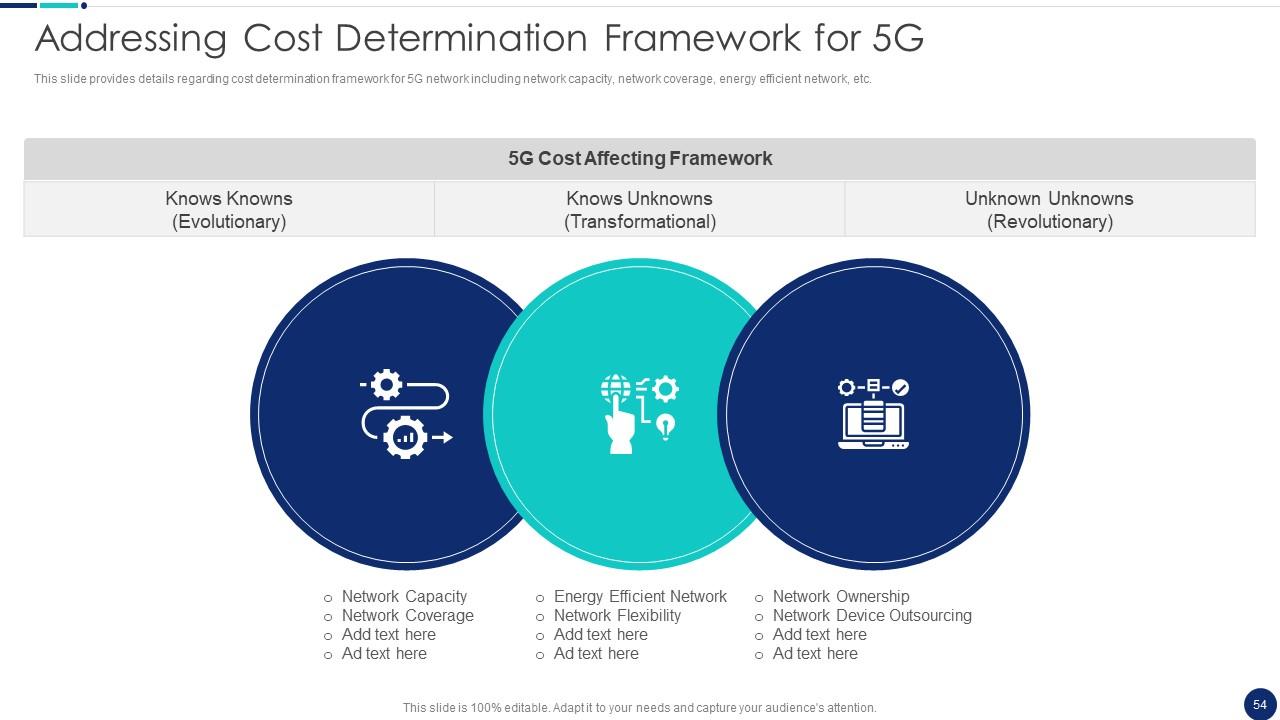
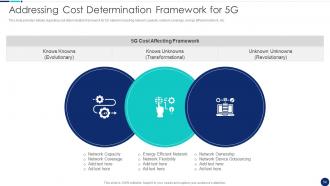
Slide 54: This slide represents Addressing Cost Determination Framework for 5G.
Slide 55: This slide showcases network capacity drivers such as spectral efficiency and spectral capacity.
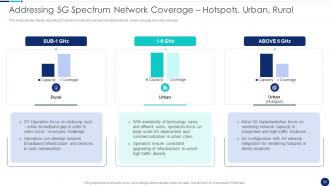
Slide 56: This slide shows 5G spectrum network coverage including hotspots, urban coverage and rural coverage.
Slide 57: This slide presents 5G era network flexibility in terms of NFV/SDN and cloud RAN in order to cater customized services.
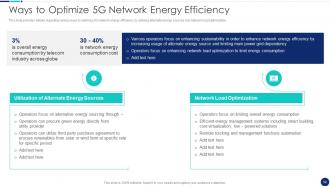
Slide 58: This slide displays Ways to Optimize 5G Network Energy Efficiency.
Slide 59: This slide represents network ownership approaches associated to 5G networks.
Slide 60: This slide showcases 5G network equipment sourcing by operators.
Slide 61: This slide displays Icons for Road to 5G Era – Technology and Architecture.
Slide 62: This slide is titled as Additional Slides for moving forward.
Slide 63: This slide provides 30 60 90 Days Plan with text boxes.
Slide 64: This slide shows Weekly Timeline with Task Name.
Slide 65: This slide represents Roadmap for Process Flow.
Slide 66: This slide displays Column chart with two products comparison.
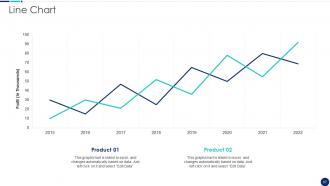
Slide 67: This slide describes Line chart with two products comparison.
Slide 68: This is a Financial slide. Show your finance related stuff here.
Slide 69: This slide shows Post It Notes. Post your important notes here.
Slide 70: This slide contains Puzzle with related icons and text.
Slide 71: This slide showcases Magnifying Glass to highlight information, specifications, etc.
Slide 72: This is a Thank You slide with address, contact numbers and email address.
Road To 5G Era Technology And Architecture Powerpoint Presentation Slides with all 77 slides:
Use our Road To 5G Era Technology And Architecture Powerpoint Presentation Slides to effectively help you save your valuable time. They are readymade to fit into any presentation structure.
-
Every time I ask for something out-of-the-box from them and they never fail in delivering that. No words for their excellence!
-
I came across many PowerPoint presentations with excellent creatives and I believe they would be beneficial to my work.
