


5G Network Technology Architecture Powerpoint Presentation Slides




Try Before you Buy Download Free Sample Product
 Impress Your
 Audience
 100%
100% Editable
 Save Hours
 of Time


By providing more excellent peak data rates of several Gbps, 5G wireless technology increases efficiency and efficacy. Grab our smartly designed 5G Technology Architecture template. It gives a brief overview of how 5G technology works and how the shift from 1G to 5G happened. The OSI stack mapping for the 5G protocol levels, design and planning considerations, and implementation options are all included in our 5G Generic Architecture deck. It covers the various 5G designs, like the 5G generic network, and demonstrates the operation of the NR RRC, NR U-plane, SDAP, PDCP, RLC, and MAC Layers. Our 5G NR Standard Architecture PPT also covers the 5G radio access network, its fundamental design, and the functional architecture for context- and content-aware 5G platforms. Additionally, it shows the practical elements of the architecture, such as the frequency bands at the center of 5G networks, MEC, network slicing, a checklist for implementing the architecture, and many more. Lastly, our 5G Core Architecture module includes a dashboard for recording the success of the 5G architecture, a timeline, and a roadmap for its implementation. Get access right away.
People who downloaded this PowerPoint presentation also viewed the following :
Content of this Powerpoint Presentation
Slide 1: This slide introduces 5G Network Technology Architecture (IT). Commence by stating Your Company Name.
Slide 2: This slide depicts the Agenda of the presentation.
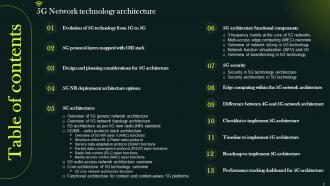
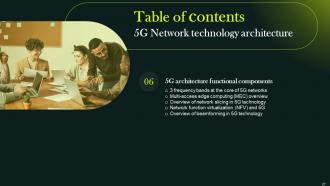
Slide 3: This slide incorporates the Table of contents.
Slide 4: This slide highlights the Title for the Topics to be discussed further.
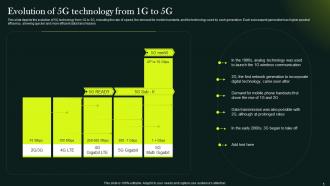
Slide 5: This slide depicts the evolution of 5G technology from 1G to 5G.
Slide 6: This slide mentions the Heading for the Contents to be covered next.
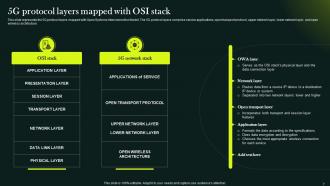
Slide 7: This slide represents the 5G protocol layers mapped with Open Systems Interconnection Model.
Slide 8: This slide reveals the Title for the Ideas to be discussed in the following template.
Slide 9: This slide describes the design and planning considerations for 5G architecture.
Slide 10: This slide indicates the Heading for the Ideas to be covered in the forth-coming template.
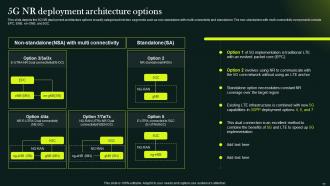
Slide 11: This slide depicts the 5G NR deployment architecture options broadly categorized into two segments.
Slide 12: This slide elucidates the Title for the Components to be discussed next.
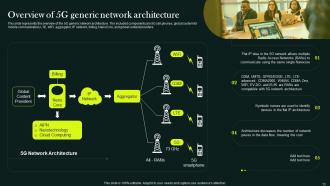
Slide 13: This slide represents the overview of the 5G generic network architecture.
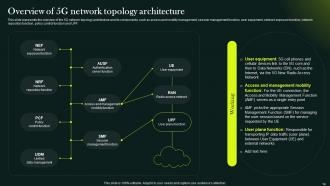
Slide 14: This slide portrays the Overview of 5G network topology architecture.
Slide 15: This slide depicts the 5G architecture as per the 5G NR standard.
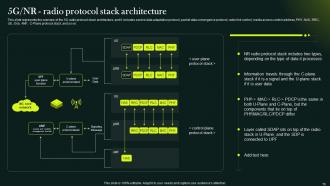
Slide 16: This slide showcases the overview of the 5G radio protocol stack architecture.
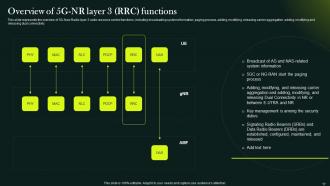
Slide 17: This slide presents the Overview of 5G-NR layer 3 (RRC) functions.
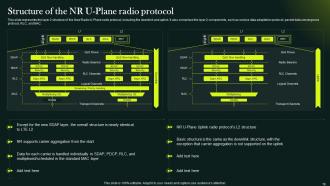
Slide 18: This slide reveals the layer 2 structure of the New Radio U-Plane radio protocol.
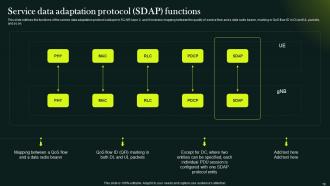
Slide 19: This slide outlines the functions of the service data adaptation protocol sublayer in 5G-NR layer 2.
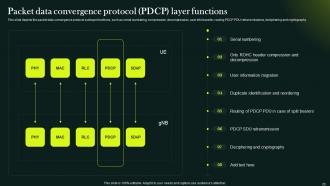
Slide 20: This slide talks about Packet data convergence protocol (PDCP) layer functions.
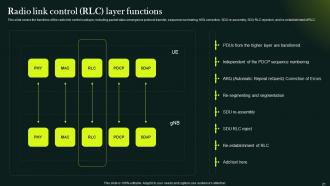
Slide 21: This slide mentions the Radio link control (RLC) layer functions.
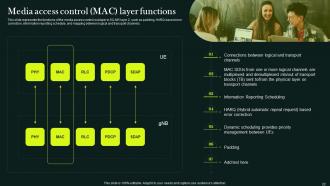
Slide 22: This slide shows the functions of the media access control sublayer in 5G-NR layer 2.
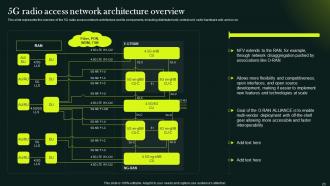
Slide 23: This slide represents the overview of the 5G radio access network architecture and its components.
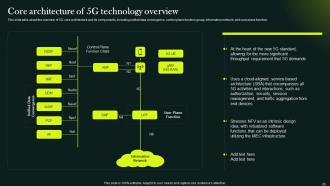
Slide 24: This slide talks about the Core architecture of 5G technology overview.
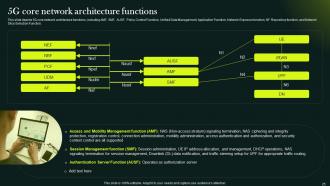
Slide 25: This slide exhibits the 5G core network architecture functions.
Slide 26: This slide depicts the Functional architecture for context and content-aware 5G platforms.
Slide 27: This slide portrays the Heading for the Topics to be discussed next.
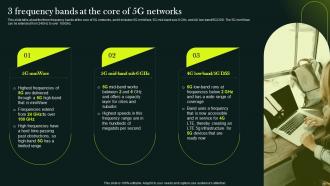
Slide 28: This slide talks about the three frequency bands at the core of 5G networks.
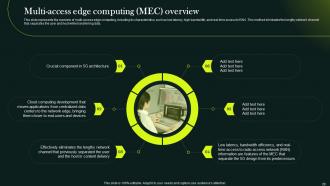
Slide 29: This slide showcases the Multi-access edge computing (MEC) overview.
Slide 30: This slide indicates the Overview of network slicing in 5G technology.
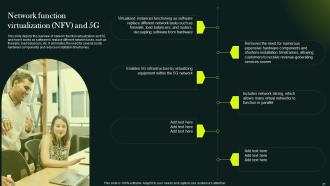
Slide 31: This slide deals with Network function virtualization (NFV) and 5G.
Slide 32: This slide portrays the Overview of beamforming in 5G technology.
Slide 33: This slide includes the Title for the Topics to be discussed in the following template.
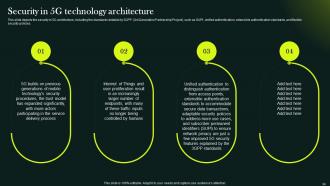
Slide 34: This slide depicts the security in 5G architecture, including the standards detailed by 3GPP (3rd Generation Partnership Project).
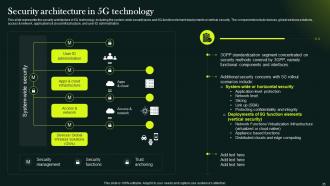
Slide 35: This slide represents the security architecture in 5G technology.
Slide 36: This slide displays the Heading for the Contents to be covered next.
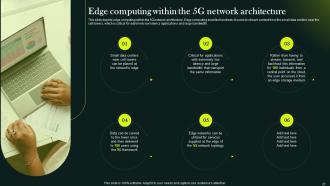
Slide 37: This slide reveals edge computing within the 5G network architecture.
Slide 38: This slide mentions the Title for the Ideas to be discussed further.
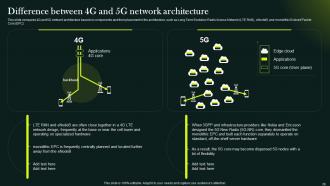
Slide 39: This slide compares 4G and 5G network architecture based on components and their placement in the architecture.
Slide 40: This slide indicates the Heading for the Ideas to be covered in the following template.
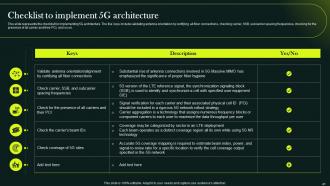
Slide 41: This slide represents the checklist for implementing 5G architecture.
Slide 42: This slide includes the Title for the Contents to be discussed next.
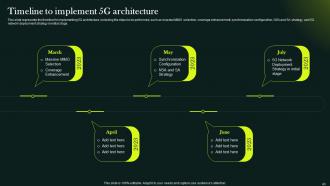
Slide 43: This slide presents the timeline for implementing 5G architecture.
Slide 44: This slide displays the Heading for the Topics to be covered further.
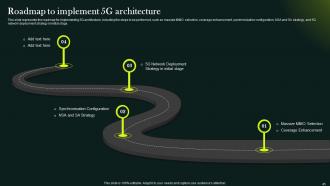
Slide 45: This slide reveals the roadmap for implementing 5G architecture.
Slide 46: This slide indicates the Title for the Ideas to be further discussed.
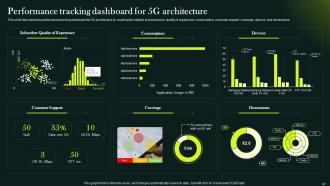
Slide 47: This slide describes the performance tracking dashboard for 5G architecture.
Slide 48: This is the Icons slide containing all the Icons used in the plan.
Slide 49: This slide is used for depicting Additional information.
Slide 50: This is the 30 60 90 days plan slide for efficient planning.
Slide 51: This slide presents the Clustered column.
Slide 52: This slide elucidates information related to the Financial topic.
Slide 53: This is the Puzzle slide with related imagery.
Slide 54: This slide is used for showcasing the company's targets.
Slide 55: This is the Thank you slide for acknowledgement.
5G Network Technology Architecture Powerpoint Presentation Slides with all 60 slides:
Use our 5G Network Technology Architecture Powerpoint Presentation Slides to effectively help you save your valuable time. They are readymade to fit into any presentation structure.















FAQs for 5G Network Technology Architecture
So basically you've got three main pieces: the Radio Access Network (RAN) with all the base stations and antennas, then there's the 5G Core that handles authentication and routing stuff. Oh and User Equipment - that's just your phone or whatever device. Network slicing is pretty cool actually, lets carriers basically create separate virtual networks for different things. The whole setup is way more cloud-based than 4G was. It's also more distributed which makes sense I guess. Honestly if you're diving into 5G deployments, I'd start with wrapping your head around the core network functions first - that's where things get messy and complicated.
So 5G is basically doing everything in the cloud now instead of relying on tons of physical hardware like 4G did. The coolest part? Network slicing - sounds techy but it's actually brilliant. Your phone and some random IoT sensor can use totally different "slices" of the same network, each one tuned for what it needs to do. Way more flexible than before. You can actually customize how the network performs based on what you're trying to accomplish. I mean, that's a pretty big deal when you think about it. Makes deployment so much easier too.
So SDN is like the brain of 5G networks - it splits control from data so you can manage everything through software instead of being stuck with whatever's hardcoded into hardware. Way more flexible than the old approach. You get this universal remote vibe for your whole network infrastructure, which honestly makes things so much easier. 5G networks can slice bandwidth dynamically, prioritize different traffic types, and adapt on the fly. If you're diving into 5G stuff, definitely check out how SDN controllers work with network function virtualization. That's where things get really interesting.
So network slicing is basically like creating multiple virtual networks within one 5G setup. Picture highway lanes - each one handles different traffic types. You can have one slice for super low-latency stuff like self-driving cars, another for IoT devices, and maybe one for streaming video. All running at once on the same hardware, which honestly saves a ton of money. Each slice gets its own performance rules and security settings too. Way better than building separate networks for every single use case, right? If you're doing 5G planning, just think about what specific things your company actually needs first.
So with cloud-native stuff, you can actually scale your 5G network up and down based on what's happening - no more being stuck with whatever hardware you bought. Containers make deployments way faster too. Your ops team won't hate you because everything's manageable through APIs. Multiple network functions can share the same infrastructure, which is honestly just smart resource use. The real win? You can adapt in real-time when traffic goes crazy or you need new services. No major infrastructure headaches. It's pretty much the only way that makes sense anymore.
So 5G basically puts tiny data centers right at the cell towers instead of sending everything to some server farm across the country. They call it MEC or something - Multi-access Edge Computing. Your phone's data gets processed like a few miles away instead of traveling hundreds of miles and back. Way faster obviously. We're talking under 10ms instead of that annoying 50-100ms lag you get with regular cloud stuff. Pretty neat how they figured that out. If you're doing anything real-time, you should definitely check what MEC options are available around you.
So 5G's actually got some solid security upgrades over 4G. They use 256-bit encryption now, which is pretty robust. Each network slice runs independently too, so if one gets compromised it won't affect others. The authentication process ditched those old shared secrets for public key cryptography - way more secure. Processing happens at the edge instead of some far-off data center, which I think is smart for multiple reasons. Zero-trust architecture means everything gets verified constantly. Just make sure your IT team knows about these changes when they're setting everything up, since the security approach is different now.
So the main thing is 5GC ditched those old point-to-point interfaces for a service-based architecture. Think microservices - everything talks through APIs now instead of those rigid S1, S6a connections. Way more flexible honestly. Control and user planes are completely separated too, so you can scale each one based on your actual traffic needs. Network slicing is built right in, which is pretty cool for handling different service requirements. Oh and definitely map out how your current EPC functions convert to the new 5GC ones first - saves you headaches later.
Honestly, 5G's network slicing is pretty brilliant for IoT stuff. Basically you can carve out dedicated chunks of bandwidth - so your critical factory sensors get their own guaranteed slice while random smart bulbs get whatever's leftover. Edge computing helps too since you're not constantly sending data halfway across the country. The connection density is insane compared to 4G - way more devices per area. I'd say figure out which of your devices absolutely need instant response times versus the ones that can wait a bit. That'll help you plan which slices to prioritize.
URLLC is basically a total network redesign - you're looking at sub-1ms latency with 99.999% reliability. Pretty intense requirements, honestly. Edge computing has to get way closer to users, plus you need network slicing for critical traffic isolation. The scheduling algorithms are completely different too. Radio interfaces get priority mechanisms, which makes everything way more complex than regular broadband. But that complexity enables autonomous cars, industrial automation, remote surgery - stuff that literally can't have hiccups. My advice? Figure out what actually needs URLLC first (versus what you think needs it) because the infrastructure costs will hit hard.
So AI is basically like having a really smart network admin running your 5G setup 24/7. It automatically slices up network resources based on what people actually need, predicts when traffic's gonna spike, and catches security issues early. Plus it does predictive maintenance so things don't randomly break - which honestly saves you so much headache later. My advice? Build AI management tools into your deployment from day one. Way easier than trying to add them afterwards when you're already dealing with a live network.
Honestly, the infrastructure costs are brutal - you're looking at massive equipment investments right off the bat. Spectrum management gets messy too since everyone's fighting over limited bands. You can't just ditch 4G overnight, so there's this whole integration headache where you're running both systems. Coverage is probably the worst part though. Those higher frequencies don't punch through walls like 4G does, so suddenly you need base stations everywhere. Energy bills go through the roof too, which nobody talks about enough. Budget for running parallel networks for at least 18-24 months - it's gonna be expensive but there's no real shortcut.
Dude, these new frequencies are a total game changer for coverage planning. mmWave is honestly kind of a pain - super short range and gets blocked by everything, so you'll need tons more small cells than usual. Mid-band isn't terrible, gives you decent balance, but the propagation models get really messy when you're trying to manage multiple frequency layers at once. Your RF planning tools? Yeah, those need a complete overhaul. I learned this the hard way on my last project. Run those coverage sims way earlier than you think and seriously budget for like 3x more site acquisition than any LTE deployment.
Okay so the 5G RAN is basically your phone's direct line to the network - that's where all your speed and latency gets determined. It handles the fancy stuff like beamforming and massive MIMO right at the edge, which is how you get those insane sub-1ms response times. Plus it's constantly juggling resources and managing interference in real-time. Here's the thing though - even if you have an amazing core network, a crappy RAN will tank your entire experience. It's honestly the make-or-break component. Without proper optimization there, you're just not gonna get those 5G speeds everyone talks about.
So Open RAN breaks apart the old telecom setup where you had to buy everything from one vendor. Now you can mix hardware and software from whoever you want - pretty smart move honestly. The whole thing runs on standardized APIs and open interfaces, which means no more getting trapped with one supplier. For your 5G rollout, this is huge because you're not stuck with those massive all-or-nothing packages anymore. Costs go down, you can actually innovate without waiting forever for approvals. My advice? Figure out what pieces you really need to be proprietary versus what you can go open with.
-
Much better than the original! Thanks for the quick turnaround.
-
“Thank you to the SlideTeam. Your presentations look really skillful and have made my life so much easier.”