

Comparison Between 4G And 5G Based On Features And Technology Powerpoint Presentation Slides




Try Before you Buy Download Free Sample Product
 Impress Your
 Audience
 100%
100% Editable
 Save Hours
 of Time


This PowerPoint presentation gives a brief idea about the Comparison between 4G and 5G technology, including the evolution of 5G and the difference between 1G, 2G, 3G, 4G, and 5G. In this Comparison between 4G and 5G based on Features and Technology PowerPoint Presentation, we have covered the difference between 4G and 5G based on features and technology, including latency, download speed, base station, OFDM coding, and cell density. In addition, this PPT contains the features of 5G over 4G that comprises more speed and capacity, connects more users and devices, acts as different networks, traffic system transformation, gaming, and relationship with the agriculture industry. Also, the 5G Impact on the Environment over 4G PPT presentation includes the technologies used in the 5G communication system, the difference between OFDM and CDMA technical specifications, positive and negative impact of 5G on the Environment, such as more energy consumption and emissions, radiations, life cycle impact, and E-waste. Furthermore, this template caters to a timeline, a roadmap to implement 5G technology, and a performance tracking dashboard for 5G. Download our 100 percent editable and customizable template, which is also compatible with Google Slides.
People who downloaded this PowerPoint presentation also viewed the following :
Content of this Powerpoint Presentation
Slide 1: This slide introduces Comparison Between 4G and 5G Based on Features and Technology.
Slide 2: This slide states Agenda of the presentation.
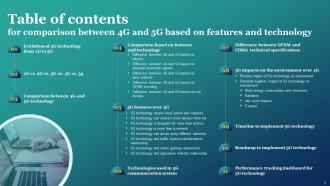
Slide 3: This slide presents Table of Content for the presentation.
Slide 4: This slide highlights title for topics that are to be covered next in the template.
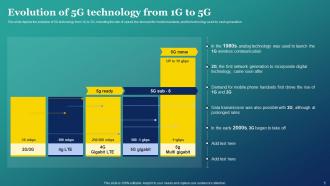
Slide 5: This slide displays Evolution of 5G technology from 1G to 5G.
Slide 6: This slide highlights title for topics that are to be covered next in the template.
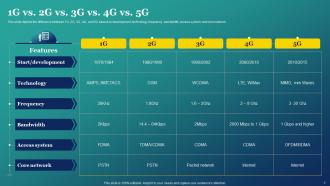
Slide 7: This slide represents difference between 1G, 2G, 3G, 4G, and 5G.
Slide 8: This slide highlights title for topics that are to be covered next in the template.
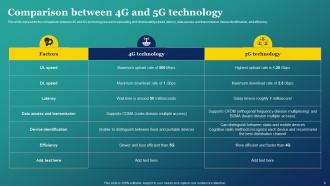
Slide 9: This slide showcases Comparison between 4G and 5G technology.
Slide 10: This slide highlights title for topics that are to be covered next in the template.
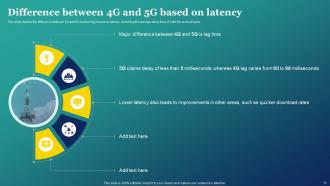
Slide 11: This slide shows Difference between 4G and 5G based on latency.
Slide 12: This slide showcases Difference between 4G and 5G based on potential download speeds.
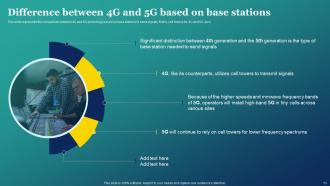
Slide 13: This slide presents Difference between 4G and 5G based on base stations.
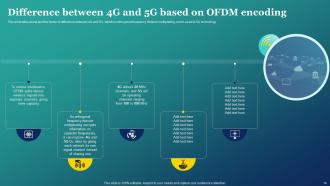
Slide 14: This slide displays Difference between 4G and 5G based on OFDM encoding.
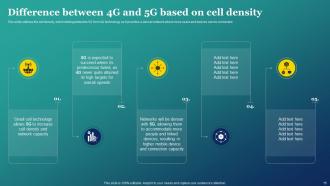
Slide 15: This slide represents Difference between 4G and 5G based on cell density.
Slide 16: This slide highlights title for topics that are to be covered next in the template.
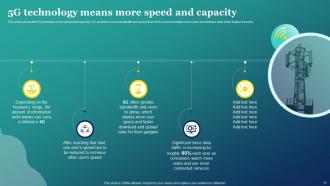
Slide 17: This slide showcases 5G technology means more speed and capacity.
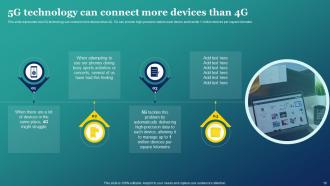
Slide 18: This slide shows 5G technology can connect more devices than 4G.
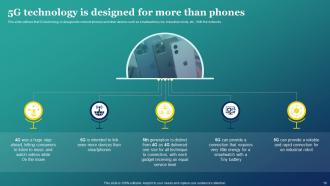
Slide 19: This slide outlines that 5G technology is designed to connect phones and other devices.
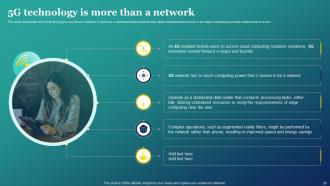
Slide 20: This slide represents how 5G technology is more than a network.
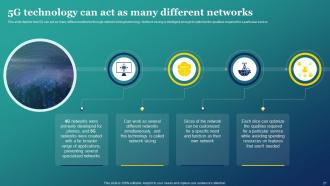
Slide 21: This slide depicts how 5G can act as many different networks.
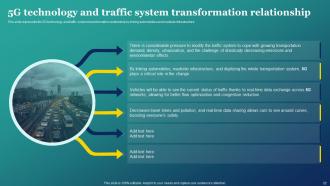
Slide 22: This slide showcases 5G technology and traffic system transformation relationship.
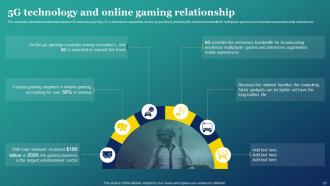
Slide 23: This slide shows 5G technology and online gaming relationship.
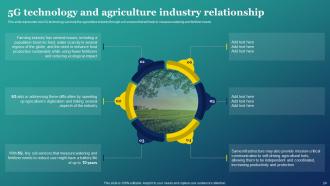
Slide 24: This slide presents 5G technology and agriculture industry relationship.
Slide 25: This slide highlights title for topics that are to be covered next in the template.
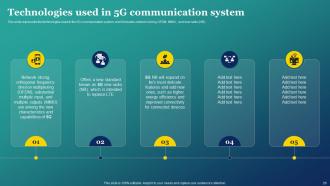
Slide 26: This slide displays Technologies used in 5G communication system.
Slide 27: This slide highlights title for topics that are to be covered next in the template.
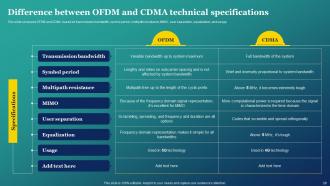
Slide 28: This slide represents Difference between OFDM and CDMA technical specifications.
Slide 29: This slide highlights title for topics that are to be covered next in the template.
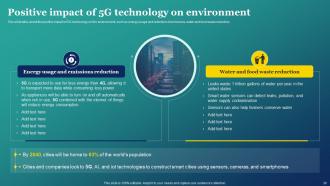
Slide 30: This slide showcases Positive impact of 5G technology on environment.
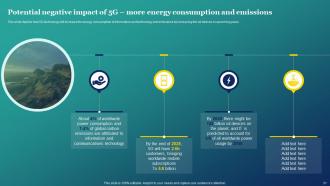
Slide 31: This slide depicts how 5G technology will increase the energy consumption.
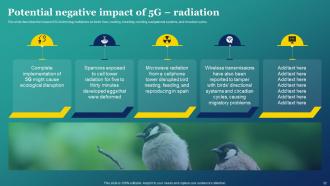
Slide 32: This slide describes the impact of 5G technology radiations on birds’ lives, nesting, breeding, etc.
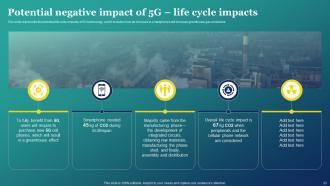
Slide 33: This slide represents the potential life cycle impacts of 5G technology.
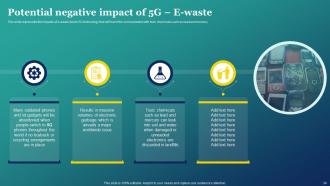
Slide 34: This slide showcases impacts of E-waste due to 5G technology.
Slide 35: This slide highlights title for topics that are to be covered next in the template.
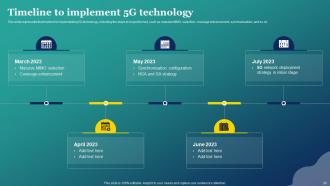
Slide 36: This slide shows Timeline to implement 5G technology.
Slide 37: This slide highlights title for topics that are to be covered next in the template.
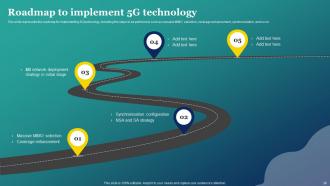
Slide 38: This slide presents Roadmap to implement 5G technology.
Slide 39: This slide highlights title for topics that are to be covered next in the template.
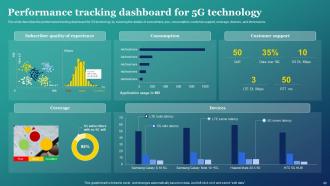
Slide 40: This slide displays Performance tracking dashboard for 5G technology.
Slide 41: This slide is titled as Additional Slides for moving forward.
Slide 42: This slide contains all the icons used in this presentation.
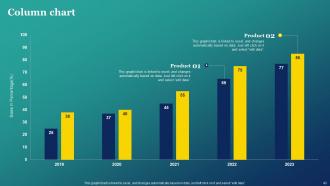
Slide 43: This slide displays Column chart with two products comparison.
Slide 44: This slide shows Post It Notes. Post your important notes here.
Slide 45: This slide depicts Venn diagram with text boxes.
Slide 46: This is a Timeline slide. Show data related to time intervals here.
Slide 47: This is Our Goal slide. State your firm's goals here.
Slide 48: This is an Idea Generation slide to state a new idea or highlight information, specifications etc.
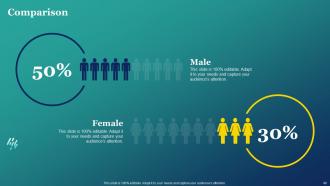
Slide 49: This is a Comparison slide to state comparison between commodities, entities etc.
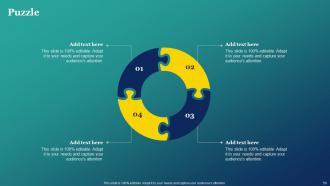
Slide 50: This slide contains Puzzle with related icons and text.
Slide 51: This is a Thank You slide with address, contact numbers and email address.
Comparison Between 4G And 5G Based On Features And Technology Powerpoint Presentation Slides with all 56 slides:
Use our Comparison Between 4G And 5G Based On Features And Technology Powerpoint Presentation Slides to effectively help you save your valuable time. They are readymade to fit into any presentation structure.








FAQs for Comparison Between 4G And 5G Based On Features And Technology
5G delivers speeds up to 100 times faster than 4G, reaching 10 Gbps compared to 4G's 100 Mbps, while reducing latency from 50 milliseconds to under 1 millisecond. These improvements enable real-time applications like autonomous vehicles, remote surgery, and IoT manufacturing systems, with industries finding that enhanced connectivity streamlines operations and delivers superior customer experiences.
5G technology enhances IoT connectivity through ultra-low latency, massive device capacity, and network slicing capabilities that 4G cannot match. These advancements enable real-time industrial automation, smart city infrastructure, and autonomous vehicle networks, with manufacturing plants and healthcare facilities finding that 5G delivers seamless device coordination and operational efficiency at unprecedented scale.
5G delivers significantly faster speeds, ultra-low latency, massive device connectivity, and enhanced reliability compared to 4G networks. These capabilities enable businesses in manufacturing, healthcare, and logistics to streamline operations through real-time monitoring, automated processes, and instantaneous data analysis, ultimately delivering improved efficiency and competitive advantage.
5G utilizes higher frequency spectrum bands, including millimeter waves (24-100 GHz), mid-band (1-6 GHz), and low-band frequencies, while 4G primarily operates in lower frequency ranges below 3 GHz. This expanded spectrum allocation enables significantly faster data speeds, lower latency, and greater network capacity, with telecommunications providers finding that the strategic combination of multiple bands delivers enhanced coverage and performance for increasingly data-intensive business applications.
Small cells play a significantly more critical role in 5G deployment than 4G, serving as essential infrastructure for dense coverage, capacity enhancement, and millimeter wave signal propagation. While 4G networks relied primarily on macro towers with small cells as supplementary coverage, 5G architecture fundamentally depends on small cell networks to deliver ultra-low latency, massive connectivity, and gigabit speeds across urban environments.
5G networks deliver significantly improved energy efficiency compared to 4G through advanced technologies like network slicing, beamforming, and optimized resource allocation, reducing power consumption per bit transmitted. While 5G infrastructure requires initial investment, telecommunications providers and smart city planners increasingly find that enhanced efficiency, reduced operational costs, and sustainable connectivity solutions ultimately deliver competitive advantage in an increasingly environmentally-conscious market landscape.
Transitioning from 4G to 5G networks presents security challenges including expanded attack surfaces, network slicing vulnerabilities, edge computing risks, IoT device proliferation, and legacy system integration complexities. While these challenges require strategic investment in advanced security frameworks, organizations increasingly find that proactive security planning during transition ultimately delivers enhanced network resilience and competitive advantage.
**INPUT**: How does the user experience differ when accessing high-demand applications on 4G versus 5G? **OUTPUT**: 5G delivers significantly enhanced user experiences through ultra-low latency, faster download speeds, and improved network capacity compared to 4G's limitations with bandwidth-intensive applications. While 4G networks often struggle with streaming 4K content, cloud gaming, and AR applications, 5G enables seamless real-time interactions, instantaneous app responses, and superior multimedia performance, ultimately transforming how users engage with demanding digital services. [Word count: 59 words]
5G dramatically transforms mobile gaming through ultra-low latency under 10 milliseconds, download speeds up to 100 times faster than 4G, and enhanced real-time multiplayer capabilities. These improvements enable cloud gaming services, seamless augmented reality experiences, and console-quality graphics on mobile devices, with gaming companies increasingly leveraging 5G to deliver competitive advantages and superior user experiences.
Healthcare services will dramatically evolve with 5G technology through real-time remote surgeries, instantaneous patient monitoring, and seamless telemedicine consultations across vast distances. Hospitals and medical institutions are increasingly leveraging 5G's ultra-low latency to enable robotic surgeries, AI-powered diagnostics, and immediate emergency response systems, ultimately delivering faster patient care and enhanced treatment outcomes.
Transitioning from 4G to 5G networks requires comprehensive infrastructure upgrades including small cell deployments, fiber optic backhaul expansion, network densification, advanced antenna systems, and edge computing facilities. These strategic enhancements enable telecommunications providers to deliver significantly faster speeds, lower latency, and enhanced connectivity across industries, with many organizations finding that improved network performance drives competitive advantage and operational efficiency.
5G revolutionizes AR and VR applications through ultra-low latency, massive bandwidth capacity, and enhanced processing speeds that 4G cannot deliver effectively. These advanced capabilities enable seamless real-time rendering, multi-user virtual environments, and complex spatial computing experiences, with industries like healthcare, manufacturing, and retail increasingly leveraging immersive technologies for training, remote collaboration, and customer engagement solutions.
5G infrastructure deployment costs significantly more than 4G due to denser network requirements, advanced hardware, and extensive fiber backhaul needs. While initial investments are substantial, many telecommunications companies find that 5G's enhanced capacity, lower latency, and ability to support emerging technologies ultimately deliver greater revenue opportunities and competitive advantages.
Regulatory bodies oversee spectrum allocation, establish safety standards, facilitate infrastructure deployment, and ensure fair competition among telecommunications providers during 5G rollout. Through streamlined permitting processes and coordinated policy frameworks, agencies like the FCC enable faster network deployment while maintaining security protocols, ultimately delivering enhanced connectivity for businesses and consumers in an increasingly digital economy.
5G significantly accelerates smart city development through ultra-low latency, massive device connectivity, and higher bandwidth compared to 4G's limitations. This enables real-time traffic management, autonomous vehicle coordination, and instant emergency response systems, with cities like Barcelona and Singapore finding that 5G delivers seamless infrastructure integration, enhanced public services, and improved resource efficiency.
-
I'm happy to discover your PowerPoint presentations and templates. They met my expectations precisely. Very innovative!
-
One word for SlideTeam–Versatile!