


2502 business ppt diagram business circular process 8 stages powerpoint template




Try Before you Buy Download Free Sample Product
 Impress Your
 Audience
 100%
100% Editable
 Save Hours
 of Time


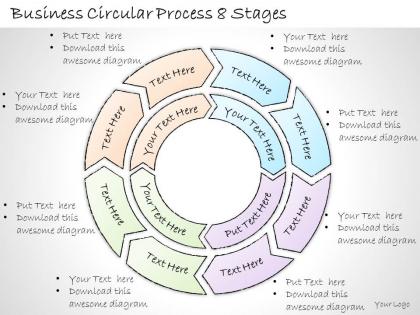
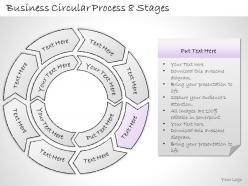
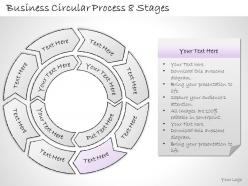
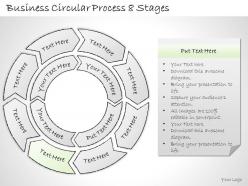
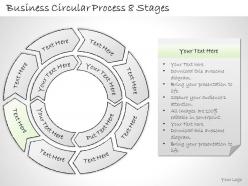
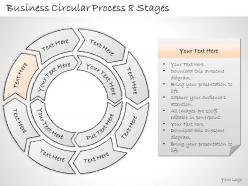
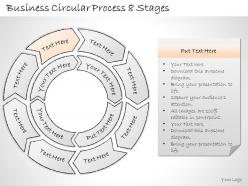
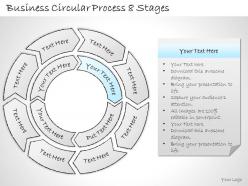
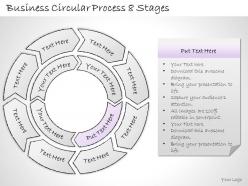
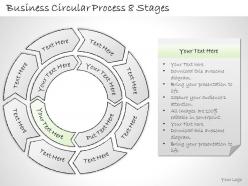
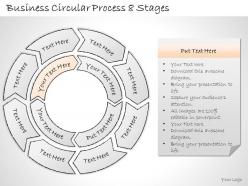
Attract your audience with our business PPT diagram business circular process 8 stages template design. The amazingly created presentation slide has been designed with utmost care by the team of our innovative designers. Our PPT image highlights the various aspects of business process which are very important for any business organization in order to survive in today’s world. Use this PPT diagram for business and marketing related presentations. Our slide design has a graphic of circular arrow process which is in hand drawn style and can be used to showcase various business concepts such as innovation, growth, objectives, analysis, business team, closing a deal, operations, etc. The graphic conveys the message in a creative manner and is fully editable so you can even add icons and further expand the horizon of your business activities. Whatever you desire to achieve can be done with our PPT slideshow. We have a wide range of business slides which can be easily incorporated into your professional presentations. Announce the ground rules with our 2502 Business Ppt Diagram Business Circular Process 8 Stages Powerpoint Template. Familiarise them with the basic code.
People who downloaded this PowerPoint presentation also viewed the following :
2502 business ppt diagram business circular process 8 stages powerpoint template with all 17 slides:
Use our 2502 Business Ppt Diagram Business Circular Process 8 Stages Powerpoint Template to weave a web of your great ideas. They are guaranteed to attract even the most critical of your colleagues.
FAQs for 2502 business ppt diagram business circular process 8
The key stages in the business circular process include design for circularity, sustainable sourcing, efficient production, distribution and retail, consumer use, and end-of-life management through recycling or regeneration. These interconnected phases enable organizations to minimize waste, reduce resource consumption, and create closed-loop systems, with companies across manufacturing, retail, and technology sectors finding that circular approaches ultimately deliver cost savings and competitive advantage.
The circular process differs from traditional linear models by emphasizing reuse, recycling, and regeneration rather than the traditional take-make-dispose approach, creating closed-loop systems that minimize waste and maximize resource efficiency. While linear models focus on single-use consumption, circular approaches enable businesses to reduce costs, create new revenue streams, and enhance sustainability, with many manufacturing and retail organizations finding that these strategies deliver competitive advantage and improved operational resilience.
Sustainability serves as the foundational driver of the business circular process, emphasizing resource efficiency, waste reduction, closed-loop systems, and regenerative practices that minimize environmental impact. Through circular strategies, organizations across manufacturing, retail, and technology sectors achieve significant cost savings, enhanced brand reputation, and competitive differentiation, while contributing to long-term environmental stewardship and business resilience.
Businesses can effectively measure circular initiative success through key performance indicators like waste reduction percentages, resource efficiency ratios, cost savings from reused materials, circular revenue streams, and lifecycle assessment improvements. These metrics enable organizations across manufacturing, retail, and technology sectors to track environmental impact while quantifying financial returns, ultimately delivering competitive advantage and operational transparency.
Common challenges include resistance to change, high initial investment costs, complex supply chain restructuring, regulatory compliance requirements, and lack of skilled workforce. These obstacles present both operational and strategic considerations, with many manufacturing companies, retail organizations, and technology firms finding that phased implementation approaches help minimize disruption while building internal expertise and stakeholder buy-in.
Technology facilitates circular business transitions by enabling resource tracking through IoT sensors, optimizing material flows with AI analytics, and connecting stakeholders via digital platforms for waste exchange and reuse opportunities. Through blockchain transparency and predictive maintenance systems, companies across manufacturing, retail, and logistics streamline operations, reduce waste costs, and create new revenue streams, ultimately delivering competitive advantage in increasingly sustainability-focused markets.
Organizations can minimize circular process waste by implementing lean manufacturing principles, adopting predictive maintenance schedules, establishing comprehensive recycling programs, optimizing resource allocation systems, and creating closed-loop feedback mechanisms. These practices streamline operations by reducing material consumption, extending equipment lifecycles, and improving process efficiency, with many manufacturing and retail companies finding that strategic waste reduction ultimately delivers significant cost savings and enhanced competitive advantage.
Employee engagement significantly influences circular business strategy effectiveness by driving innovation in waste reduction, fostering sustainable practices across operations, and ensuring consistent implementation of circular principles throughout the organization. Engaged employees actively identify resource optimization opportunities, champion recycling initiatives, and develop creative solutions for product lifecycle extension, with many companies finding that highly engaged teams deliver 23% better profitability and stronger environmental outcomes.
Several frameworks guide circular process development, including the Ellen MacArthur Foundation's Circular Design Guide, Cradle to Cradle principles, the Circular Business Model Canvas, and Life Cycle Assessment methodologies. These frameworks enable organizations to systematically redesign operations, optimize resource flows, and identify circular opportunities across manufacturing, retail, and service sectors, ultimately delivering cost reductions and competitive advantage.
Companies can encourage consumer participation through education campaigns, incentive programs like trade-in discounts, convenient take-back services, and transparent sustainability reporting. By making circular practices accessible and rewarding, businesses in retail, electronics, and fashion sectors streamline customer engagement while building brand loyalty, ultimately delivering enhanced customer relationships and competitive advantage in an increasingly sustainability-focused marketplace.
Businesses should track material efficiency ratios, waste diversion rates, resource recovery percentages, cost savings from reused materials, and circular revenue streams from refurbished products. These metrics enable organizations across manufacturing, retail, and technology sectors to measure operational improvements, identify optimization opportunities, and demonstrate competitive advantages, with many companies finding that comprehensive tracking ultimately delivers enhanced profitability and sustainability outcomes.
The circular economy transforms supply chain management by prioritizing resource reuse, waste minimization, and closed-loop systems rather than traditional linear models. Companies across manufacturing, retail, and technology sectors are redesigning their supply networks to incorporate recycling partnerships, reverse logistics, and sustainable sourcing, ultimately delivering cost reductions, enhanced brand reputation, and competitive advantage in an increasingly environmentally-conscious marketplace.
Financial benefits of adopting circular business models include reduced raw material costs, enhanced resource efficiency, new revenue streams from waste monetization, lower disposal expenses, and improved risk management through supply chain diversification. Companies across manufacturing, retail, and technology sectors increasingly find that circular approaches deliver significant cost savings, operational resilience, and competitive advantages in resource-constrained markets.
Yes, circular processes can be seamlessly integrated into existing business operations through strategic resource mapping, supply chain optimization, and waste-to-input conversion systems. Many manufacturing companies, retail organizations, and service providers successfully implement these approaches by redesigning workflows, partnering with recycling networks, and adopting sustainable technologies, ultimately delivering cost reductions and enhanced operational efficiency.
Fashion, automotive, electronics, and packaging industries have successfully implemented circular processes through design for durability, take-back programs, material recovery systems, and closed-loop manufacturing. Companies like Patagonia, BMW, and Interface demonstrate that circular approaches deliver significant cost reductions, enhanced brand loyalty, and competitive advantage, with many organizations finding that strategic resource optimization ultimately drives both sustainability and profitability.
-
Excellent work done on template design and graphics.
-
Wonderful templates design to use in business meetings.