


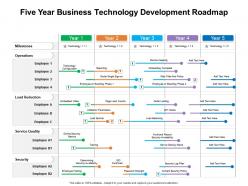
Five year business technology development roadmap





Try Before you Buy Download Free Sample Product
 Impress Your
 Audience
 100%
100% Editable
 Save Hours
 of Time


Visualize your work plan and communicate your ideas impactfully with our pre designed Five Year Business Technology Development Roadmap. Showcase the detailed overview of the project, the key deliverables, and the milestones to be achieved with the help of our fully customizable PowerPoint layout. You can easily emphasize on the project goals and discuss all the activities involved in an easy to comprehend manner by utilizing our professionally designed PPT theme. This roadmap PowerPoint layout is a perfect strategic planning tool that can help in keeping the project on track. With our attractive PowerPoint theme, you can articulate the workflow, track the work progress, and have a clear vision of the goal to be achieved. Download this versatile Five Year Business Technology Development Roadmap and save your hours of work.
People who downloaded this PowerPoint presentation also viewed the following :
Five year business technology development roadmap with all 2 slides:
Use our Five Year Business Technology Development Roadmap to effectively help you save your valuable time. They are readymade to fit into any presentation structure.
FAQs for Five year business
Start with what tech you actually own - not what you think you have (there's always missing stuff, honestly). Map your business goals next and figure out which tech gaps are stopping you from hitting them. Budget estimates are crucial for each project, plus realistic timelines with milestones. Don't forget dependencies between projects - that's where things get messy fast. Risk assessments matter too, especially backup plans for anything critical. Oh, and review it every quarter since business moves crazy fast these days.
Tech trends basically run your whole roadmap - they decide what's doable, what customers want, and where competitors are going. I track AI adoption, cloud stuff, security threats... honestly feels like drinking from a fire hose half the time. But don't just chase every new shiny thing, you know? Map trends to your actual business goals first. Figure out which ones will really matter for your situation. I'd say pick 2-3 trends that fit your strategy and run some pilots. Way better than trying to do everything at once and spreading yourself too thin.
Honestly, you can't just lock yourself in a room and expect your roadmap to work. Getting leadership on board early means smoother budget talks later. Department heads know where the real problems are - they're dealing with broken processes daily. And don't forget the actual users! I've watched brilliant plans crash because nobody asked the people who'd use the stuff. Everyone's got different priorities too, which gets messy fast. Map out who you need first, then set up regular check-ins. Trust me, surprises during planning are way better than disasters after launch.
So I'd definitely use some kind of scoring system - weigh business impact vs how hard it'll be to actually pull off. Map everything out by cost, timeline, how well it fits your strategy, and what kind of return you're looking at. Quick wins are obvious picks, but don't sleep on the bigger strategic stuff even if it takes forever. Honestly, most people rush through this part and it bites them later. Make sure everyone agrees on how you're scoring things upfront - saves so much drama down the road. Oh and review it quarterly since priorities change constantly.
Honestly, ProductPlan or Roadmunk are solid picks for this - Lucidchart works too if you want more flexibility. First thing is mapping out your current capabilities, then tie everything back to what the business actually wants to achieve. Rolling wave planning is your friend here: get detailed for the next 6-12 months, then stay high-level after that. Oh, and definitely talk to your key stakeholders before you start building anything visual. I can't tell you how many beautiful roadmaps I've seen that completely missed the mark because nobody asked the right people what they needed.
So think of a tech roadmap like GPS for your IT spending - way better than just buying random stuff that looks cool. Start with your business goals (growth targets, new markets, whatever you're chasing) then figure out which tech actually moves the needle on those things. I'd revisit it every quarter since priorities change constantly. The whole point is making sure you're spending on projects that actually boost revenue or efficiency, not just because the tech is shiny. Honestly beats the old "throw money at problems" approach most companies do.
Track the hard numbers first - delivery times, budget, ROI, user adoption rates. That last one's honestly the most telling because unused tech is just money down the drain. Then measure the fuzzy stuff: employee satisfaction, customer experience, whether it actually helps your business goals. Set your baselines before starting anything, check quarterly. But here's the thing - don't just hoard spreadsheets. Actually look at the data and pivot your roadmap when needed. I've seen too many companies collect metrics religiously but never act on them.
Honestly, quarterly reviews are your best bet - I learned this the hard way after trying monthly updates (total waste of time). Save the deep dive for once a year when you can really assess budget stuff and new tech trends. Those quarterly check-ins? Just focus on milestones and any curveballs that popped up. Waiting longer than six months is risky because things move fast these days. The annual review is where you'll dig into whether your strategy still makes sense. Block those quarterly dates in your calendar right now - they're super easy to blow off but you'll regret it.
Ugh, the worst thing you can do is get way too detailed right off the bat. Focus on big picture stuff first - trust me on this one. Also never make your roadmap solo! I've watched people create these gorgeous plans that totally missed what anyone actually wanted. Get different teams involved early so you know their priorities and when stuff needs to happen. Oh and here's the thing - it's gonna change constantly anyway. Build flexibility in from the start and treat it like a Google doc, not the Ten Commandments. Review it every quarter minimum or you'll be screwed.
Don't lock yourself into specific tech choices years ahead - that's how you end up stuck with garbage. Focus on what business problems you're trying to solve instead. Build in quarterly reviews to check out new stuff that's emerging. Keep some budget free for when something cool pops up. Modular beats monolithic every time, trust me on this one. The key thing is making your team see pivoting as being smart, not giving up. I've watched way too many companies paint themselves into corners because they committed too early and couldn't adapt.
AI and IoT aren't just buzzwords anymore - they'll literally make or break your roadmap. But here's the thing: half the "revolutionary" tech out there is just marketing fluff. Focus on what actually fixes your problems first. AI handles the boring repetitive stuff and helps you make smarter decisions. IoT gets you live data from whatever you're running. Don't go crazy though - pick maybe two solid use cases to test out before you dump money into some massive rollout. Map everything back to real business results and timelines that actually make sense.
So basically, a tech roadmap shows you exactly what investments you'll need and when. Way better than scrambling every quarter wondering where your budget should go. You can actually plan ahead - like knowing you'll need cloud migration people in Q2 or those AI folks everyone's hiring next year. Honestly saves you from so many "oh crap, we don't have money for this" situations. Plus it makes fighting for headcount way easier since you can show leadership the bigger picture. I'd start by just mapping what tech gaps you have now against your business goals. Pretty straightforward once you get going.
Honestly, I learned this one the hard way after putting executives to sleep with technical diagrams - oops! Different audiences need totally different approaches. C-suite wants business impact and timelines, not the technical weeds. Your IT team needs those nitty-gritty dependency details though. Make visual roadmaps with clear milestones and always connect tech stuff back to business results. Keep it fresh because stale roadmaps kill your credibility fast. I do quarterly check-ins with each group and literally create different versions - detailed for IT, strategic for leadership, simple for end users. Try it at your next stakeholder meeting.
First thing - figure out what legacy systems you actually need vs what you're just used to having around. Map the business-critical ones and tackle those gradually instead of doing some massive overhaul. Bridge connections work way better than trying to replace everything at once. Some of that old software honestly runs circles around newer stuff anyway. Timeline-wise? Add like 50% more time than you think because this stuff always gets messy. Oh, and definitely loop in the people who use these systems every day - they'll catch issues you'd never think of.
Honestly, the people side is way harder than the tech part - learned that the hard way on my last project. You can build the most perfect system ever, but if nobody wants to use it, you're screwed. Get your team excited about the "why" before you even start building anything. Find those early adopters in each department who'll become your cheerleaders. Training is huge too - don't just dump new software on people and expect them to figure it out. I'd start having those conversations yesterday if I were you.
-
Professional and unique presentations.
-
Excellent work done on template design and graphics.
-
Easy to edit slides with easy to understand instructions.
-
Nice and innovative design.