

30 60 90 day plan with tick marks and arrows on top powerpoint ideas





Try Before you Buy Download Free Sample Product
 Impress Your
 Audience
 100%
100% Editable
 Save Hours
 of Time


Whenever a company takes up a long-term project, one of the first moves it makes is that it creates a 30 60 90 day plan and a user can discuss the same by using the 30 60 90 days strategic plan template for PowerPoint. The 30 60 90 day plan management PPT slide serves as a guide for the organization, in a detailed manner it helps in presenting a list of foreseeable targets which the organization needs to achieve in the course of the first ninety days of the project. A presenter can explain that the 30 60 90 day PowerPoint template describes the essentially three stages of any project. When an individual wants to impress a prospective employer, one of the items he wants to take with him to the interview is a 90 days plan. The 30 60 90 day HR plan presentation slide act as a document that states what they are going to do for their employees in the first 90 days along with that they can represent how they will help them in their first three months on the job. Enlighten folks on bigotry with our 30 60 90 Day Plan With Tick Marks And Arrows On Top Powerpoint Ideas. Bring an end to expressions of intolerance.
People who downloaded this PowerPoint presentation also viewed the following :
Content of this Powerpoint Presentation
"In preparing for battle, I have always found that plans are useless, but planning is indispensable." – Dwight D. Eisenhower.
What if short-term goals are not just for immediate benefits, but they hold the key to the elusive complexities of conducting a successful business? Whether you are starting a new business or extending the limits of the current one, defining the attainable milestones is paramount. Introduce the 30-60-90-day plan— a specific plan to help you through the crucial first months and set the stage for your success.
Visualize a road map decorated with check marks and arrows to represent triumphs made and the way ahead. This graphical representation keeps you focused and is a continuous prompt of the to-dos and the goals to be accomplished. Day by day, you get closer to your goals, gaining momentum and confidence on the move.
But where to begin? What is the transformation of these short-term aspirations into concrete outcomes? Don't worry; we have a PowerPoint template explicitly set for your 30-60-90-day plan.
In a world where agility and adaptability are key, our 30-60 90-Day Plan template provides the resources you need to navigate the complexities of the modern business environment with ease and assurance. Unleash your capability for achievement and move your efforts forward with this invaluable toolkit.
Check out another PPT Design on the topic to remove the visual confusion and focus on only the essential aspects for a more transparent presentation.
Template 1: 30-60-90 Day Plan with Tick Marks and Arrows on Top
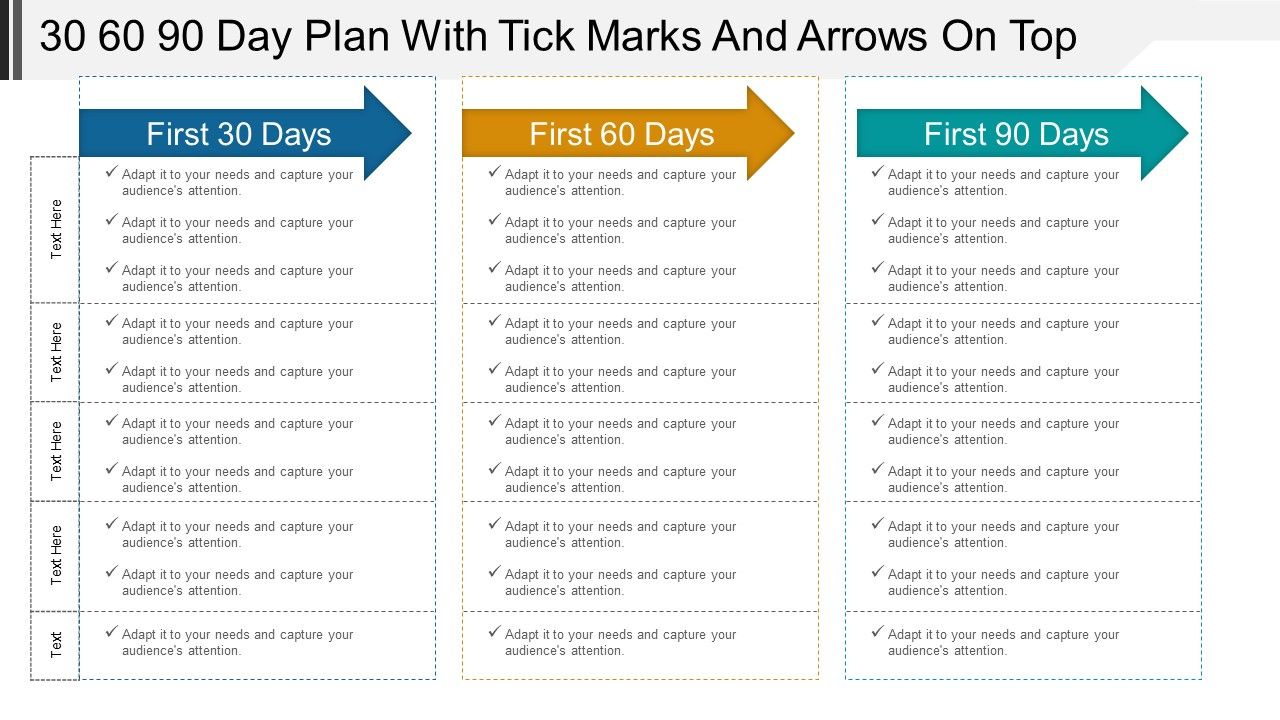
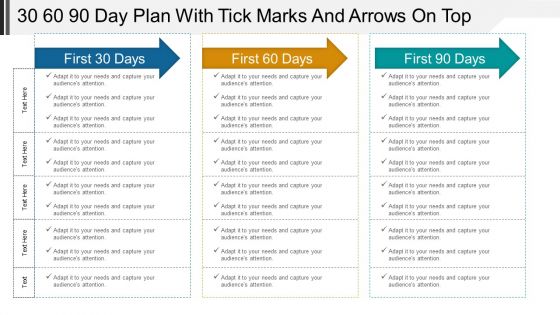
Whether launching a new enterprise or growing an existing organization, this well-developed and curated 30-60-90-day plan is your perfect find. This slide comprises three horizontally aligned columns: 30 days, 60 days, and 90 days. Each column embodies an important stage in your path toward accomplishing your objectives.
What makes this slide beautiful is its flexibility. Its full editable features allow you to make it fit your organization's unique requirements. This intuitive layout ensures you are always focused and allows for quick and clear comprehension for your audience.
Conclusion
Breaking objectives into short targets – 30, 60, and 90 days – offers an uncomplicated roadmap and leads to a habit of small victories. Indeed, when lofty objectives are put into bite-sized milestones, businesses can retain focus, momentum, and flexibility to remain agile in challenges and responsive to opportunities. Follow the old wise advice, “Inch by inch; it is a cinch.” So, this small target philosophy is not an innovation but the way ahead and the approach that provides sustainable growth and lasting success.
Explore SlideTeam’s 30-60-90-Day Project Management Plan Examples to encourage team accountability and motivation.
30 60 90 day plan with tick marks and arrows on top powerpoint ideas with all 5 slides:
Impress folks with your imaginative approach through our 30 60 90 Day Plan With Tick Marks And Arrows On Top Powerpoint Ideas. Establish yourself as a capable entrepreneur.

FAQs for 30 60 90 day plan with tick marks and arrows on
Okay so basically you want to break it into three chunks. First month? Just soak everything up - learn the role, figure out company culture, meet the important people. Honestly, don't worry about making huge changes yet. Month two is where you start getting into actual projects and spotting ways to improve things. Build those relationships too. Last 30 days should show some real wins and set you up long-term. Oh, and definitely set specific goals for each phase - your manager will appreciate the structure. Regular check-ins help too so you're not going off track.
Look, your 30-60-90 day plan really depends on what you're actually doing. Sales? Focus on building your pipeline and relationships. Tech roles need you learning the systems and jumping into sprints. Customer-facing means mapping out all those stakeholder relationships - honestly can be overwhelming at first. Leadership positions get way more complex with strategic planning and team assessments. Here's what works: ask your manager what "crushing it" looks like at each checkpoint, then just work backwards. Don't overthink it.
Don't make your goals super vague like "learn company culture" - be specific instead. Like "finish onboarding modules and meet with five key people." Also, resist cramming everything into those first 30 days because honestly? You'll still be learning basic stuff like who to ask for IT help. Check what your manager actually wants from you too - I've seen people write elaborate plans that totally miss the mark. Oh, and don't just write it once and forget about it. Schedule regular check-ins so you're actually using the thing to track how you're doing.
Look, a 30-60-90 day plan is basically your way of showing stakeholders you're not just randomly doing stuff. They get to see exactly what you're working on and when things will happen. No more awkward "so... what have you been up to?" conversations. It sets up perfect check-in moments too. People really prefer knowing what's coming instead of being surprised all the time. Your meetings become way more productive because everyone's on the same page about what success looks like. Shows you're actually thinking ahead rather than just figuring it out as you go. Just share it upfront and shoot them quick updates at each milestone – keeps everyone happy and aligned.
Honestly, having specific goals in your 30-60-90 day plan is a game changer. It keeps everyone focused since there's no guessing what needs to happen next. When problems pop up - and they will - you'll catch them way earlier because you've got actual milestones to check against. No more of that "we'll wing it" mentality that always bites you later. Plus you get to celebrate the small wins, which honestly keeps people motivated. Oh, and make sure each goal is measurable and connects to real outcomes. Then just work backwards to figure out your daily tasks.
Track specific numbers for each 30-day chunk - like how many systems you've learned or team members you've connected with. Weekly manager check-ins are honestly a game changer, way more helpful than I expected when I started doing them. Be real about what's bombing and what's clicking, then pivot for the next phase. Oh and set up some basic tracking system right away - even just phone notes work. I'm terrible with spreadsheets but even I can handle that. Focus on completion rates and feedback scores from people you're working with. Those weekly convos will keep you from going totally off course.
Look, you'll definitely want to check in with your manager and teammates at each milestone - trust me on this one. Some of your early assumptions are gonna be completely wrong (mine always were). Getting feedback helps you figure out what actually matters versus what you *think* matters. Don't just wait for the formal 30/60/90 reviews either. Quick weekly chats with your boss can save you from going down the wrong path for weeks. I'd honestly rather pivot early than realize I've been focusing on the wrong stuff. Your teammates usually have good insights too about priorities you might've missed.
Honestly, those 30-60-90 plans are game changers for new hires. Break it down like this: first month is just basic stuff - learning systems, meeting people, figuring out where the bathroom is (kidding, but you know what I mean). Second month gets them into actual role training and building relationships. Last stretch? That's when they start handling real work independently. Without this structure, new people just drown in information and quit faster. I've seen it happen too many times. Set up clear goals for each phase and they'll actually know what success looks like. Your future self will thank you.
Honestly, just use a basic Google Doc or Word template - don't overthink it. I've seen people get way too fancy with project management software when all you need is something simple. Break it into three sections (30/60/90 days) with like 3-5 specific goals under each. PowerPoint works too if you're presenting to your boss or whatever. The main thing is making sure your goals are actually measurable, not just vague stuff like "learn the role better." Oh, and jot down what resources you'll need - that always comes up in reviews. Start with a free template online and tweak it for your company's vibe.
Here's the thing - a 30-60-90 day plan basically gives your team a roadmap instead of leaving them to guess what you want. Start with some easy wins in month one to build confidence. Month two, go after bigger stuff. By 90 days, people actually see progress on the major goals. What really works though is getting your team involved in setting those milestones - they'll buy in way more than if you just hand down orders from your office. Oh, and don't forget to celebrate the small wins weekly. Sounds cheesy but it genuinely keeps momentum going.
Okay so here's what I've learned from watching people bomb these presentations - make it super visual with clear 30/60/90 day milestones that actually mean something. Don't just list random tasks. Show them how you'll drive revenue or cut costs, because honestly that's all they really care about. Lead with your biggest wins upfront since executives zone out fast. Address roadblocks before they ask - shows you're not just winging it. Oh, and always connect everything back to whatever the company's obsessing over this quarter. End by being specific about what resources you need. They hate vague asks.
Build your retrospective learnings straight into each phase. First 30 days - tackle whatever went wrong last time. Communication sucked? Schedule those stakeholder check-ins from day one. Days 60-90 can use the processes that actually worked before. I keep this messy doc of "wins and fails" from old projects because honestly? We forget everything so fast it's embarrassing. Your 30-60-90 gets way more strategic when it's built on real experience instead of some cookie-cutter template. Just start by writing down 3-5 lessons from your last project and turn them into actual actions.
Pick 2-3 metrics max for each phase or you'll go crazy trying to track everything. First 30 days? Focus on learning stuff - training modules you've finished, how many key people you've met, that kind of thing. Then around 60 days, start looking at actual work you're contributing to projects. The 90-day mark is when you can finally measure real impact on business goals. I'd honestly worry more about the later metrics since that's what really matters long-term. Just make sure whatever you choose actually connects to what your boss thinks success looks like in your role.
Set both main goals and stretch goals for each phase - that way you can shift things around when priorities change. Your first 30 days should be more about learning and observing anyway. Those early weeks always throw curveballs you didn't expect. At 60 and 90 days, build in checkpoint reviews where you can actually pivot based on what you've figured out. Don't wait until the end of each phase to talk with your manager either - regular check-ins let you course-correct as you go instead of sticking to some plan that doesn't make sense anymore.
Stay flexible and tweak things when stuff isn't working. I'd check in with your manager weekly to make sure you're focused on the right stuff - priorities shift constantly in new roles. Around day 45 you'll probably feel swamped (everyone does), so break big goals into tiny daily wins. Seriously, checking off small tasks helps more than you'd think. Keep notes on what's actually working vs what's a waste of time. Don't hesitate to ask for help or resources. Your plan should make life easier, not stress you out more.
-
It saves your time and decrease your efforts in half.
-
Content of slide is easy to understand and edit.