

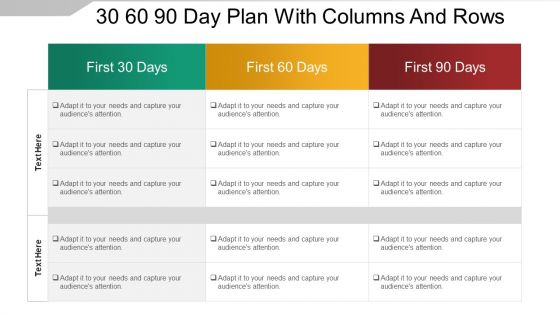
30 60 90 day plan with columns and rows sample of ppt





Try Before you Buy Download Free Sample Product
 Impress Your
 Audience
 100%
100% Editable
 Save Hours
 of Time


Engage your audience through our 30 60 90 Day Plan With Columns And Rows Sample Of Ppt. Set the tone for a good dialogue.
People who downloaded this PowerPoint presentation also viewed the following :
30 60 90 day plan with columns and rows sample of ppt with all 5 slides:
Get dual benefits from our 30 60 90 Day Plan With Columns And Rows Sample Of Ppt. They help advertise and confirm your abilities.
FAQs for 30 60 90 day plan with columns and rows
Think of a 30-60-90 day plan as your sanity-saver when tackling big projects. You take those massive goals and chop them into actual doable pieces. First 30 days? Grab the low-hanging fruit and get some wins under your belt. Days 30-60, you're building on that momentum. By day 90, you've got real results to show. Honestly, it's one of the few planning methods that actually works because it stops you from drowning in the big picture. Your team knows what they're doing, bosses can see progress happening, and you're not staring at some impossible mountain wondering where to start. Work backwards from your end goal - makes the whole thing way less overwhelming.
Honestly, a good PPT is everything for your 30-60-90 day plan. Visual timelines and clear milestones make it so much easier to follow than boring text blocks. People can actually see how each phase connects. Short sentences work great for key goals. Then use longer sections when you're explaining the bigger picture and how everything flows together. I'd definitely keep the same format for each 30-day chunk - makes it look way more professional. Oh, and throw in specific numbers so everyone knows what you're actually aiming for. Nobody wants to guess what "success" means, you know?
For your PPT, start with clear goals for each 30-day chunk. Add specific milestones and how you'll measure success. Honestly, execs eat up timeline visuals - throw in a good chart. First 30 days should focus on learning stuff, then build relationships in the next month. By day 90, show what you'll actually contribute. Don't skip the stakeholder mapping part - it's boring but necessary. Quick wins in the early days will make you look good. Keep everything measurable so your boss can track progress and you can prove you're not just coasting.
So basically, your goals ramp up in ambition as you go. The first 30 days? You're just absorbing everything - figuring out who's who, learning the systems, understanding how stuff actually works. Month two is when you start doing real work and contributing to projects. Then by 90 days, you're supposed to be running independently and suggesting improvements - honestly, that's where it gets fun. It's like learning the rules first, then playing, then eventually changing the game. Just make sure your presentation shows that clear jump from "help me understand this" to "here's how we can do it better."
Honestly, just go with a simple timeline layout - horizontal bars work great. Pick different colors for each 30-day chunk and stick with them. Nobody wants to read paragraphs in presentations, so use bullet points and icons instead. I'd add progress markers too, like checkboxes showing what's done vs. what's coming. Graphs are solid for displaying your growth targets. Oh, and make your fonts huge - I can't tell you how many times I've seen people squint at tiny text during meetings. Charts help break things up visually. Start basic with a template rather than getting fancy with animations right away.
Honestly, it's all about knowing your audience. With executives, lead with ROI and big-picture stuff - they don't care about the nitty-gritty details, just results. Keep it short because their time is precious. Your team needs the opposite though. They want the actual steps and processes since they're doing the work. I'd drop the corporate speak when talking to your team too - way more effective. Oh, and here's the thing - same presentation structure works for both, you're just shifting what you emphasize. Strategic vision for the C-suite, tactical execution for everyone else.
Don't be vague - saying you'll "learn the role" means nothing. Get specific about actual deliverables you can hit in 30 days. Also, resist the urge to cram everything in there. You're new! Focus on value you'll bring to the team, not just what you want to learn. Keep slides super simple too - animations are honestly just annoying in these situations. Most crucial thing? Talk to your manager first about what they actually want to see. I've seen people build entire presentations around stuff their boss didn't even care about. That's awkward for everyone.
Build in feedback sessions right at your milestones - trust me on this one. After you present, grab quick 15-minute check-ins with your manager at 30, 60, and 90 days. People totally underestimate how useful these conversations actually are. Keep notes in your original PPT or wherever so you can track what changes you made based on their input. Here's the thing though - ask specific stuff like "What should I prioritize differently?" instead of the generic "How am I doing?" Don't treat these like performance reviews. They're more like plan tweaks, you know?
Look, market analysis is what keeps you from making dumb decisions in your 30-60-90 plan. First 30 days? You're digging into competitor moves, what customers actually want, trends worth watching. Then 60-90 is where you take all that info and build your strategy around it. Trust me, going in blind sucks - I've watched teams crash because they skipped this step. You'll know which opportunities are worth chasing and which problems need fixing first. Oh, and grab both the hard numbers AND talk to actual people. Data shows you what's happening, but customers tell you the real why behind it all.
So instead of boring bullet points, try Prezi or Canva to make your 30-60-90 day plan actually look good. Trello or Asana are great for showing real-time progress - honestly makes you look way more organized than you probably are lol. Gantt charts in Monday.com work well for timelines, and you can embed clickable links to docs or resources. Interactive dashboards are perfect for displaying your metrics. Oh, and make it feel like a living document rather than another PowerPoint everyone will zone out during. People remember dynamic presentations way better than static ones.
Pick like 3-4 metrics max - trust me, more than that and you'll lose track. Mix hard numbers (revenue, calls made, projects done) with the softer stuff that actually matters just as much. Things like building relationships or nailing new processes. Your manager's feedback scores are huge too, especially early on. Just don't go nuts setting impossible targets - I've seen people do that and it backfires hard. The qualitative wins can be just as career-changing as hitting your numbers, which honestly took me way too long to figure out.
Yeah totally! Think of it like you're writing a mini story. Your current situation is the opening scene, then each 30-day chunk becomes a chapter - like "Learning the Ropes" or "Making My Mark." Map out the challenges as your plot points. I actually love the hero's journey angle where you're tackling obstacles to hit your goals. Don't overthink it though - I've watched people go overboard with fancy metaphors. Simple storytelling works better. Throw in specific examples of wins you're expecting. It makes the whole plan way more engaging than just bullet points, you know?
Oh man, stakeholder feedback always shakes things up! Timelines get moved around constantly - they either want everything yesterday or suddenly realize stuff needs way more time. Your priorities will definitely get reshuffled, especially when leadership decides they care about something totally different now. Budget changes happen all the time too based on what resources they actually have. And here's the fun part - sometimes they'll just throw brand new objectives at you or tweak existing ones to match whatever the company's obsessing over this quarter. My advice? Build in some wiggle room from the start. Leave buffer time and have backup plans ready because trust me, you'll need them.
Ugh, missing deadlines is the worst. First thing - figure out what actually went wrong. Bad timing? Not enough people? Something totally out of your control? Don't just push everything back though, that's where people mess up big time. Pick what's actually critical and maybe extend those timelines. Other stuff? Honestly might need to drop it or break it into way smaller pieces. The trick is owning up to it when you tell everyone. Like don't pretend nothing happened - people aren't stupid. Update your presentation with the real deal and get it out there ASAP. Better to rip the band-aid off now.
Dude, sales teams absolutely crush it with these plans - new reps get up to speed way faster. Tech companies are obsessed with them too because onboarding engineers is such a pain otherwise. Works amazing in consulting, finance, healthcare... basically anywhere with complicated products or those endless sales cycles. Oh, and don't just grab some random template online. You've gotta tweak the milestones to actually fit your company's vibe and what you're doing. I've seen people try to force generic ones and it's pretty obvious when they don't match the role.
-
Nice and innovative design.
-
Great experience, I would definitely use your services further.