


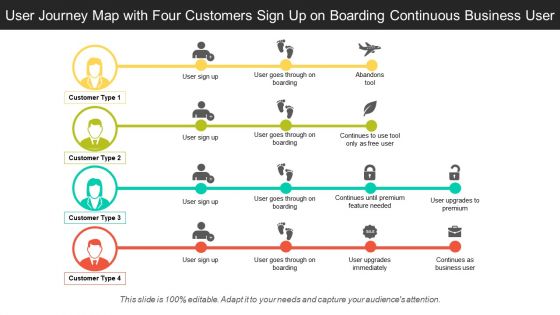
User journey map with four customers sign up on boarding continuous business user





Try Before you Buy Download Free Sample Product
 Impress Your
 Audience
 100%
100% Editable
 Save Hours
 of Time


Our User Journey Map With Four Customers Sign Up On Boarding Continuous Business User will drive you to finding the answer. They enable you to figure anything out.
People who downloaded this PowerPoint presentation also viewed the following :
User journey map with four customers sign up on boarding continuous business user with all 5 slides:
Astound your team with our User Journey Map With Four Customers Sign Up On Boarding Continuous Business User. They will bow in respect of your ideas.
FAQs for User journey map with four customers sign up on boarding
Key stages include awareness, consideration, purchase, onboarding, usage, support, and retention or advocacy phases. These stages help organizations understand customer touchpoints, pain points, and emotional states throughout their experience, with companies in retail, banking, and healthcare finding that comprehensive mapping streamlines service delivery, reduces friction, and ultimately enhances customer satisfaction while identifying optimization opportunities.
Understanding user emotions transforms journey maps from functional flowcharts into empathetic blueprints by identifying pain points, moments of delight, and emotional triggers at each touchpoint. This emotional intelligence enables organizations to prioritize improvements strategically, design more intuitive interfaces, and create memorable experiences, with many companies finding that emotion-driven optimizations significantly increase customer satisfaction and retention rates.
Effective user journey mapping tools include Miro, Lucidchart, Adobe XD, Figma, and specialized platforms like UXPressia and Smaply. These technologies streamline collaboration by enabling real-time editing, template libraries, and stakeholder input integration, with many organizations finding that visual mapping tools accelerate design processes while enhancing customer experience optimization across departments.
User personas significantly influence journey mapping by providing detailed demographic insights, behavioral patterns, pain points, and motivational drivers that shape each touchpoint design. Through persona-driven mapping, organizations create targeted experiences for specific user segments like busy executives or budget-conscious families, ultimately delivering more personalized customer interactions and higher conversion rates across all channels.
Common pitfalls include making assumptions without user research, focusing solely on happy paths while ignoring frustration points, creating overly complex maps, and failing to update journeys regularly. These oversights lead to incomplete understanding of user experiences, with many organizations finding that involving cross-functional teams and validating maps through real user feedback delivers more accurate, actionable insights for improving customer touchpoints.
Incorporating user feedback into journey mapping involves collecting insights through surveys, interviews, usability testing, analytics data, and direct customer observations at each touchpoint. This feedback enables organizations to validate assumptions, identify pain points, and optimize experiences based on real user behavior, with many companies finding that continuous feedback integration delivers more accurate journey maps and ultimately stronger customer satisfaction and retention rates.
User journey mapping improves customer engagement and retention by identifying pain points, optimizing touchpoints, personalizing interactions, and streamlining communication across channels. Through detailed journey analysis, companies in retail, banking, and healthcare can reduce friction, anticipate customer needs, and deliver targeted experiences, ultimately increasing satisfaction rates and loyalty while minimizing churn.
Cross-functional teams collaborate effectively during user journey mapping by establishing shared objectives, conducting joint research sessions, and creating unified documentation accessible to all stakeholders. Through collaborative workshops, regular check-ins, and centralized feedback systems, teams from marketing, product, design, and customer service can align perspectives, minimize silos, and ultimately deliver more comprehensive customer experiences that drive business growth.
User journey metrics should include conversion rates, task completion rates, time-to-completion, customer satisfaction scores, and drop-off points at each stage. These measurements enable organizations to identify friction areas, optimize touchpoints, and streamline experiences, with many retail and financial services companies finding that comprehensive tracking ultimately delivers higher engagement and improved customer retention.
User journey maps inform marketing strategies by identifying key touchpoints, emotional triggers, pain points, and decision-making moments throughout the customer experience. These insights enable marketers to create targeted campaigns, personalize messaging, optimize channel selection, and align content with specific journey stages, with many organizations finding that journey-informed strategies deliver higher conversion rates and stronger customer relationships.
Storytelling transforms user journey maps from static diagrams into compelling narratives that humanize data, communicate pain points, and inspire stakeholder action through emotional connection and contextual understanding. These narrative-driven maps enable design teams, product managers, and executives to visualize real customer experiences, identify improvement opportunities, and align cross-functional efforts, ultimately delivering more empathetic solutions and strategic user-centered decisions.
User journey maps should be updated every 3-6 months or following major product changes, customer feedback patterns, or market shifts to maintain accuracy. Many organizations find that regular quarterly reviews enable them to capture evolving customer behaviors, integrate new touchpoints, and address emerging pain points, ultimately delivering more personalized experiences and sustained competitive advantage.
User journey maps focus on digital interactions and specific touchpoints within products or services, while customer journey maps encompass the entire relationship lifecycle, including pre-purchase research, emotional states, and post-purchase experiences. While user journey maps streamline product development and interface optimization, customer journey maps enable comprehensive experience design across all channels, with many organizations finding that combining both approaches delivers deeper insights, enhanced customer satisfaction, and ultimately stronger competitive advantage in increasingly complex marketplace environments.
User journey mapping assists in identifying pain points by visualizing each touchpoint, interaction, and emotional response throughout the customer experience, revealing friction areas, abandoned processes, and moments of frustration. Through detailed mapping, organizations can pinpoint specific bottlenecks in checkout processes, confusing navigation paths, and service gaps, ultimately enabling targeted improvements that streamline user flows and enhance overall satisfaction across digital and physical touchpoints.
Touchpoints represent critical interaction moments between users and your business, including websites, customer service calls, mobile apps, physical locations, and marketing communications. These contact points significantly influence user perceptions and decisions throughout their journey, with many organizations finding that optimizing touchpoint experiences streamlines conversions, enhances customer satisfaction, and ultimately delivers measurable competitive advantage.
-
Perfect template with attractive color combination.
-
Great designs, Easily Editable.