


30 60 90 day learning plan ppt slides
You must be logged in to download this presentation.




Try Before you Buy Download Free Sample Product
 Impress Your
 Audience
 100%
100% Editable
 Save Hours
 of Time


Our 30 60 90 Day Learning Plan Ppt Slides are topically designed to provide an attractive backdrop to any subject. Use them to look like a presentation pro.
People who downloaded this PowerPoint presentation also viewed the following :
Content of this Powerpoint Presentation
Description:
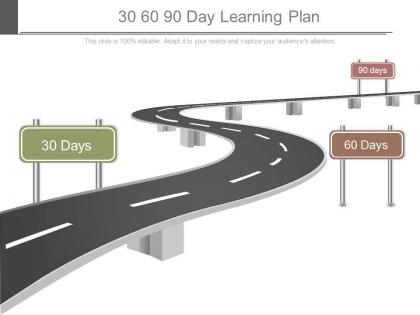
The image displays a graphic that's metaphorically designed to represent a strategic 30 60 90 Day Learning Plan. The winding road depicted here symbolizes the journey of learning or achieving goals over a period of time. Road signs are placed along the road at intervals labeled "30 Days," "60 Days," and "90 Days" to signify checkpoints or milestones within the plan.
Each text element serves a specific purpose:
1. "30 60 90 Day Learning Plan" is the title which suggests that the content of the presentation would outline a structured plan over a three-month period.
2. The subtext "This slide is 100% editable. Adapt it to your needs and capture your audience's attention." informs the user that the template is customizable for their specific purposes and encourages them to engage their audience meaningfully with tailored content.
3. Road signs "30 Days," "60 Days," and "90 Days" represent the progression and evaluation points within the plan. These could be seen as stages where one would assess progress, adjust strategies, or introduce new objectives.
Use Cases:
Such a slide can be applied across various industries for planning and development purposes, particularly where progress tracking is essential:
1. Human Resources:
Use: Streamlining employee onboarding and training timelines for efficient integration and knowledge transfer.
Presenter: HR manager or Training coordinator.
Audience: New employees or HR department.
2. Sales:
Use: Implementing effective sales training and target setting for new recruits to drive performance.
Presenter: Sales manager or sales coach.
Audience: Sales team or individual sales professionals.
3. Education:
Use: Developing and optimizing curricular plans and student assessment intervals for effective learning.
Presenter: Teacher or education administrator.
Audience: Faculty members or educational planners.
4. Health Care:
Use: Facilitating professional development for medical staff or rolling out new medical protocols effectively.
Presenter: Medical educator or healthcare manager.
Audience: Medical staff or administrative staff.
5. Technology:
Use: Managing product development milestones and educating teams on new technology deployment.
Presenter: Project manager or tech lead.
Audience: Development team or technical staff.
6. Marketing:
Use: Planning and executing marketing campaigns through defined phases to achieve objectives.
Presenter: Marketing director or campaign coordinator.
Audience: Marketing team or department.
7. Project Management:
Use: Evaluating project phases and setting learning objectives for team members to optimize performance.
Presenter: Project manager or team leader.
Audience: Project team members or stakeholders.
30 60 90 day learning plan ppt slides with all 7 slides:
Use our 30 60 90 Day Learning Plan Ppt Slides to effectively help you save your valuable time. They are readymade to fit into any presentation structure.
FAQs for 30 60 90 day learning
So basically break it into three chunks - first 30 days is all about soaking up info. Company culture, who's who, what processes they use, your actual job duties. The next month you'll start contributing real work and building relationships. Honestly, month two can feel like drinking from a fire hose but push through it. Look for ways to improve stuff too. Last 30 days? Time to step up. Propose solutions, maybe lead a small project, set some bigger goals. Oh and definitely track specific wins in each phase - your manager will want to see what you actually got done.
First thing - make a list of what you think you know vs. what you actually need to know. Test yourself with practice problems or try explaining stuff out loud (trust me, it's weird but it works). Get feedback from your teammates about where they think you're struggling. Honestly, this part sucks because you have to face reality. Write down everything - your strong points and the gaps. I'd say after a month you'll have a solid picture of what needs work. Then you can focus on the real problems instead of guessing what might be wrong.
Honestly, start with stuff that gets your hands dirty right away - Coursera, Udemy, Khan Academy beat just reading books any day. First month? Stick to foundational courses and YouTube tutorials. Month two is where you actually build things - projects, case studies, whatever lets you practice. Oh, and don't go crazy picking like 10 different resources. Two or three good ones work way better. Final month, find some communities or maybe a mentor if you can swing it. The feedback loop thing is huge - you'll actually retain what you're learning instead of just consuming content mindlessly.
Honestly, just start with whatever you need to understand first before moving on to harder stuff. Like, you can't jump into advanced topics if you don't get the basics yet. First month should be all foundations. Month two is when you tackle the skills that'll actually help your job right now. Then save the fancy advanced stuff for last when you've got everything else down. What I'd do is make three lists and figure out what depends on what - like which topics unlock others, you know? Also think about what's gonna make the biggest difference day-to-day. Write it all down so you don't get distracted by shiny new topics later.
Honestly, I'd just stick with a simple spreadsheet - list your goals by phase and update weekly. Color-coding is weirdly satisfying (green/yellow/red makes progress super obvious). Notion or Trello work too if you're into that stuff, or hell, even a regular notebook. The real trick is picking whatever you'll actually use consistently instead of something complicated that'll sit there collecting digital dust. Oh and definitely do a quick 15-minute check-in each week to see what's clicking and what isn't. Trust me on the weekly thing - it makes a huge difference.
Okay so here's what actually works - meet with your mentors every 2-3 weeks but ask them specific stuff, not just "how am I doing?" That's way too vague. Keep a little tracker of what people tell you and rate how you're improving on each thing. I'm gonna be real, I used to absolutely hate criticism but it's honestly the fastest way to get better. Find people who are crushing it in areas you suck at and shadow them or set up study sessions. Oh and this is key - don't just nod and forget about it. Actually make the changes and circle back to show you listened.
Definitely build networking into your 30-60-90 plan. First month, just connect with people who can answer your basic questions - honestly, I picked up way more from random coffee chats than any official training. Around day 60, start reaching out to folks in other departments and people outside your company. Those relationships become huge learning accelerators since they'll share resources and give you feedback you'd never find in books. Oh, and try to have at least one real professional conversation weekly. Sounds formal but it's really not - most people actually like helping newcomers out.
I'd probably do like 70-30, mostly hands-on stuff after your first week. Maybe spend 2-3 days getting the basics down first, then flip it so you're doing real work most of the time. Use books and courses to fill in gaps when you hit walls - honestly the theory clicks way better when you're already struggling with actual problems. By day 60 you'll barely touch formal learning, just quick googling and maybe deeper dives on tricky stuff. Oh and definitely track what you learn from doing vs studying, it's kinda wild to see the difference.
Honestly, be way more specific than I was when I started this stuff. Like instead of "learn Python," go with "finish 3 Python tutorials and make one tiny project in 30 days." I made that mistake big time my first go-around. Weekly milestones help tons - "read 2 industry articles per week" or "practice for 30 minutes daily." Make your 30-day goals challenging but not impossible, then ramp up difficulty for the longer ones. Write them somewhere you'll actually see them (not buried in some app) and check in weekly. You can always tweak things if life gets crazy.
Honestly, the small wins thing actually works - I was skeptical too but celebrating tiny progress kept me going. Set weekly goals instead of just saying "I'll learn more" because that's too vague. Track what you do each day, even if it's just 10 minutes of reading or whatever. Get someone to check in with you about it. When you're feeling blah (which happens to everyone), just commit to 15 minutes instead of your usual hour. You'll probably end up doing more once you start anyway. Consistency beats those crazy 3-hour study marathons every time.
Honestly, just assume everything's gonna take way longer than you think - I usually add like 20% extra time because life's messy. Figure out what usually trips you up first. Do you burn out after two weeks? Work suddenly explodes? Get stuck on the hard stuff? Have backup plans ready - maybe videos AND written guides so you're not scrambling. Oh, and this part's crucial: pick one day each week to actually check how things are going. Don't wait until you're totally derailed to fix stuff. Weekly reality checks save me every time.
Okay so months 2-3 are when you stop just reading about stuff and actually start doing it. Your first month was getting the basics down, right? Now you gotta get your hands dirty with real projects. Honestly, this part's gonna feel pretty chaotic - I remember feeling like I was just fumbling around constantly. Build something small but actual, you know? Even if it's kinda janky at first. And start talking to people in the field instead of just watching from the sidelines. Stop consuming so much content and start making your own stuff. Get people to give you feedback on what you're building.
Honestly, sit down after those 90 days and figure out what actually worked. Check your original goals - which ones did you crush? Which ones fell flat? Some might not even matter anymore (priorities are weird like that). Also look at HOW you learned stuff. YouTube videos vs reading docs - what clicked better? Were your deadlines realistic or completely insane? I'm betting too ambitious lol. Use all that info for your next round. Being real about what sucked is the only way to focus on what didn't.
Honestly, you've gotta get specific with your goals or you'll just drift. Write down real benchmarks upfront - finish 3 courses by day 30, demo 2 skills by day 60, lead something by day 90. None of that "I want to understand better" nonsense because like... what does that even mean? Track the obvious stuff (certs, completed tasks) but also the fuzzy things like confidence and whether people actually listen when you talk. Can you explain concepts without sounding lost? Weekly self check-ins help too - I skip mine sometimes but they're clutch when you do them.
Honestly, don't let all that learning just disappear into the void! In your last week, grab 3-5 things you actually learned and connect each one to something real at work. Pick one small project first - something that won't blow up if you mess around with it. Apply your new skills there, then move up to bigger stuff. I'm terrible at this part, but document your wins as you go. You'll want proof later when you're trying to remember what worked. Oh, and set a reminder to check back in 30 days - see what's actually stuck and what you've already forgotten.
-
Good research work and creative work done on every template.
-
Great product with effective design. Helped a lot in our corporate presentations. Easy to edit and stunning visuals.
-
Innovative and attractive designs.
-
Excellent work done on template design and graphics.
-
Designs have enough space to add content.
-
Excellent design and quick turnaround.
-
Attractive design and informative presentation.
-
Helpful product design for delivering presentation.
-
Design layout is very impressive.
-
Awesome use of colors and designs in product templates.
-
Page:
- You're currently reading page 1
- Page 2
-
