


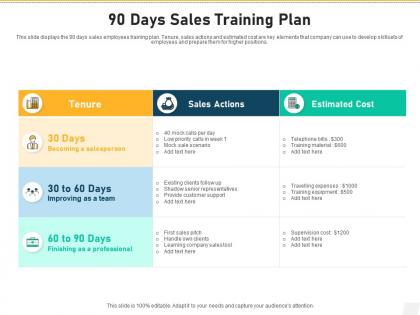
90 days sales training plan




Try Before you Buy Download Free Sample Product
 Impress Your
 Audience
 100%
100% Editable
 Save Hours
 of Time


This slide displays the 90 days sales employees training plan. Tenure, sales actions and estimated cost are key elements that company can use to develop skillsets of employees and prepare them for higher positions.
People who downloaded this PowerPoint presentation also viewed the following :
90 days sales training plan with all 2 slides:
Use our 90 Days Sales Training Plan to effectively help you save your valuable time. They are readymade to fit into any presentation structure.
FAQs for 90 days
Key elements include sales methodology training, product knowledge development, customer relationship management, objection handling techniques, and performance measurement systems. These components work together by building foundational skills, enhancing customer interactions, and tracking progress, with many organizations finding that comprehensive training programs ultimately deliver higher conversion rates, shorter sales cycles, and improved team performance across diverse market segments.
Tailoring sales training involves conducting skills assessments, analyzing performance gaps, surveying team feedback, and identifying industry-specific obstacles your representatives encounter daily. Through customized modules addressing individual weaknesses, role-specific scenarios, and targeted coaching sessions, organizations streamline skill development, enhance conversion rates, and ultimately deliver improved sales performance across diverse market segments.
Technology serves as the backbone of modern sales training programs through AI-powered simulations, virtual reality practice environments, learning management systems, mobile training apps, and data analytics platforms. These digital tools enhance learning by providing personalized coaching, real-time performance feedback, and scalable training delivery, with many organizations finding that technology-enabled programs reduce training costs while improving sales performance and knowledge retention.
**INPUT**: How can we measure the effectiveness of our sales training initiatives? **OUTPUT**: Sales training effectiveness can be measured through conversion rates, revenue per representative, average deal size, sales cycle length, and customer satisfaction scores. These metrics enable organizations to track performance improvements across different timeframes, with many companies finding that combining quantitative data with qualitative feedback ultimately delivers clearer insights into training ROI and competitive advantage. **Word count: 54 words**
Knowledge retention techniques include spaced repetition, interactive role-playing, microlearning modules, peer-to-peer discussions, and real-world case studies. These approaches enhance retention by reinforcing concepts through multiple touchpoints, engaging different learning styles, and connecting theoretical knowledge to practical applications, with many sales organizations finding that combining visual aids with hands-on practice ultimately delivers higher performance outcomes.
Sales training should be refreshed quarterly for core skills and immediately when new products, market conditions, or customer behaviors emerge. Many organizations find that combining regular monthly skill reinforcements with comprehensive quarterly updates ensures teams stay current with industry trends, competitive landscapes, and evolving buyer expectations, ultimately delivering sustained revenue growth and improved customer relationships.
Sales skill assessments include role-playing scenarios, case study analyses, sales simulation exercises, behavioral interviews, and performance metrics evaluations. These assessment methods enhance training effectiveness by identifying specific skill gaps, measuring knowledge retention, and tracking behavioral changes, with many organizations finding that comprehensive pre-and-post training evaluations ultimately deliver improved conversion rates and stronger sales performance.
Incorporate real-world scenarios through role-playing exercises, case study analysis, customer interaction simulations, objection handling workshops, and industry-specific challenge recreations. These immersive approaches enable sales teams to practice authentic situations like client negotiations and product demonstrations, while building confidence and strategic thinking skills, ultimately delivering improved closing rates and stronger customer relationships.
The ideal duration for a sales training program typically ranges from 4-12 weeks, depending on complexity, role requirements, and organizational needs. Through structured modules combining foundational skills, product knowledge, and practical application, companies like tech firms and financial services find that 6-8 week programs effectively balance comprehensive learning with faster time-to-productivity, ultimately delivering stronger performance outcomes.
**INPUT**: How can we foster a culture of continuous learning within our sales team? **OUTPUT**: Fostering continuous learning requires establishing regular skill development sessions, peer mentoring programs, knowledge sharing platforms, performance feedback loops, and incentivized learning goals. Through these strategic approaches, sales teams enhance product expertise, refine closing techniques, and adapt to market changes, with many organizations finding that this ultimately delivers higher conversion rates and sustained competitive advantage. *Word count: 54 words*
**INPUT**: What specific sales methodologies should be included in our training curriculum? **OUTPUT**: Essential sales methodologies include SPIN Selling, Challenger Sale, Solution Selling, MEDDIC, and Consultative Selling approaches, each targeting different customer engagement scenarios and deal complexities. These methodologies enhance performance by improving qualification processes, objection handling, and relationship building, with many organizations finding that combining multiple approaches delivers stronger conversion rates and ultimately creates more adaptable, strategic sales teams. **Word count: 60 words**
Role-playing exercises enhance sales training by simulating real customer interactions, building confidence through repetition, and allowing safe practice of objection handling techniques. These interactive scenarios enable sales teams to refine communication skills, test different approaches with immediate feedback, and develop muscle memory for challenging situations, ultimately delivering improved closing rates and stronger customer relationships.
Best practices for onboarding new sales representatives include structured product knowledge training, shadowing experienced team members, role-playing customer scenarios, CRM system proficiency, and clear performance metrics. These approaches streamline the learning curve by combining theoretical knowledge with practical application, ultimately delivering faster time-to-productivity and higher conversion rates, with many organizations finding that comprehensive onboarding reduces turnover significantly.
Effective CRM and sales technology training combines hands-on practice sessions, role-based customization, ongoing coaching, and integration with real sales scenarios. Through interactive workshops and mentorship programs, sales teams develop proficiency in lead management, pipeline tracking, and automation features, while continuous feedback loops ensure technology adoption translates into improved conversion rates and streamlined sales processes.
**INPUT**: What strategies can we implement to engage remote sales teams in training sessions? **OUTPUT**: Effective remote sales training strategies include interactive virtual simulations, gamified learning modules, peer-to-peer collaboration sessions, microlearning bite-sized content, and real-time coaching platforms. These approaches enhance engagement by creating competitive elements, fostering team connections, and delivering personalized feedback, with many organizations finding that blended formats combining live sessions with self-paced learning ultimately improve retention and performance outcomes. [Word count: 60]
-
Great quality product.
-
Designs have enough space to add content.