


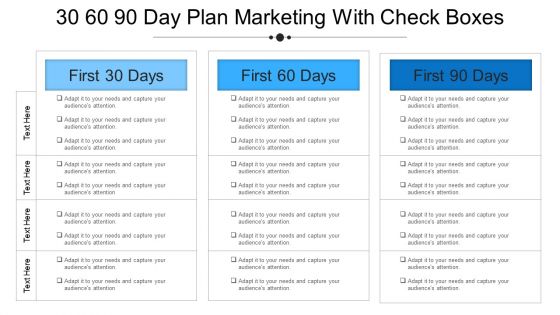
30 60 90 day plan marketing with check boxes example of ppt





Try Before you Buy Download Free Sample Product
 Impress Your
 Audience
 100%
100% Editable
 Save Hours
 of Time


Only a fool would give a presentation without preparing. Shore up your pitch with our clever 30 60 90 Day Plan Marketing With Check Boxes Example Of Ppt designs.
People who downloaded this PowerPoint presentation also viewed the following :
30 60 90 day plan marketing with check boxes example of ppt with all 5 slides:
Our 30 60 90 Day Plan Marketing With Check Boxes Example Of Ppt are all for a courageous approach. Derive the benefits of your bold actions.


FAQs for 30 60 90 day plan marketing with check boxes
Key objectives include establishing market presence, building brand awareness, generating qualified leads, optimizing campaign performance, and achieving measurable ROI milestones. These structured phases enable marketing teams to systematically scale their efforts, with many organizations finding that this approach delivers faster customer acquisition, improved budget allocation, and stronger competitive positioning through progressive goal achievement.
Businesses measure success through phase-specific KPIs: brand awareness metrics and initial engagement rates in days 1-30, lead generation and conversion tracking in days 31-60, and revenue impact plus customer acquisition costs in days 61-90. This structured approach enables marketing teams to optimize campaigns progressively, identify successful tactics early, and demonstrate clear ROI, with many organizations finding that consistent measurement across phases delivers significantly improved marketing performance and strategic alignment.
Common pitfalls include setting unrealistic timelines, lacking clear metrics, insufficient budget allocation, poor cross-team communication, and ignoring market feedback during execution. Many organizations find that overcommitting resources in the first 30 days while neglecting long-term relationship building ultimately undermines strategic momentum, making regular milestone reviews and adaptive planning essential for sustained success.
Businesses should prioritize tasks by focusing on foundational setup in the first 30 days, expansion and optimization in 60 days, and scaling strategies by 90 days. This approach enables companies to establish market presence, refine customer acquisition channels, and ultimately accelerate growth, with many organizations finding that structured timeframes deliver measurable improvements in campaign performance and ROI.
Effective research methods for the first 30 days include customer surveys, competitor analysis, social media listening, website analytics review, and stakeholder interviews. These approaches streamline market understanding by revealing customer preferences, competitive positioning, and performance gaps, with many marketing teams finding that combining quantitative data with qualitative insights ultimately delivers comprehensive strategic foundations for campaign optimization.
Audience segmentation fundamentally shapes tactical selection by determining communication channels, messaging approaches, and engagement strategies for each phase based on specific demographic, behavioral, and psychographic characteristics. In the initial 30 days, segments might require different awareness-building tactics like social media for younger audiences versus email campaigns for professionals, while 60-90 day phases adapt conversion strategies accordingly, ultimately delivering more targeted results and higher ROI across diverse customer groups.
Early metrics should include website traffic, lead generation rates, social media engagement, email open rates, and initial conversion tracking. These foundational indicators help marketing teams quickly identify which channels and campaigns are resonating with target audiences, while providing essential baseline data for optimization decisions, ultimately ensuring strategic adjustments can be made before significant budget allocation in subsequent phases.
During the 60-day phase, businesses can leverage social media through targeted advertising campaigns, influencer partnerships, user-generated content initiatives, community engagement strategies, and analytics-driven optimization. These approaches streamline brand visibility by building authentic relationships, amplifying reach through strategic collaborations, and refining messaging based on performance data, ultimately delivering enhanced customer engagement and measurable conversion growth across platforms.
Content marketing serves as the foundation for building brand awareness, nurturing leads, and establishing thought leadership throughout each phase of a 30-60-90 day plan. During the initial 30 days, content focuses on audience engagement and SEO optimization, while subsequent phases emphasize conversion-driven materials and performance analysis, ultimately delivering sustained customer acquisition and measurable ROI growth.
Teams ensure alignment throughout 30-60-90 day marketing plan execution by establishing regular check-ins, shared dashboards, and clear role definitions from day one. Weekly progress reviews, cross-functional meetings, and real-time performance tracking enable marketing teams, sales departments, and leadership to stay synchronized on objectives, quickly address challenges, and maintain momentum toward strategic goals.
Marketing automation platforms like HubSpot, Marketo, and Salesforce streamline campaign execution, lead tracking, and performance analytics throughout your 30-60-90 day timeline. These tools enhance efficiency by automating email sequences, tracking customer journeys, and providing real-time dashboard insights, with many organizations finding that integrated CRM systems ultimately deliver faster campaign optimization and measurable ROI acceleration.
Market conditions significantly impact 90-day phase adjustments through shifting consumer behaviors, competitive landscapes, economic factors, and emerging opportunities that require strategic pivots. Organizations typically modify budget allocations, campaign messaging, channel priorities, and target segments based on real-time market data, with many finding that flexible planning during this phase delivers stronger ROI and competitive positioning.
**INPUT**: What are some effective ways to gather feedback from stakeholders after the 90-day period? **OUTPUT**: Effective feedback methods include stakeholder surveys, one-on-one interviews, focus groups, performance analytics reviews, and cross-departmental workshops to assess campaign outcomes. These approaches enable organizations to capture quantitative results, qualitative insights, and strategic recommendations, with many companies finding that structured feedback sessions ultimately deliver actionable improvements and stronger stakeholder alignment for future marketing initiatives. **Word count: 55 words**
Successful 30-60-90 day marketing plans include SaaS companies achieving 40% lead increases through progressive content campaigns, retail brands driving seasonal sales through phased product launches, and B2B firms capturing market share via strategic competitor analysis and targeted outreach. These structured approaches enable organizations to build momentum systematically, optimize resource allocation based on early results, and ultimately deliver measurable growth while maintaining strategic focus across increasingly competitive markets.
Ongoing training integrates into the 30-60-90 framework by establishing foundational skills in the first 30 days, advancing strategic capabilities during days 31-60, and implementing specialized expertise in the final phase. This progressive approach enables marketing teams to build competencies systematically while executing campaigns, with many organizations finding that structured learning cycles ultimately enhance performance, reduce onboarding time, and deliver stronger campaign results.
-
Awesome use of colors and designs in product templates.
-
Graphics are very appealing to eyes.